Basics of Evolution - Korzh O.P. - 2006
Part III. PATHS OF LIFE EVOLUTION
Chapter 20. Main Stages in the Evolution of Multicellular Animals
20.7. The Transition of Vertebrates to Land
Land vertebrates are most likely to have evolved from lobe-finned Fishes, which were highly abundant during the Devonian period. It was previously thought that direct
ancestors of terrestrial vertebrates should be sought among lungfishes, since the latter share A large number of traits with amphibians. However, Specific features of their Skull Structure, fins, and other traits render this hypothesis groundless.
The transition of vertebrates to land required a whole series of aromorphic transformations in their anatomical, morphological, and physiological traits.
The most important of these can be considered the appearance of pulmonary Respiration and The Development of the pentadactyl limb. Rhipidistians (extinct lobe-finned fish and direct ancestors of land vertebrates) already possessed Lungs that helped them survive dry periods, as the drying up of terrestrial Water bodies was quite frequent in the Devonian. It is also believed that they did not swim, but rather "crawled" along the bottoms of water bodies among dense vegetation using their fleshy fins. Thus, lungs and limbs originally arose as adaptations to living in oxygen-deficient aquatic environments, and later became a crucial prerequisite for vertebrates to move onto land.
Colonizing a different habitat required the transformation of almost every organ. For instance, The Emergence of lungs led to the development of a second circulatory loop and the necessity to separate arterial and venous Blood (in amphibians, the atrium divides into two). On land, limbs become the most important Organs of locomotion (Fig. 20.5); they must support the body above the ground and be capable of movement (in the aquatic environment, the fish's tail served as the primary organ of propulsion, while fins mainly functioned to regulate body position). The need to rely on limbs led to The formation of limb girdles, to which the limbs attach via hinge-type joints. The amphibian limbs themselves are structured as levers, allowing them to simultaneously perform two Functions: support and movement. They consist of three main segments: the upper arm/thigh, forearm/shank, and hand/FOOT.
Class="center">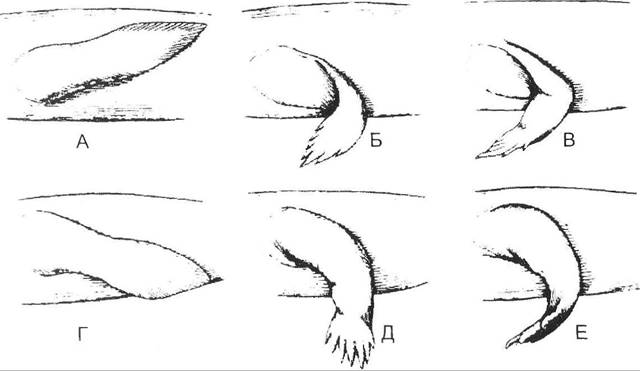
Fig. 20.5. Diagram of changes in THE POSITION OF paired limbs during the transition from fish to amphibian (after A. Romer, T. Parsons, 1992):
A–C — pectoral limb; D–F — pelvic limb; A, D — position in fish; B, E — transitional stage; C, F — position in amphibian
Due to the low density of air, orienting oneself by turning the entire body becomes impossible, which is why the HEAD gains mobility relative to the trunk. There arose a need to strengthen the skull, leading to the fusion of the Axial Skeleton with the visceral skeleton (forming the autostylic jaw suspension). As a consequence, the hyomandibula, which previously connected these PARTS OF THE skull, lost its original function and transformed into an auditory ossicle (part of the Middle ear). The Need for a more complex auditory organ was caused by the difference in sound wave propagation in water and air. Furthermore, most other organs underwent anatomical, morphological, and sometimes physiological restructuring.
Yet, amphibians cannot be considered entirely terrestrial forms, as they have not yet severed their ties with the aquatic environment.
The lungs of these animals provide only 30-70% of the total oxygen consumed by the Organism, with the remainder supplied by cutaneous respiration. This is why their Skin must always remain moist. Their Water-Salt METABOLISM has also changed little: amphibian Kidneys are of the mesonephric type, meaning their function is geared toward excreting excess water that is directly absorbed through the skin. However, the strongest tie to the aquatic environment is observed during amphibian reproduction: water is essential both for egg Fertilization and for the subsequent development of larvae (tadpoles), which only transform into adult forms and move to land after metamorphosis. In its structure, a tadpole resembles a fish more than an adult animal: it has fins, a lateral line, external (and later internal in some forms) gills, a single circulatory loop, a two-chambered Heart, etc.
Ichthyostegans are considered the first terrestrial animals; except for their limbs, they still closely resembled ordinary fish. They were The earliest representatives of labyrinthodonts—a large group of primitive amphibians that arose in the mid-Devonian and gave rise to modern forms and reptiles.
Last update: 07/08/2026
Editorial and Educational Adaptation: This material has been compiled based on the primary/original source text. The project team performed an editorial review, corrected technical inaccuracies, structured sections, and adapted the content for an educational format.
What was processed:
- elimination of formatting defects (OCR errors, structural breaks, corrupted characters);
- editorial organization of content;
- standardization of terminology in accordance with academic sources;
- verification of factual statements against the original source text.
All mentions of the author, publication year, and origin of the primary text have been preserved in accordance with the source.