Fundamentals of Evolution - Korzh O.P. - 2006
Part II. MACROEVOLUTION
Chapter 11. Means of Transformation of Organs and Functions
11.4. Heterobathmy and Compensation
Organisms possess Organ Systems that are relatively weakly linked functionally (such as the locomotor and digestive systems in animals, or roots and flowers in plants). For an Organism to exist normally, a strict correspondence in the development levels of separate systems without a direct functional connection is not required. For instance, humans exhibit an extraordinary development of The Nervous system (primarily the CNS), whereas the dental and digestive systems remain virtually unchanged compared to ancestral unspecialized forms (humans remain omnivores). Moreover, human Sense Organs are considerably less developed than those of other mammals; most organs are unspecialized, which does not hinder the overall Progressive development of humankind.
This phenomenon of unequal evolutionary rates across different parts of an organism is known as heterobathmy, or mosaic development. The Theory of mosaic development was founded by Wilhelm Roux, a student of Ernst Haeckel. Through experiments involving localized defects in frog embryos (Fig. 11.10), he concluded that the embryo is a mosaic of self-differentiating Cells. It was subsequently proven that two mechanisms operate during The Development of any organism: 1) morphogenetic determinants, which drive the independence (mosaicism) of individual Cell development, and 2) intercellular interactions, which direct the regulatory type of development.
The closer the functional relationship between individual organs, the more synchronized the level of their development.
Class="center">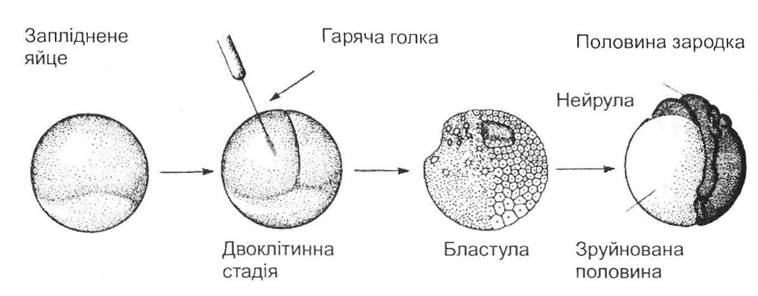
Fig. 11.10. W. Roux's attempt to demonstrate mosaic development (after S. Gilbert, 1994). Destruction of one cell in a two-cell embryo leads to the development of only half of the embryo
It is believed that maximum developmental mosaicism in individual systems is characteristic of the most primitive representatives of major taxonomic groups. With further specialization of the organism, a certain leveling in the development of its parts takes place.
Another phenomenon concerning interrelated organs and organ systems is compensation. The same functional outcome can be achieved through different Anatomical and morphological adaptations. For example, in rodents, the Evolution of the Digestive System may lead to active specialization of the gut while barely affecting the dental system; conversely, active Development of the dental system often occurs while the intestinal tube remains largely unchanged. In this case, the excessive development of one component within interrelated organs is compensated for by the underdevelopment of another (Fig. 11.11).
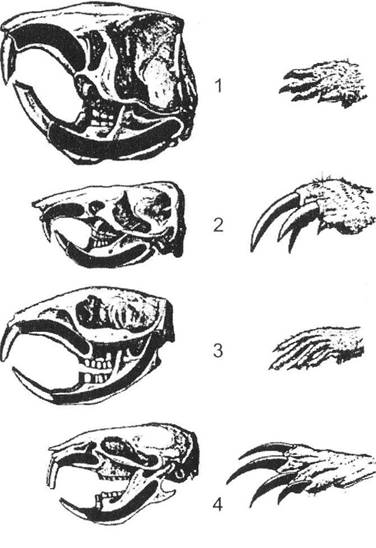
Fig. 11.11. Compensation of burrowing organ Functions in rodents (after N.M. Vorontsov, 1999):
1 - mole-rat (Spalax); 2 - zokor (Myospalax); 3 - mole-vole (Ellobius); 4 - Prometheus vole (Prometheomys)
A distinction can be made regarding medical compensation, where the function of a lost organ or its part is assumed by other organs (hypertrophy of one Kidney following the loss of the other, enlargement of the Liver or Stomach after partial resection, etc.). This holds no evolutionary significance, as it concerns solely the individual organism. Evolutionary compensation can be traced across all representatives of a given taxonomic group, affecting the interdependent development of functionally linked organs. It should be noted that certain phenomena may have multiple interpretations. For instance, the degeneration of Hair cover in cetaceans is accompanied by the active development of a thick layer of blubber, which can be viewed either as substitution or as a specific form of compensation.
Food for Thought
As we can see, nature never resorts to redundant novelties—in most cases, it follows the rule that "there is nothing new under the sun" (literally: "the new is well-forgotten old"). No element of an organism disappears without a trace, even if it has lost its primary functions. If we cannot establish the immediate functional purpose of certain organs, it does not mean they lack function: the latter may influence the overall course of ontogeny, serving as the basis for specific differentiations (gill slits in terrestrial vertebrates became the prerequisite for The formation of many organs). But more on that later.
Last update: 07/08/2026
Editorial and Educational Adaptation: This material has been compiled based on the primary/original source text. The project team performed an editorial review, corrected technical inaccuracies, structured sections, and adapted the content for an educational format.
What was processed:
- elimination of formatting defects (OCR errors, structural breaks, corrupted characters);
- editorial organization of content;
- standardization of terminology in accordance with academic sources;
- verification of factual statements against the original source text.
All mentions of the author, publication year, and origin of the primary text have been preserved in accordance with the source.