Fundamentals of Evolution - O.P. Korzh - 2006
Part I. MICROEVOLUTION
Chapter 10. Speciation as a Major Phenomenon of the Evolutionary Process
10.2. Allopatric Speciation
Today, following E. Mayr, the vast majority of evolutionary biologists distinguish between allopatric and sympatric speciation, taking into account the presence or absence of territorial Separation between evolving groups. However, according to K.M. Zavadsky, this principle by far does not exhaust all possible types of speciation. Therefore, let us examine its most important forms.
Allopatric speciation (from Greek allos — other and patris — homeland) occurs due to long-term geographical isolation between populations (sometimes referred to simply as geographical speciation).
Speciation through the formation and separation of geographical races is a rather widespread and well-known mode of new species formation.
As early as the late 19th century, M. Wagner was one of the first to draw attention to the possibility of new species forming solely through geographical isolation. In his works, he demonstrated the ubiquity of geographical variation and emphasized the potential for a given population to transform into an independent species if isolated. Geographical variation as a factor caused Darwin to doubt the immutability of species, yet it did not compel him to accept this theory. In the scientist's view, the main problem with The Theory of geographical speciation was that isolation per se cannot explain the adaptive Significance of the direct Structure of organisms, which contradicts the theory of evolution. In most cases, the traits affected by geographical variation lack direct adaptive value.
Nowadays, with the mechanisms underlying hereditary variation and various intrapopulation processes being well understood, such problems no longer arise. Moreover, today we can speak of different forms of allopatric speciation, notably geographical and ecological.
Geographical speciation is understood as The process of adaptation to new climatic and biocenotic conditions. A significant number of species that had large ranges during the Tertiary period changed through the formation and segregation of geographical races. Populations are formed that reproduce "within themselves" due to their remoteness from other populations or through the substantial influence of spaces uninhabitable for them. Adaptation to specific living conditions and semi-isolation from other populations facilitate the establishment of geographical races, which may subsequently evolve into separate species (Fig. 10.1).
Class="center">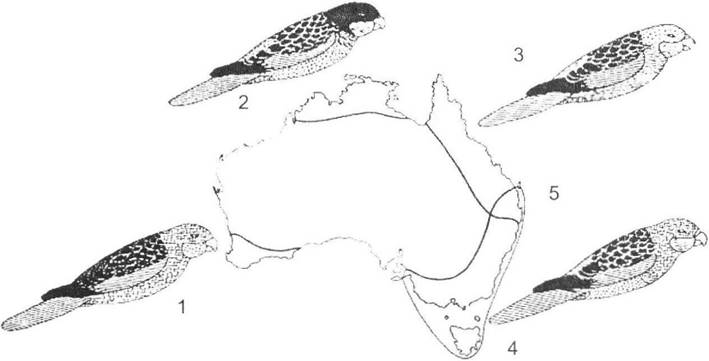
Fig. 10.1. Geographical variation of the genus Platycercus in Australia (after A. Cain, 1958):
1 - P. icterotis; 2 - P. venustus; 3 - P. adscitus; 4 - P. eximius; 5 - range overlap
Thus, the lily of the valley (Convallaria majalis) as a species formed in the Miocene (about 25 million years ago) and spread throughout broadleaf forests. In the Quaternary period, this species was eradicated across part of its range and shifted southward, and following the retreat of the glaciers, the reverse process began—its spread northward along with forests. This resulted in five independent, mutually isolated territories occupied by this species, which drove The formation of distinct geographical races.
It is worth noting that in Europe, a significant number of species formed precisely As a result of geographical isolation caused by the Ice Age. During the maximum glaciation of Central Europe, the overwhelming majority of living organisms shifted to the southeast and southwest, surviving on the Iberian and Balkan Peninsulas. The expansion of these forms after the retreat of the glaciers led to their encounter in certain parts of their range, where they hybridize, behave as independent species, or do not intersect at all.
An example is the thrush nightingale (Luscinia luscinia) and the common nightingale (L. megarhynchos), whose ranges overlap somewhat in Europe: where they meet, they prefer different Types of Vegetation. Similarly, the carrion crow (Corvus corone) and the hooded crow (C. cornix), upon encountering each other in Europe, form a narrow Hybridization zone, as discussed earlier.
Another cause of geographical speciation can be the dispersal of certain species. As an example, we can cite knotweed (Polygonum aviculare), the formation of whose geographical races is explained by the dispersal of its seeds from Europe in eastern and southern directions.
Thus, two distinct modes of geographical speciation are possible. The first is the fragmentation of the parental species' range under METABOLISM/18.html">The Influence of various climatic and biocenotic factors. In this case, the speciation process itself occurs not during migration, but after its completion due to specific environmental changes. The second is that speciation can take place during migration, when the Transformation of a population occurs simultaneously with its dispersal. These processes are most noticeable on islands, especially oceanic ones (discussed in more detail in the next chapter).
However, on any island, regardless of its origin, specific conditions arise (primarily geographical isolation to a greater or lesser degree), which invariably promotes active speciation. The initial deficiency of island fauna or flora (the absence of many components typical of continents) and a certain limitation of the island's resources drive high rates of form-formation processes, and in many cases, adaptive radiation (the formation of many related species that have diverged into independent ecological niches in the absence of competitors).
Sometimes, multiple successive colonizations of new isolated territories can occur, resulting in The Emergence of several species. Thus, the chaffinch (Fringilla coelebs) colonized the Canary Islands twice, forming a new species, Fringilla teydea, the first time, and merely a subspecies the second time. Pigeons of the genus Ptilinopus colonized the Fiji Islands three times, and the earliest forms have evolved so far from the ancestral stock that scientists today classify them into a different genus.
Forms originating from the same parental group can acquire genetic independence at the species level during prolonged isolation. However, in the case of continuous invasion (where clear geographical isolation is absent due to the constant influx of individuals from the maternal form), earlier and later immigrants lose The ability to undergo independent evolutionary development.
Such high rates of speciation are also characteristic of mountain systems, where the sharp alternation of different biotopes leads to significant territorial isolation of individual populations. Speciation is also facilitated by pure distance isolation, as clearly demonstrated by so-called ring species. The best-known Examples involve the herring gull (Larus argentatus) and the lesser black-backed gull (L. fuscus), as well as subspecies of the great tit (Parus major).
Ring species were first described by Stegmann for two gull species: the herring gull and the lesser black-backed gull. It is believed that these forms originated in the territory of the former Beringia, and after the sinking of the ocean floor and the Formation of the Bering Strait, they presumably began to disperse in eastern and western directions. During their expansion into new territories (some scientists believe there were more dispersal directions associated with the Eurasian glaciation period), new subspecies formed. Despite the fact that these subspecies freely interbreed across almost their entire range, in Europe the differences between the herring gull and the lesser black-backed gull reach a point where the latter no longer interbreed.
The great tit also has a fairly large range covering most of Eurasia, which breaks down into the habitation areas of individual subspecies. The specifics of its dispersal (presumably bypassing the Himalayas) led to two subspecies (Parus major major and P. major minor), upon meeting in the Far East, living side by side without interbreeding. These examples illustrate geographical speciation during dispersal.
K.M. Zavadsky proposes to define ecological speciation as the formation of new species through The Development of local ecotypes and their subsequent segregation—a process that proceeds through the same pathways as geographical speciation. At the same time, it should be noted that the division of races into geographical and ecological is conventional. The most striking example of ecological speciation can be considered the formation of ecological races in many freshwater Fishes (winter and spring races, etc.), which may differ in spawning times, spawning grounds, and other ecological characteristics, thereby achieving complete isolation. According to K.M. Zavadsky, ecological speciation is just as widespread among animals and plants as geographical speciation. Since there are no fundamental differences between them, we do not consider it necessary to examine this issue in greater detail.
Thus, allopatric speciation is initially driven by some form of geographical isolation.
If this factor persists over a long period, the population manages to acquire specific traits and develop distinct biological isolation mechanisms from the original form. Conversely, if the isolation was incomplete or short-lived, speciation processes slowed down, resulting only in the emergence of a new subspecies.
Last update: 07/08/2026
Editorial and Educational Adaptation: This material has been compiled based on the primary/original source text. The project team performed an editorial review, corrected technical inaccuracies, structured sections, and adapted the content for an educational format.
What was processed:
- elimination of formatting defects (OCR errors, structural breaks, corrupted characters);
- editorial organization of content;
- standardization of terminology in accordance with academic sources;
- verification of factual statements against the original source text.
All mentions of the author, publication year, and origin of the primary text have been preserved in accordance with the source.