BOTANY WITH BASICS OF HYDROBOTANY (AQUATIC PLANTS OF UKRAINE) - B.Ye. Yakubenko - 2011
XIV. TOOLS AND METHODS FOR STUDYING AQUATIC VEGETATION
To characterize the habitat conditions of aquatic vegetation, identify the patterns governing its composition, vitality, and distribution within a Water body, and gain a General Overview of the ecosystem, it is necessary to obtain data on its Morphology, particularly the CHARACTERISTICS OF THE coastal zone and its productivity, depending on the researcher's objectives. Below is a Brief Overview of some simple instruments used in aquatic vegetation research.
Depth measurements are carried out using a sounding lead with weights or a sounding pole in rivers and shallow lakes (Fig. 211).
Class="center">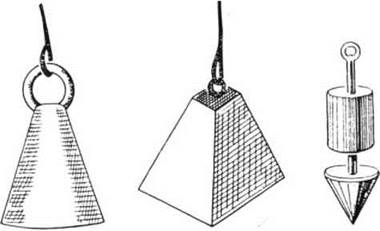
Fig. 211. Sounding weights (left) and a sounding lead with a funnel (right).
A sounding pole is a straight, smooth wooden rod about 3 m long and 3-6 cm in diameter, marked at 25 cm intervals and painted with light-colored oil paint. A sounding lead is a metal weight with an eyelet attached to a twine or rope marked at 20 cm intervals. These instruments are used to measure the depth of a water body.
For quantitative Assessment of Aquatic vegetation, water rakes up to 3 m long are used (Fig. 212).

Fig. 212. Three- and six-tine water rakes (left) and a sickle-shaped knife (right).
One of them features a crossbar 13 cm long, tine length of 16 cm, tine bend length of 6 cm, and a socket for a handle. Another has a crossbar 0.5 cm thick, 1.5 cm wide, and approximately 15 cm long. Instead of a flat bar, an iron pipe up to 1 cm in diameter can be used. Tines and a socket for a handle (which can be 3.5-4 m long) are welded to the bar at a distance of 2.5 cm.
These rakes are convenient for gathering all submerged plants, those with floating leaves, and certain emergent species. This work is best performed from a boat. The rakes are lifted vertically or at an angle. Before pulling them out of the water, the rakes are flipped so that the tines point upward. It is advisable to mark the handle at 20-30 cm intervals, which also allows for measuring the depth of the water body.
The sickle-shaped knife is made of steel in the shape of a strongly curved sickle (Fig. 213) with a socket for a 2-3 m handle. The cutting edge must be on the inner side, with a rounded tip. It is used for cutting the rhizomes of aquatic plants.
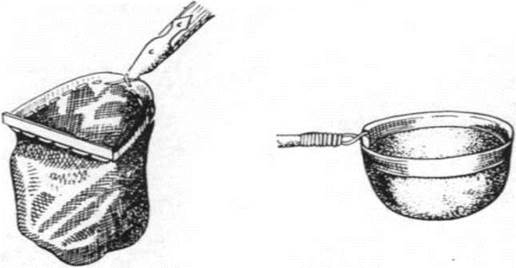
Fig. 213. Scraper (left) and wash net (right).
The scraper has a horseshoe shape in the form of a metal rim.
A socket for the handle is welded to the convex side of the rim, while the free ends of the rim are secured with steel strips, one side of which (for 23 cm) extends beyond the rim, sharpened and bent upward at a 45° angle. Holes are made along the other side of this strip and the rim to secure a bag made of fine-mesh fishing net. The rim height is 8-20 cm, width is 3-4 cm, and the length of the steel strip is 6-18 cm. The scraper is convenient for collecting small benthic plants on hard substrates, especially where they are extremely sparse.
The net (Fig. 215) has a sturdy rim 20-25 cm in diameter with a bag made of loose fabric and a wooden handle about 1 m long. The net is used to collect small plants from the surface or water Column when they are mowed in test plots.
To collect aquatic plants from the bottom of a water body, Ramensky dredges (Fig. 214), rectangular tined dredges (Fig. 215), and more advanced designs for hydrobiological work (Fig. 216) are used.
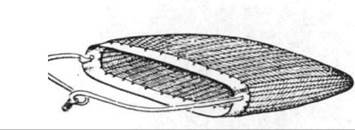
Fig. 214. Ramensky dredge.
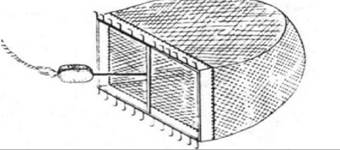
Fig. 215. Rectangular tined dredge.

Fig. 216. Dredges for hydrobiological work: drop dredge (left) and rectangular dredge (right).

Fig. 217. Inspection tubes: metal (left) and wooden rectangular (right).
To examine the bottom of a water body and study underwater plant thickets in conditions of a disturbed water surface or opaque water, an inspection tube (Fig. 217) proposed by H. Gams [130] is used. This tool is described in detail by V. M. Katanska [29], where further information can be found.
For quantitative assessment of plants per unit area, projective cover estimation and sampling are used. To determine phytomass in communities of all plant groups, frames with an area of 0.25, 0.5, and 1 sq. m are employed, preferably square-shaped. They are made of wood, aluminum, or synthetic pipes (Figs. 215–217).
To cut plants from specific areas, a large scythe with a blade perpendicular to the snath axis is used (Fig. 218). For convenience when working from a boat in deep areas, the free end of the snath should remain 1.0–1.5 m above the water level when the scythe touches the bottom. Mowing is performed with short, sharp jerks.
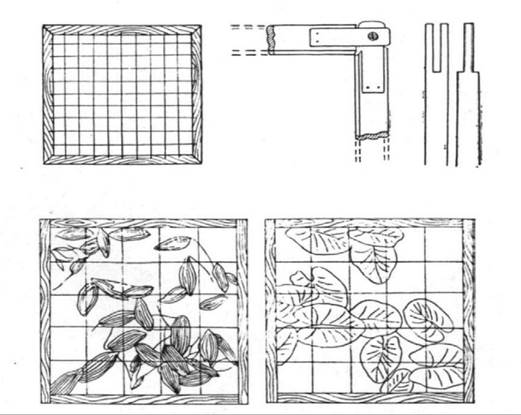
Fig. 218. Wooden frame for plant counting with a scale grid.
Top right: connection of the slats.

Fig. 219. Double frame for plant sampling at shallow depths.
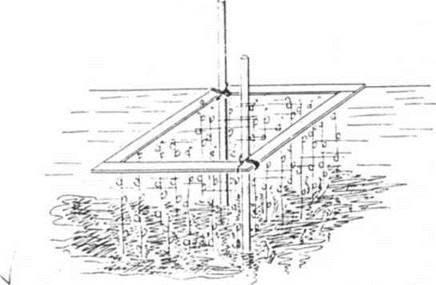
Fig. 220. Placement and fastening of the frame at the corners before plant mowing.
The scythe is used to cut plants for phytomass determination using the test plot method. Its use is advisable at depths not exceeding 2.5 m during calm weather.
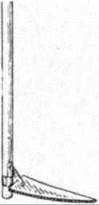
Fig. 221. Scythe with a short blade.
In addition to the tools mentioned above, botanical studies of aquatic vegetation employ bottom grabbers, double-sided water rakes, thicket samplers, scrapers, phytomass cutting devices, various modifications of biocoenometers, and many other instruments described in detail by V. M. Katanska [38].
Last update: 07/08/2026
Editorial and Educational Adaptation: This material has been compiled based on the primary/original source text. The project team performed an editorial review, corrected technical inaccuracies, structured sections, and adapted the content for an educational format.
What was processed:
- elimination of formatting defects (OCR errors, structural breaks, corrupted characters);
- editorial organization of content;
- standardization of terminology in accordance with academic sources;
- verification of factual statements against the original source text.
All mentions of the author, publication year, and origin of the primary text have been preserved in accordance with the source.