BOTANY WITH BASICS OF HYDROBOTANY (AQUATIC PLANTS OF UKRAINE) - B.Ye. Yakubenko - 2011
X. SEED PLANTS
Family Boraginaceae (Borage family)
Mostly herbs, rarely shrubs or trees (in the tropics). Stems ribbed. Leaves alternate, simple, entire. Like the stems, they are covered predominantly with stiff hairs. Flowers in solitary cymes, actinomorphic or slightly zygomorphic, pentamerous, with a five-lobed limb; the corolla throat often bears scales; corolla tubular or rotate; stamens five; pistil formed of two carpels with a superior Ovary, initially two-celled and later four-celled, surrounded by a nectar disc. Flower formula: ↑*K(5)C(5)A5G(2). Fruit a four-nutlet (tetracarpellary schizocarp). Almost all species of the borage family are insect-pollinated plants, and therefore they possess various adaptations for cross-pollination (heterostyly, protandry, etc.).
Includes about 100 genera and 1,900 species, distributed mainly in the Northern Temperate Zone. In Ukraine, there are 28 genera and 111 species.
Water forget-me-not (Myosotis palustris L.). A perennial herbaceous plant, 15-50 cm tall; uliginophyte, entomophile, barochor, myrmecochor (Fig. 157). Stem ascending, branched, densely or sparsely pubescent in the lower part with reflexed hairs, appressed-pubescent or almost glabrous in the upper part. Leaves alternate, sessile, lanceolate, entire, pubescent with sparse, upward-appressed hairs.
Class="center">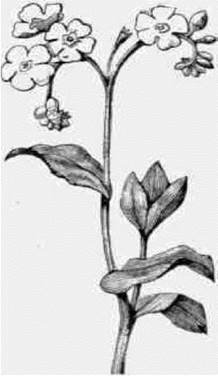
Fig. 157. Water forget-me-not
Flowers bisexual, perianth actinomorphic, double, pentamerous. Calyx bell-shaped, five-toothed, pubescent with upward-directed appressed hairs; sepals 2-4 mm long. Corolla blue, 6-9 mm in diameter, with a short cylindrical tube and a rotate, five-lobed limb. The throat of the corolla features five yellow scales. Androecium of five stamens; the pistil style equals or nearly equals the calyx lobes. Fruit a four-nutlet. Blooms in May-September. Propagates by seeds.
An ornamental plant. It serves as food for gastropod Mollusks (pond snails, ramshorn snails, viviparous snails, hydrobiids).
Grows in bogs, along water bodies, and in wet meadows. Distributed in the Opillya forests, Polissya, the Forest-Steppe, and the northern part of the Steppe; less commonly in the southern Steppe.
Genus Comfrey (Symphytum). Large perennial herbs, mostly stiffly pubescent, with broad, long-petioled basal stem leaves and sessile, more or less decurrent cauline leaves. Flowers actinomorphic, bractless, in solitary or paired leafy cymes, sometimes gathered into paniculate inflorescences.
Calyx five-cleft or five-toothed, with unequal lobes. Corolla regular, violet, dull-purple, or yellowish-white, tubular-campanulate, with a broad and short five-toothed limb and five lanceolate-subulate, pointed scales Ciliate along the margin in the throat. Stamens five, with short filaments. Pistil with a four-celled, four-lobed ovary, a thread-like style, and a small capitate stigma. Flower formula: *K(5)C(5)A5G(2). The fruit develops from four oblique, ovoid, smooth, wrinkled, finely tuberculate nutlets with an elaiosome (appendage). There are 11 comfrey species growing in Ukraine.
Common comfrey (Symphytum officinale L.). A perennial herbaceous plant, 50-100 cm tall; uliginophyte, entomophile, barochor (Fig. 158). Rhizome hypogeogen, plagiotropic. Stem erect, branched, narrowly winged. Leaves decurrent along the stem, narrowed at the base into a winged petiole, entire, oblong-ovoid, gradually tapering toward the apex, acute, 10-20 cm long and 3-5 cm wide. The entire plant is pubescent with stiff hairs.
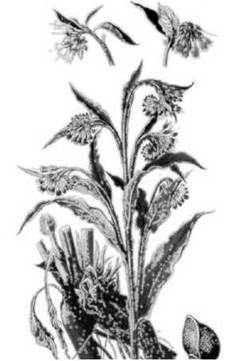
Fig. 158. Common comfrey
Inflorescence a cyme. Flowers bisexual, actinomorphic, with a double perianth; corolla sympetalous, violet, tubular, twice as long as the calyx, the latter up to 8 mm long. Fruit a four-nutlet, the nutlets shiny, smooth. Blooms in May-July. Propagates by rhizome and seeds.
A fodder, honey-producing, medicinal, and poisonous plant. Nevertheless, it is consumed by gastropod mollusks (pond snails), Russian desmans, and beavers.
Grows in moist and waterlogged meadows, along riverbanks, and in alder swamps within the Forest districts, Forest-Steppe, and Steppe zones.
Don comfrey (Symphytum tanaicense Stev.). A perennial herbaceous plant, 60-100 cm tall; uliginophyte, entomophile, barochor. Stems and leaves glabrous and shiny almost to the very top. Leaves narrow-lanceolate or lanceolate-linear, long-acuminate, narrowed toward the base, the lower ones on long petioles, the upper ones sessile, decurrent.
Inflorescence a cyme. Corolla pink or reddish-pink. Fruit a four-nutlet. Blooms in May-July. Propagates by rhizome and seeds.
Grows in damp, waterlogged, and flooded sites, along the banks of large rivers and their tributaries throughout Ukraine (concentrated mainly in the Dnieper and Don basins); in Transcarpathia in the vicinity of the town of Berehove.
Last update: 07/08/2026
Editorial and Educational Adaptation: This material has been compiled based on the primary/original source text. The project team performed an editorial review, corrected technical inaccuracies, structured sections, and adapted the content for an educational format.
What was processed:
- elimination of formatting defects (OCR errors, structural breaks, corrupted characters);
- editorial organization of content;
- standardization of terminology in accordance with academic sources;
- verification of factual statements against the original source text.
All mentions of the author, publication year, and origin of the primary text have been preserved in accordance with the source.