BOTANY WITH BASICS OF HYDROBOTANY (AQUATIC PLANTS OF UKRAINE) - B.Ye. Yakubenko - 2011
X. SEED PLANTS
Family Menyanthaceae
Most often perennial herbaceous plants with alternate leaf arrangement, valvate or imbricate corolla, and a significantly dissected stele formed by separate or sometimes scattered vascular bundles; an optimally developed system of intercellular spaces and cavities is present.
Class="center">Water/water.files/image155.jpg" width="197"/>
Fig. 154. Bogbean (Menyanthes trifoliata)
Five genera and 50 species are known, with a nearly cosmopolitan distribution, mainly in temperate and subtropical Regions of the globe. Two genera and two species are found in Ukraine.
Bogbean (Menyanthes trifoliata L.). A perennial plant, 15-30 cm tall; pleistogeophyte, entomophilous, hydrochore (Fig. 154). Rhizome creeping, thickened, up to 1.5 cm in diameter, 30-60 cm long. Leaves basal, long-petiolate, trifoliate with oblong-ovate leaflets.
Inflorescence a raceme. Flowers bisexual, actinomorphic, perianth double. Calyx and corolla limb five-parted. Corolla funnel-shaped, nearly white on the outside, pink on the inside with acute lobes that are hairy on the inner side. Androecium of five stamens, gynoecium syncarpous, style filiform, stigma bilobed. Blooms in May–June. Fruit a globose-ovoid capsule, unilocular, bivalved. Seeds smooth, glossy, up to 3 mm long. Propagated by rhizomes and seeds.
A honey-producing and medicinal plant. A decoction of the leaves is used as a bitter tonic to stimulate appetite and improve digestive function. It serves as food for Mollusks, narrow-winged moths, wax moths, geese, ducks, rails, and beavers.
Grows in sphagnum bogs, marshy meadows, and along muddy banks of rivers and lakes. Distributed throughout Ukraine, mainly in Polissya and the Carpathians, and rarely in the Steppe.
Floating Heart (Nymphoides peltata (S. G. Gmel.) O. Kuntze). A perennial herbaceous aquatic plant, 20-150 cm tall, entomophilous, hydrochore, epizoochore (Fig. 155). Rhizome creeping, plagiotropic, jointed, 40-100 cm long, sympodial-branching, rooting at the bottom of the water body. Stem long, more or less cylindrical. Leaves floating on the water surface, on long petioles (up to 10-15 cm long), with an orbicular-cordate leaf blade, 4-10 cm in diameter, entire or shallowly sinuate, covered with small glands on the underside. The plant resembles miniature water lilies, though its Kidney-shaped leaves are considerably smaller. Inflorescence umbellate, sympodial, axillary. The inflorescence contains five to six flowers that open asynchronously. Buds 1.5 cm long, ovoid with an acute apex.
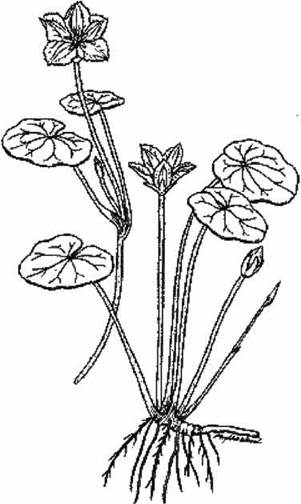
Fig. 155. Floating heart
Flowers bisexual, actinomorphic. Perianth double, calyx deeply five-parted, sepals 1-1.5 cm long. Corolla yellow, with a five-parted limb and Ciliate throat. Fruit an ovoid capsule, about 2 cm long. Seed flat, elliptic, 6 mm long, ciliate along the margin. Blooms above the water surface in June–August. Propagated by rhizome fragments and seeds. Seeds have a prolonged dormancy period (up to one year).
The plant serves as food for crayfish, dipteran insects including mosquitoes, and waterfowl.
Grows in lakes, oxbows, ponds, and in the shallows of freshwater estuaries. Distributed in the southern Forest-Steppe, the Steppe (lowlands of the Danube, Southern Bug, and Dnieper rivers), and Polissya (Uborth, Horyn, and Desna rivers). A rare relict species, protected and listed in the Red Data Book of Ukraine.
Last update: 07/08/2026
Editorial and Educational Adaptation: This material has been compiled based on the primary/original source text. The project team performed an editorial review, corrected technical inaccuracies, structured sections, and adapted the content for an educational format.
What was processed:
- elimination of formatting defects (OCR errors, structural breaks, corrupted characters);
- editorial organization of content;
- standardization of terminology in accordance with academic sources;
- verification of factual statements against the original source text.
All mentions of the author, publication year, and origin of the primary text have been preserved in accordance with the source.