PLANT BIOPHYSICS - Y. I. Posudin - 2004
II. TRANSPORT PROCESSES IN THE SOIL-PLANT-ATMOSPHERE SYSTEM
9. ENERGY TRANSPORT
9.4. PRACTICAL APPLICATIONS OF HEAT TRANSFER
Class="center">9.4.1. Leaf Thermography
The method of recording leaf Temperature is known as thermography. Transpiration processes and infrared radiation of a leaf are accompanied by specific changes in its surface temperature. The Use of an infrared-sensitive sensor that gradually scans the surface makes it possible to analyze the spatial distribution of leaf temperature with an accuracy of up to 0.07 °C. Infrared thermography is used to study transpiration processes and The impact of convective currents on them (Fig. 9.19). Every year, farmers growing fruits, vegetables, and flowers suffer millions of dollars in losses from spring frosts. The application of infrared thermography helps identify internal and external factors responsible for temperature damage to crops, and allows for the investigation of leaf cooling and freezing mechanisms.
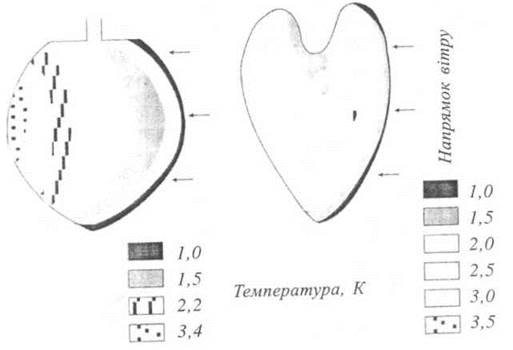
Fig. 9.19. Infrared thermography technique used to study transpiration processes and The Effect of convective currents on them.
An important issue is the impact of pathogenic organisms on plants, which causes Cell death accompanied by a corresponding change in temperature. Thermography is capable of detecting localized areas on the leaf surface affected by infection.
9.4.2. Thermal Remote Sensing
Thermal radiation from plant canopies and the Earth's surface can propagate through the atmosphere due to the so-called "atmospheric windows" in the infrared transmission spectrum of the atmosphere (Fig. 9.20). This thermal infrared radiation is recorded using techniques similar to multispectral scanning, but within the 8–14 µm range. The resulting image character depends on the object's temperature and emissivity. Thermal sensors installed on low-altitude aircraft provide high resolution (about one meter), whereas satellite-based thermal sensors resolve areas of 700–900 m. Modern thermal sensing devices are capable of detecting temperature differences of about 0.4 K. Disadvantages include METABOLISM/18.html">The Influence of meteorological conditions on measurement results, and the fact that soil probing is limited to a layer 2–4 cm thick.
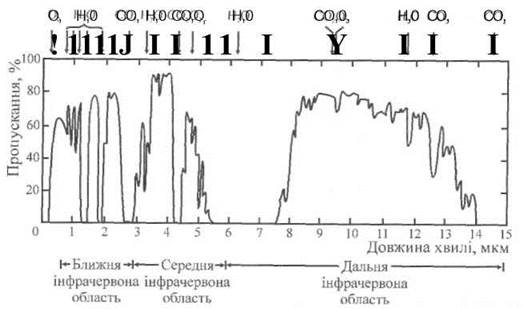
Fig. 9.20. "Atmospheric windows" in the infrared transmission spectrum of the atmosphere.
Thermal remote sensing is used to assess the size and temperature of plant canopies and the impact of external factors on them, soil moisture, thermal anomalies, the level of thermal pollution, the state of Water surface areas, ice and snow masses, volcanic activity, drainage structures, and thermal industrial emissions. Thermal infrared remote sensing has become widely used in analyzing landscape ecological processes—measuring soil moisture and surface evaporation, studying heat balance characteristics and heat fluxes, and assessing heat exchange between forest stands.
1. Characterize the MAIN TYPES OF natural radiation.
2. What is the radiation balance of a leaf?
3. Explain the mechanisms of optical radiation reflection from the leaf surface.
4. Name the reflectance vegetation indices.
5. Explain the mechanisms of chlorophyll fluorescence in green leaves.
6. Name the fluorescent vegetation indices.
7. Characterize the Main Methods of fluorescence spectroscopy.
8. List the main heat dissipation processes for a leaf.
9. What is leaf thermography?
10. What is The basis of thermal remote sensing of plant canopies?
Last update: 07/08/2026
Editorial and Educational Adaptation: This material has been compiled based on the primary/original source text. The project team performed an editorial review, corrected technical inaccuracies, structured sections, and adapted the content for an educational format.
What was processed:
- elimination of formatting defects (OCR errors, structural breaks, corrupted characters);
- editorial organization of content;
- standardization of terminology in accordance with academic sources;
- verification of factual statements against the original source text.
All mentions of the author, publication year, and origin of the primary text have been preserved in accordance with the source.