BIOLOGY Volume 3 - A Guide to General Biology - 2004
27. MECHANISMS OF SPECIATION
27.8. Intraspecific Speciation
Intraspecific speciation involves several factors, but in all cases, an essential prerequisite is the cessation of Gene flow between populations. As a result, each subpopulation becomes genetically isolated. Changes in allele and genotype frequencies within individual populations, driven by natural Selection acting on the range of phenotypes produced by Mutations and sexual recombination, lead to The formation of races and subspecies. If genetic isolation persists for a long period, and the subspecies subsequently meet again in the same region, they will either interbreed or find interbreeding impossible. If interbreeding is successful, they are still considered to belong to the same species. Inability to interbreed means that speciation has occurred, and the former subspecies must now be regarded as distinct species. It is believed that evolutionary changes can occur in precisely this manner.
The initial factor in the speciation process can be a decrease in the intensity of selection pressure within a population. This may lead to an increase in intraspecific Variability. If new phenotypes possess adaptations to environmental conditions present at the periphery of the range, the population has the opportunity to expand its distribution area. In cases where gene flow within the population remains unimpeded, the species exhibits localized phenotypic variation (ecotypes), still retains a common gene pool, and continues to be a single species. Such situations typically give rise to clines.
Speciation can occur only if barriers arise that lead to reproductive isolation among the members of a given population. Reproductive isolation is established by isolating mechanisms (a term introduced by Th. Dobzhansky) of one type or another.
Class="center">27.8.1. Isolating Mechanisms
An isolating mechanism is a means that creates and maintains reproductive isolation within a population. Reproductive isolation can be brought about by mechanisms operating before or after Fertilization. Table 27.3 presents a slightly modified version of Dobzhansky's Classification of isolating mechanisms.
Table 27.3. Isolating Mechanisms (after Dobzhansky)
Prezygotic mechanisms (barriers to hybrid formation) |
|
Seasonal (temporal) isolation |
The breeding season or flowering time of two species occurs at different times of the year; for example, in California, Pinus radiata flowers in February, whereas Pinus attenuata flowers in April |
Ecological isolation |
Two species inhabiting the same area prefer different habitats. For example, Viola arvensis grows on calcareous soils, whereas Viola tricolor prefers acidic soils |
Behavioral isolation |
Animals exhibit species-specific courtship rituals that elicit a response only from individuals of the same species, which prevents mating between individuals of different species. This is observed, for instance, in certain species of fish, birds, and insects |
Mechanical isolation |
In animals, successful copulation is hindered by differences in The Structure of reproductive Organs; in plants, pollination of closely related species is carried out by different animals |
Postzygotic mechanisms (barriers occurring in hybrids) |
|
Hybrid inviability |
Hybrids are formed, but they do not reach maturity, as, for example, hybrids between the northern and southern races of the leopard frog (Rana pipiens) in North America |
Hybrid sterility |
Hybrids are incapable of producing functional Gametes, such as the mule (2n = 63), resulting from a cross between a horse (Equus equus, 2n = 60) and a donkey (Equus hemionus, 2n = 66) |
Hybrid breakdown |
F1 hybrids are fertile, but the F2 generation and offspring from backcrosses between F1 hybrids and parental forms either fail to develop or are sterile, as, for example, in hybrids between different cotton species (Gossypium) |
27.8.2. Allopatric Speciation
Allopatric speciation (from the Greek allos — other, patris — homeland) is characterized by the fact that spatial Separation plays a significant role at one of its stages. Such separation, created by geographical barriers (e.g., mountain ranges, seas, or rivers) or differences in preferred habitats, can impede gene flow: organisms or their gametes lose The ability to meet, leading to reproductive isolation. Adaptation to new conditions or random Genetic Drift in small populations leads to changes in allele and genotype frequencies. As a result of prolonged population separation, genetic isolation may arise between them, persisting even if they happen to come together again. New species can arise in this manner. For example, The Diversity of Darwin's finches of the family Geospizidae and their distribution across the Galapagos Islands are considered the result of allopatric speciation.
According to David Lack, the finches initially arrived on the islands from the South American mainland, and here, in the absence of competition from native species (low selection pressure), adaptive radiation took place, leading to The Emergence of diverse species adapted to various ecological niches. The Evolution of the different species, which presumably occurred under conditions of geographical isolation, proceeded so far that when they subsequently met again on certain islands, they were able to coexist as independent species.
27.8.3. Sympatric Speciation
Genetic differences can also accumulate in allopatric populations that have been geographically isolated for much shorter periods of time. If these populations subsequently meet, hybrids may appear in the overlap zones. For example, the British Isles are inhabited by the carrion crow (Corvus corone) and the hooded crow (Corvus corone cornix). The carrion crow has an entirely black plumage, and this form is distributed in England and southern Scotland. In the hooded crow, only the flanks are black, while the back and belly are gray; it inhabits northern Scotland. Hybrids between the hooded and carrion crows occupy a narrow strip in central Scotland (Fig. 27.15). These hybrids have low fertility, which effectively prevents gene flow between the hooded and carrion crow populations (postzygotic isolating mechanisms).

Fig. 27.15. The hybrid zone as a barrier preventing gene flow between two populations. Due to the presence of this zone, which cuts across Scotland, the two crow species remain distinct (A). B. The existence of such barriers between adjacent populations is frequently observed; they operate in the following manner: in areas where the geographical ranges of species A and B overlap, interbreeding produces hybrids with reduced fertility; subsequently, species A crosses freely with the hybrid AB, and AB with species B, but the presence of the hybrid AB hinders free interbreeding between populations A and B.
Over time, selection against interbreeding between these two forms may arise, leading to speciation. Since such speciation ultimately occurs within the same geographical region, it is called sympatric speciation (from the Greek syn — together, patris — homeland).
Sympatric speciation is not associated with the geographical separation of populations during the period when genetic isolation is established. It requires The Development of some mechanism of reproductive isolation resulting from selection within a geographically continuous area. This mechanism can be structural, physiological, behavioral, or genetic.
Sympatric speciation is more often viewed as a mechanism explaining how closely related species, which likely originated from a common ancestor through temporary isolation, can coexist as distinct species in the same geographical region. For example, in the Galapagos Islands, the finch Camarhynchus pauper inhabits only Charles Island, where it coexists with a related form, C. psittacula, which is widely distributed across all central islands (Fig. 27.16). Finch species apparently rely on beak size when choosing mating partners. The ranges of beak size in C. pauper on Charles Island and C. psittacula on Albemarle Island are approximately the same, but on Charles Island, C. psittacula has a longer beak. This difference is already significant enough that these two species, which differ in their feeding habits, do not attract each other during the breeding season. Thus, the species maintain their distinctiveness and are capable of coexistence.
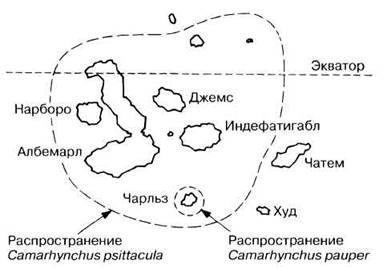
Fig. 27.16. Distribution of two finch species in the Galapagos Islands as an example of species coexistence following sympatric speciation.
27.8.4. Ring Species
A special type of sympatric speciation is observed at the point where two populations occupying the terminal regions of a cline meet and co-occur in the same area, thus closing the ring. For example, gulls of the genus Larus form a continuous population encircling the North Pole in a ring between 50 and 80° N. This ring comprises 10 races or subspecies, differing mainly in overall body size and the coloration of the legs, back, and wings. Free gene flow occurs among all these races, except where the "ends of the ring" meet in the British Isles. Here, at the extremes of their range, the gulls behave as two distinct species — the herring gull (Larus argentatus) and the lesser black-backed gull (L. fuscus). They differ in appearance, vocalizations, and migratory behavior, and interbreed only on rare occasions. Selection against their Hybridization occurs under sympatric conditions.
In sexually reproducing species, sympatric speciation without geographic isolation is unlikely. However, in asexually reproducing organisms, including higher plants with Vegetative Reproduction, a single mutant sufficiently different from the parental population to be genetically isolated can sympatrically give rise to a new species. An example is polyploidy in Spartina (section 24.9.2).
27.3. Ten subspecies of the Larus argentatus-fuscus population form a continuous ring that extends from the British Isles, through Scandinavia, Russia, the Bering Strait, Alaska, and Canada, and returns to the British Isles. If the subspecies inhabiting the Bering Strait region were to disappear, what would the consequences be for this entire population?
Last update: 06/08/2026
Editorial and Educational Adaptation: This material has been compiled based on the primary/original source text. The project team performed an editorial review, corrected technical inaccuracies, structured sections, and adapted the content for an educational format.
What was processed:
- elimination of formatting defects (OCR errors, structural breaks, corrupted characters);
- editorial organization of content;
- standardization of terminology in accordance with academic sources;
- verification of factual statements against the original source text.
All mentions of the author, publication year, and origin of the primary text have been preserved in accordance with the source.