BIOLOGY Volume 2 - A Guide to General Biology - 2004
12. MICROBIOLOGY AND BIOTECHNOLOGY
12.17. Biosensors
A biosensor is an electronic recording device that uses biological material, such as a Cell, enzyme, or antibody, to detect or measure the concentration of a chemical substance. They are particularly useful for measurements involving Enzymes or Antibodies because these molecules are highly specific and capable of distinguishing individual molecules within a complex mixture.
The reaction between the biological material and the substrate induces changes that are converted into an electrical signal by a suitable transducer (Fig. 12.30). This process mimics the way animal Sense Organs detect and respond to stimuli. (For example, the rods and cones in the retina act as transducers, generating electrical nerve impulses in response to light.) An amplifier is used to process the biosensor's electrical signal into a readable format, such as a digital display. Biosensors can detect various types of changes, including heat release, light emission, shifts in pH or mass, electron flow, or The formation of new chemical substances.
Class="center">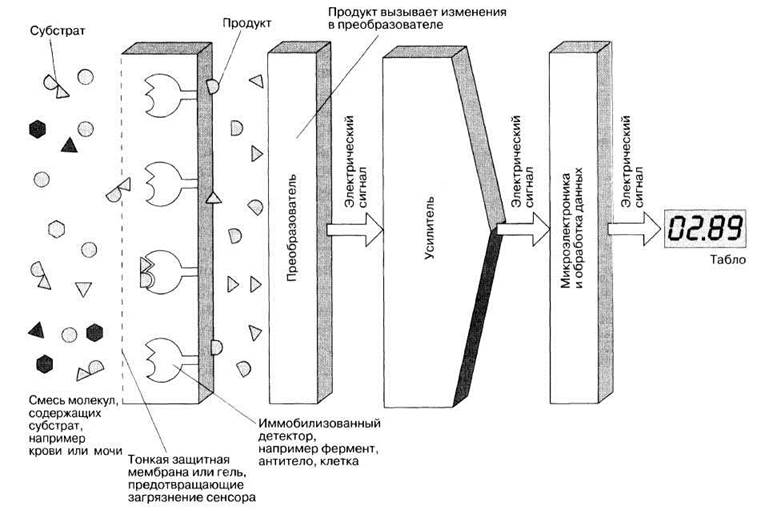
Fig. 12.30. Biosensor.
12.17.1. Advantages and Disadvantages of Biosensors
Main advantages:
1) biosensors are highly specific, allowing complex mixtures to be analyzed for a specific chemical without prior purification;
2) they are extremely sensitive, enabling the detection of very low concentrations of a substance in tiny samples;
3) they provide rapid results;
4) they are safe to use;
5) they are accurate;
6) they can be made very compact;
7) they are suitable for mass production.
Main disadvantages:
1) they are not very durable and therefore require careful handling;
2) they lack long-term stability;
3) they cannot be sterilized.
Last update: 06/08/2026
Editorial and Educational Adaptation: This material has been compiled based on the primary/original source text. The project team performed an editorial review, corrected technical inaccuracies, structured sections, and adapted the content for an educational format.
What was processed:
- elimination of formatting defects (OCR errors, structural breaks, corrupted characters);
- editorial organization of content;
- standardization of terminology in accordance with academic sources;
- verification of factual statements against the original source text.
All mentions of the author, publication year, and origin of the primary text have been preserved in accordance with the source.