BIOLOGY Volume 2 - A Guide to General Biology - 2004
17. ANIMAL COORDINATION AND REGULATION
17.8. Innate Behavior
17.8.9. Social Hierarchy
Many insects and most vertebrates exhibit various behavioral patterns associated with living in permanent or temporary groups. These behavioral patterns are collectively known as social behavior, and the resulting cohesion and cooperation have high adaptive value, as they increase the species' viability and provide a competitive advantage over other species. In such groups, a system of communication among members is crucial, and organizational efficiency is enhanced because each individual plays a specific role within the community. Hence, one of the main aspects of social behavior is the existence of a social hierarchy, or "pecking order".
This involves ranking animals based on relative dominance among conspecifics. For example, in a flock of chickens living in the same coop, a "social pyramid" is established: individual A can peck any other bird, individual B can peck any bird except A, and so on. Social status is usually established not through actual fighting, but via agonistic rituals. Similar dominance systems are known in other birds, mice ("biting order"), rats, cows, baboons, and the like. Essentially, all existing human societies are also based on some form of hierarchy.
A pecking order can be maintained only if the animals have The ability to recognize one another and possess a sufficiently developed capacity for learning. An animal's hierarchical rank generally depends on its size, strength, health, and aggressiveness, and in birds, it remains more or less constant throughout life. Lower-ranking males may rise in social status following testosterone injections, which boost their aggressiveness. If low-ranking mice are removed from their established group and provided with unrestricted food, their body mass and strength will increase, they will become more active, and upon returning to the same group, they may attain a higher social standing. The same thing happens if lower-ranking mice are temporarily placed in other groups where they hold a dominant position and are then returned. Apparently, this experience—to use anthropomorphic terminology—instills a certain confidence in them, which they retain upon returning to their original group, where they now secure a higher position.
One of the advantages of a hierarchical Structure is that it reduces aggression related to feeding, mate Selection, and territory acquisition. Furthermore, it spares animals from the injuries they might sustain if establishing dominance always involved physical fights. Another advantage of the hierarchical system is that it distributes resources in a way that ensures the survival of the fittest. For example, if a flock of 100 chickens receives only enough food to sustain 50, from the standpoint of the species' interests, it is better for half the birds to feed normally and the weaker half to starve than for all chickens to survive on half-rations, as this could hinder successful reproduction and ultimately lead to the death of the entire group. In short, social hierarchy enhances the genetic viability of the community because the strongest and genetically most fit animals gain the advantage when it comes time to reproduce.
Social Organization
When animals form stable communities, individual members perform specialized Functions, which increases the overall adaptability of the group (Fig. 17.68). Such functions may include foraging, reproduction, parental care, defense against predators, and so on. Cooperation among group members under this division of labor is based on stereotyped behavioral patterns and efficient means of communication. These behaviors and communication Methods vary widely among species and differ drastically, for instance, between primate and insect societies. In primates, the social structure is flexible—meaning individuals switch roles relatively easily—whereas in social insects, the functional specialization of colony members is determined by their Anatomical and physiological (reproductive) traits, a phenomenon known as polymorphism.
Class="center">
Fig. 17.68. Grooming (allogrooming) in adult chimpanzees is one of the ways to strengthen bonds among group members.
Ants, termites, and many bees are social insects and live in colonies organized around a caste system. The honeybee colony includes a single fertile female (the queen), thousands of sterile females (workers), and several hundred fertile males (drones). An individual's caste and its role in such a group are determined by several factors. First, fertilized (diploid) eggs develop into females, while unfertilized (haploid, developing parthenogenetically) eggs develop into males. Second, whether a larva hatching from a fertilized egg becomes a fertile queen or a sterile worker depends on its diet. If a larva is fed so-called royal jelly, it becomes a queen; if fed bee bread (a mixture of pollen and honey), it becomes a worker. This is a classic example of chemicals playing a role in community organization. Subsequent shifts in a worker's role are largely associated with the gradual development of its "milk", wax, and poison glands: it successively serves as a nest cleaner, nurse, food receiver, builder, guard, and finally, a forager. Colony members recognize each other by a specific scent acquired through mutual licking (social grooming) and feeding (trophallaxis), and they ruthlessly destroy intruders from other families attempting to enter the nest. In addition, information is transmitted among honeybees via pheromones (such as alarm pheromones) and through so-called dances—a highly specific form of visual communication.
German zoologist and Nobel laureate Karl von Frisch studied The Nature of these dances using marked foragers and specially designed observation hives with transparent walls. He discovered that worker bees locate nectar sources and communicate their direction and distance to other workers through a "dance", usually performed on vertical combs. If the food source is within a radius of up to 50 m, they perform a round dance (Fig. 17.69, A), which does not, however, indicate the direction to the source. If it is farther away, they perform the so-called waggle dance, which indicates the direction of the nectar source relative to the hive and the Sun. In doing so, the bee traces a figure-eight pattern, wagging its abdomen during the straight run of the figure eight. According to von Frisch, the bee's movement speed is inversely proportional to the distance from the hive to the food source, the waggle frequency correlates with The amount of food, and the angle between the straight run of the figure eight and the vertical equals the angle between the required flight direction and the direction of the Sun (Fig. 17.69, B). It is believed that bees account for the movement of the celestial body using a "biological clock", while on cloudy days, they determine the Sun's position in the sky based on the plane of polarized light.
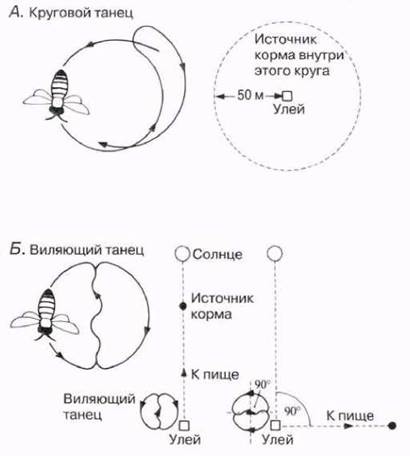
Fig. 17.69. Honeybee dances. A. The round dance is performed when the food source is less than 50 m from the hive. B. The waggle dance indicates the direction to a more distant food source as an azimuth relative to the Sun's position.
Later data suggested that bees may use high-frequency sounds to inform other workers about the Location of nectar. While it remains unclear whether this method serves as a primary means of communication, its discovery does not detract from Frisch's observations and Conclusions. This appears to be an auxiliary signaling system that reinforces the visual signals—the dances. It is known, however, that a returning forager can inform other bees about the type of flowers it has visited by feeding them some of the collected nectar and leaving its scent marks on the comb.
Last update: 06/08/2026
Editorial and Educational Adaptation: This material has been compiled based on the primary/original source text. The project team performed an editorial review, corrected technical inaccuracies, structured sections, and adapted the content for an educational format.
What was processed:
- elimination of formatting defects (OCR errors, structural breaks, corrupted characters);
- editorial organization of content;
- standardization of terminology in accordance with academic sources;
- verification of factual statements against the original source text.
All mentions of the author, publication year, and origin of the primary text have been preserved in accordance with the source.