BIOLOGY Volume 2 - A Guide to General Biology - 2004
15. HEALTH AND DISEASE
15.5. Cardiovascular Diseases
As noted in Section 15.2, infectious diseases are no longer among the leading causes of death in developed countries. Life expectancy has increased significantly and averages around 76 years. However, the risk of cardiovascular disease and Cancer increases with age. These two categories of pathology now account for two-thirds of all deaths in Western countries.
Disorders of the Heart and Blood Vessels are the leading cause of death in Britain, accounting for 40% of premature deaths. The two main pathologies in this group are CORONARY HEART DISEASE (accounting for 25% of deaths in 1990: 30% in men and 23% in women) and strokes (10% of deaths). Every day, 300 to 400 Britons die from heart attacks and strokes—a mortality rate five times higher than that during World War II. Many refer to this as a "modern epidemic" of cardiovascular disease, as its prevalence is comparable to the most devastating infections of past eras.
In 1992, the British government launched a strategy to combat cardiovascular disease. This program is based on the premise that the number of deaths can be substantially reduced. Fig. 15.14 shows the target reductions in mortality for individuals under 65 and those in older age groups. Implementing this program requires more effective Prevention and Treatment strategies for cardiovascular pathology.
Class="center">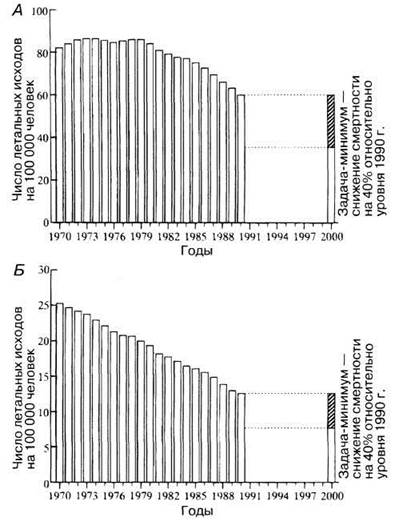
Fig. 15.14. A. Coronary heart disease mortality among individuals under 65 in the UK and projected reduction by 2000. B. Stroke mortality among individuals under 65 in the UK and projected reduction by 2000. (The Health of the Nation (1992) HMSO.)
15.5.1. Atherosclerosis
The most common cardiovascular disease is atherosclerosis. It begins with the deposition of fatty material containing high levels of Cholesterol on the inner walls of Arteries (Fig. 15.15). Over time, these yellow fatty streaks harden (arteriosclerosis) due to calcium deposition, forming structures known as atherosclerotic plaques or atheromas. These plaques narrow the arterial lumen and can even occlude it completely. This is frequently observed in the aorta and the coronary arteries that supply The Heart Muscle. Plaques roughen the smooth endothelial surface, promoting intravascular blood clotting. A local blood clot, or thrombus, forms and may grow large enough to block the artery entirely—a condition known as thrombosis. If a thrombus detaches from the vessel wall and travels through the bloodstream, it can cause the blockage (thromboembolism) of a narrower artery in another part of the body.
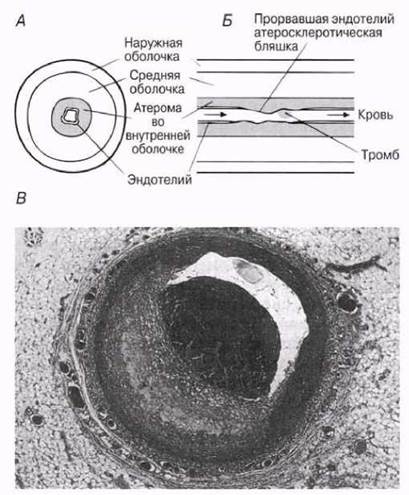
Fig. 15.15. Arterial narrowing caused by atherosclerosis. A. Diagram of a cross-section of an artery with an atheroma. B. Diagram of a Cytology/practical/54.html">Longitudinal section of such an artery with a developing thrombus. C. Cross-section of a human coronary artery almost completely blocked by a thrombus formed around an atherosclerotic plaque. Such arterial occlusion resulted in myocardial infarction.
As atheromas develop, the arterial wall weakens and may balloon outward under intravascular pressure, forming an aneurysm. The rupture of an aneurysm leads to internal bleeding (Hemorrhage). When Blood flow through an artery is restricted, the Tissues it supplies suffer from oxygen deprivation, leading to impaired function (known as ischemia) or even Cell death. The death of a section of heart muscle is called a myocardial infarction ("infarction" refers to the necrosis of any tissue resulting from compromised blood supply). Similar damage to cerebral arteries (cerebral thrombosis) can lead to a stroke, while their rupture causes a Cerebral Hemorrhage. The consequences of a stroke are typically severe, because oxygen deprivation disrupts the functioning of the cerebrum—the part of the Brain responsible for consciousness and the control of numerous Functions, including speech and movement coordination (Section 17.2.4). Both myocardial infarction and stroke are frequently fatal.
Inadequate Blood supply to any muscle causes pain and can trigger a severe, highly painful contraction known as a spasm. When this occurs in the myocardium, it results in an attack of angina pectoris. Even minor physical exertion, such as climbing stairs, can precipitate an attack. The constricting chest pain sometimes radiates from beneath the breastbone into the neck, jaw, arms, and back.
Thus, coronary heart disease manifests in two primary forms—angina pectoris and myocardial infarction. Approximately half a million cases of heart attack are recorded in Britain each year, and about a third of these patients die. Half of all fatalities occur within the first hour of the heart attack. Tremendous efforts are dedicated to saving these patients, involving not only optimal hospital care but also the deployment of ambulances equipped with life-support technology. Special anti-arrhythmic drugs help restore normal heart rhythm, and electrical defibrillation is sometimes used to restart a stopped heart.
Last update: 06/08/2026
Editorial and Educational Adaptation: This material has been compiled based on the primary/original source text. The project team performed an editorial review, corrected technical inaccuracies, structured sections, and adapted the content for an educational format.
What was processed:
- elimination of formatting defects (OCR errors, structural breaks, corrupted characters);
- editorial organization of content;
- standardization of terminology in accordance with academic sources;
- verification of factual statements against the original source text.
All mentions of the author, publication year, and origin of the primary text have been preserved in accordance with the source.