BIOLOGY Volume 1 - A Guide to General Biology - 2004
10. ORGANISMS AND THE ENVIRONMENT
10.4. Biogeochemical Cycles – Water and Nutrient Cycles
10.4.3. The Water Cycle (Hydrological Cycle)
Water is an essential component of All living organisms. They rely on it as a solvent, a chemical reactant, a mechanism for thermoregulation, and more. The primary reservoir in the hydrological cycle is the world's oceans, which hold 97% of the planet's total water (Fig. 10.13). Terrestrial and freshwater organisms obtain water through the evaporation of moisture from the ocean surface, subsequent vapor Condensation, and precipitation. Freshwater may either evaporate rapidly or return to the ocean via rivers or unchanneled surface runoff. A portion of precipitation, particularly in areas with dense vegetation, infiltrates the soil to form long-term groundwater reserves. Additionally, fresh water is stored in the glaciers and snowfields of polar and high-altitude regions.
Class="center">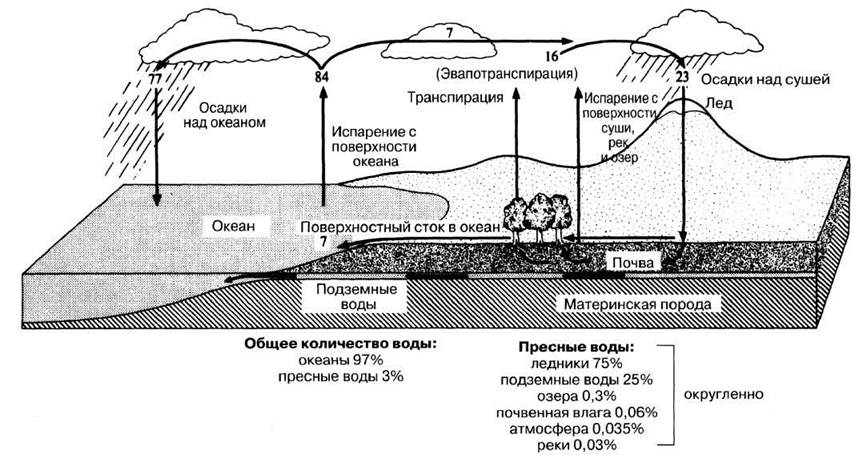
Fig. 10.13. The hydrological cycle and water reserves. The figures on the diagram correspond to an average annual global precipitation of 100 arbitrary units (Based on: R. J. Chorley, P. Haggett eds. (1967) Physical and information models in geography, Methuen.)
The hydrological cycle plays a crucial role in shaping the Earth's surface Temperature regime. Evaporating liquid absorbs heat, while condensing vapor releases it. Similarly, heat is absorbed during the melting of ice and released when water freezes. This energy exchange is vital for The Development of large-scale weather systems, which act as a key mechanism for transferring thermal energy from the equator to the poles. Without this Active Transport of thermal energy, the poles would grow increasingly colder and the equatorial regions unbearably hotter. Furthermore, as major reservoirs of water with its high heat capacity, oceans and glaciers serve as important "static" regulators of lower atmospheric temperature.
Water vapor in the atmosphere, much like carbon dioxide, is a greenhouse gas (Section 10.8.1). Consequently, water vapor exerts a significant influence on global temperatures. One of the most pressing areas of modern research is The Study of the interaction between the carbon and hydrological cycles in terms of their combined impact on climate. Understanding this interplay would help predict and minimize the potential negative consequences of the anthropogenic enhancement of the greenhouse effect.
Last update: 06/08/2026
Editorial and Educational Adaptation: This material has been compiled based on the primary/original source text. The project team performed an editorial review, corrected technical inaccuracies, structured sections, and adapted the content for an educational format.
What was processed:
- elimination of formatting defects (OCR errors, structural breaks, corrupted characters);
- editorial organization of content;
- standardization of terminology in accordance with academic sources;
- verification of factual statements against the original source text.
All mentions of the author, publication year, and origin of the primary text have been preserved in accordance with the source.