BIOCHEMISTRY - L. Stryer - 1984
VOLUME 3
Part IV INFORMATION
Class="center">Storage, Transmission, and Expression of Genetic information
Model of a deoxynucleotide monomer pair in the DNA double helix. In this pair, adenine is hydrogen-bonded to thymine

CHAPTER 24 DNA: THE GENETIC ROLE, STRUCTURE, AND REPLICATION
Deoxyribonucleic acid (DNA) is the molecule of heredity. DNA is a very long, thread-like molecule consisting of A large number of ribonucleotides. The purine and pyrimidine bases of DNA carry genetic information, whereas the sugar and phosphate groups play a structural role. This chapter discusses the Structure, genetic role, and Replication of DNA, focusing primarily on prokaryotic DNA, as these organisms have a simpler structure and follow laws common to all living things. Introduction/5.html">Eukaryotic Cell Chromosomes are examined in Chapter 29.
24.1. Covalent Structure and Nomenclature of DNA
The backbone of DNA has a uniform structure throughout the molecule. It consists of deoxyribose residues linked by phosphodiester bridges. The 3'-hydroxyl group of the sugar residue of one deoxynucleotide is joined to the 5'-hydroxyl group of the neighboring sugar via a phosphodiester bond. The sequence of bases is the variable feature in DNA. DNA contains four types of bases: two purine bases, adenine (A) and guanine (G); and two pyrimidine bases, thymine (T) and cytosine (C). The structure of a DNA chain is shown in Fig. 24.2.

The structure of DNA can also be depicted in a more concise manner. In this case, the following symbols are used to denote the four major NUCLEOTIDES:

The vertical lines in the symbols above represent sugar residues, and the letters A, G, C, and T represent the bases. The diagonal line with the symbol  (in the diagram below) denotes a phosphodiester bond. This diagonal line connects the end of one vertical line to the midpoint of another. The points of connection signify the 5'-OH and 3'-OH groups, respectively. In the example below, the symbol
  indicates that deoxyadenylate is linked to deoxycytidine by a phosphodiester bridge. The 3'-OH group of deoxyadenylate is attached to the 5'-OH group of deoxycytidine via a phosphoryl group:

Now suppose that deoxyguanylate is attached to the deoxycytidine of this dinucleotide. The corresponding trinucleotide can be represented as follows:
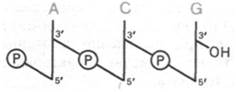
The abbreviated designation of this trinucleotide is pApCpG or ACG.
A DNA chain is characterized by polarity. One end of the chain bears a 5'-OH group, while the other bears a 3'-OH group that is not linked to another nucleotide. According to established conventions, the symbol ACG means that the free 5'-OH group belongs to deoxyadenosine, and the free 3'-OH group belongs to deoxyguanosine. Thus, base sequences are written in the 5' → 3' direction. Recall that the Amino Acid Sequence of a protein is written from the N-terminal amino acid to the C-terminal amino acid. It should be noted that ACG and GCA are different compounds, just as Glu-Phe-Ala differs from Ala-Phe-Glu.
Last update: 06/08/2026
Editorial and Educational Adaptation: This material has been compiled based on the primary/original source text. The project team performed an editorial review, corrected technical inaccuracies, structured sections, and adapted the content for an educational format.
What was processed:
- elimination of formatting defects (OCR errors, structural breaks, corrupted characters);
- editorial organization of content;
- standardization of terminology in accordance with academic sources;
- verification of factual statements against the original source text.
All mentions of the author, publication year, and origin of the primary text have been preserved in accordance with the source.