BIOCHEMISTRY - L. Stryer - 1984
VOLUME 2
PART II GENERATION AND STORAGE OF METABOLIC ENERGY
CHAPTER 13. THE CITRIC ACID CYCLE
13.3. Oxaloacetate Condenses with Acetyl-Coenzyme A to Form Citrate
The cycle begins with the Condensation of a four-carbon component, oxaloacetate, and a two-carbon component, the acetyl group of acetyl-CoA. Oxaloacetate reacts with acetyl-CoA and H2O to yield citrate and CoA.
This reaction, an aldol condensation followed by Hydrolysis, is catalyzed by citrate synthase (originally called the condensing enzyme). Oxaloacetate first condenses with acetyl-CoA to form citryl-CoA, which is then hydrolyzed to citrate and CoA. The hydrolysis of citryl-CoA drives the overall reaction strongly in the direction of citrate synthesis.
Class="center">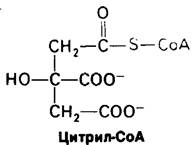
13.4. Citrate Is Isomerized to Isocitrate
To enable The oxidative decarboxylation of the six-carbon compound, citrate must be isomerized to isocitrate. This isomerization is accomplished by a dehydration followed by a Hydration step, resulting in the interchange of H and OH. The enzyme catalyzing both reactions is called aconitase, because the presumed intermediate is cis-aconitate.

13.5. Isocitrate Is Oxidized and Decarboxylated to alpha-Ketoglutarate
We now arrive at the first of the four oxidation-reduction reactions of The Citric Acid Cycle. The Oxidative Decarboxylation of isocitrate is catalyzed by isocitrate dehydrogenase:
Isocitrate + NAD ⇄ α-Ketoglutarate + СO2 +NADH.
The intermediate in this reaction is oxalosuccinate, which rapidly loses СO2 while still bound to the enzyme to form α-ketoglutarate.

The rate of α-ketoglutarate formation plays a crucial role in regulating the overall rate of the cycle, as we will discuss later (Sec. 13.18). It should also be noted that There are two types of isocitrate dehydrogenases: one is NAD+-dependent, and the other is nicotinamide adenine dinucleotide phosphate (NADP+)-dependent. The NAD+-dependent enzyme, located in the Cell/35.html">Mitochondria, is essential for The Citric Acid cycle, whereas the NADP+-dependent enzyme, present in both mitochondria and Cytoplasm, serves a different metabolic function.
Last update: 06/08/2026
Editorial and Educational Adaptation: This material has been compiled based on the primary/original source text. The project team performed an editorial review, corrected technical inaccuracies, structured sections, and adapted the content for an educational format.
What was processed:
- elimination of formatting defects (OCR errors, structural breaks, corrupted characters);
- editorial organization of content;
- standardization of terminology in accordance with academic sources;
- verification of factual statements against the original source text.
All mentions of the author, publication year, and origin of the primary text have been preserved in accordance with the source.