Protein Chemistry. Structure, Properties, Research Methods - Shendryk A.N. 2022
Methods for Experimental Research of Protein Structure
Chromatography
Paper Chromatography Method
Paper Chromatography (PC) is one of the earliest practical chromatographic Methods. In this technique, a sheet of filter or chromatographic paper serves as the stationary phase. Initially, the paper is conditioned with solvent vapors, which transforms it into a suitable stationary phase for chromatography.
In biochemical research, Water is typically used as the solvent. The eluent is an aqueous-organic mixture of mutually miscible liquids (e.g., n-butanol-water; ethyl acetate-water; butanol-acetic acid-water; pyridine-acetic acid-butanol-water; phenol-water, etc., in various volumetric ratios). The eluent moves along the paper by capillary action.
In practice, ascending, descending, and radial PC are employed.
Ascending and descending PC. Experiments are conducted as follows: A drop or a narrow strip of the test sample is applied with a capillary a short distance from the edge (the origin) of a prepared sheet of chromatographic paper. This sheet is placed in a hermetically sealed vessel (beaker) saturated with eluent vapors, ensuring that the origin is positioned above the solvent level. As the eluent moves up the paper, it carries along the Components of the analyzed sample. The stationary phase in PC is effectively water (a polar substance), whereas the Mobile phase is less polar due to the presence of the organic solvent.
Consequently, the sample components partition differently between the stationary and mobile phases and, As a result, migrate along the paper at varying rates behind the solvent front. Compounds with higher water solubility move more slowly—i.e., they are retained more strongly by the stationary phase than those with a greater affinity for the aqueous-organic solvent. The mobility of a compound in paper chromatography is conventionally expressed by its Rf value.
Class="center">
In calculating Rf, both distances are measured from the point of origin.
When analyzing multi-component mixtures, two-dimensional PC is frequently utilized. The sample is applied to a corner of the paper, and the eluent is allowed to run in one direction first. After drying the chromatogram, a second development is performed using the same or a different eluent in a direction perpendicular to the first.
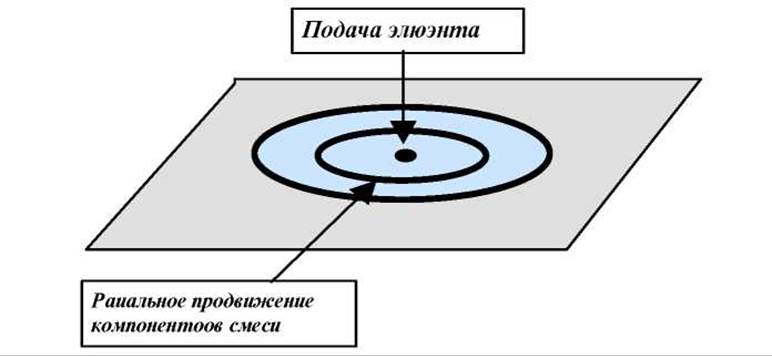
Radial PC
In addition to descending and ascending techniques, radial PC is also used. THE PRINCIPLE OF radial PC is clearly illustrated in the figure above.
Last update: 06/08/2026
Editorial and Educational Adaptation: This material has been compiled based on the primary/original source text. The project team performed an editorial review, corrected technical inaccuracies, structured sections, and adapted the content for an educational format.
What was processed:
- elimination of formatting defects (OCR errors, structural breaks, corrupted characters);
- editorial organization of content;
- standardization of terminology in accordance with academic sources;
- verification of factual statements against the original source text.
All mentions of the author, publication year, and origin of the primary text have been preserved in accordance with the source.