Pharmacognosy with the Basics of Plant Biochemistry - Kovalyov V. M. 2004
Special Part
Essential Oils
Medicinal plants and raw materials containing phenylpropane derivatives
ANISE FRUIT — FRUCTUS ANISI VULGARIS ANISE OIL — OLEUM ANISI
Anise (aniseed) — Pimpinella anisum L., syn. Anisum vulgare Gaertn., fam. Apiaceae
Aniseed; the Latinized generic name comes from pimpinella, a medieval plant name of uncertain etymology, and anisum, derived from the Greek name for the plant, anison.
An annual herbaceous, pubescent plant with a grooved, branched stem growing 25-60 cm tall.
Lower leaves are long-petiolate, orbicular-reniform, and deeply dentate; middle leaves are simple and pinnate; upper leaves are tripinnatifid. Flowers are five-petaled, small, white, arranged in compound umbels. Fruits are pear-shaped schizocarps, slightly compressed laterally, covered with short hairs, and breaking apart upon ripening into two small, greenish-gray mericarps. The taste of the fruits is spicy and slightly sweet, with a strong, aromatic scent.
Distribution. Native to Asia Minor. In Ukraine, it occurs as an escaped (wild) plant and is cultivated as an essential oil crop.
Harvesting. When half of the fruits are ripe, the plants are mowed, dried in sheaves or windrows, threshed, and cleaned of impurities.
Chemical composition of the raw material. Anise fruits contain essential oil (up to 6%), which includes anethole (80-90%), methyl chavicol (10%), anisaldehyde, anisic ketone, and anisic acid, as well as fatty oil (28%), Proteins, and furocoumarins.
Class="center">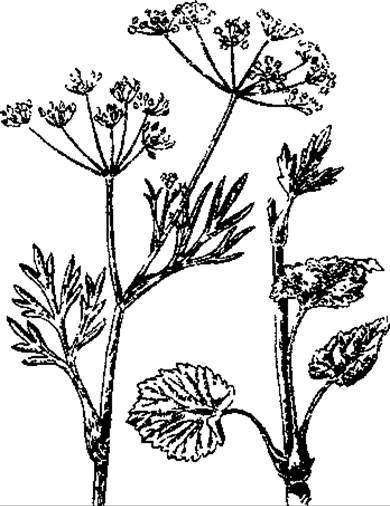
Biological activity and application. Anise preparations exhibit expectorant, anti-inflammatory, antispasmodic, diuretic, and bactericidal properties. The fruits are a component of pectoral tea and gastric herbal mixtures; anise oil is used in anise-ammonia drops, pectoral elixir, dry cough mixture, Traskov's anti-asthmatic mixture, Anitos, Alfalex, Strepsils Original, and other products.
FENNEL FRUIT — FRUCTUS FOENICULI
FENNEL OIL — OLEUM FOENICULI
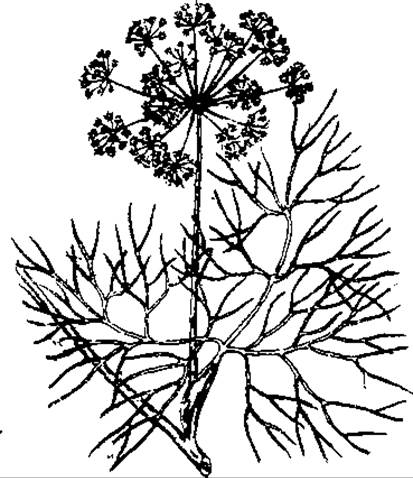
Fennel — Foeniculum vulgare Mill., fam. Apiaceae
Fennel, sweet cumin, garden fennel; the Latinized generic name comes from the diminutive of foenum (hay), and vulgaris, -e means common.
A biennial or perennial herbaceous plant with a branched stem, 1-2 m tall. Leaves are alternate and sheathing; lower leaves are petiolate and 3-4-pinnatisect into narrow linear segments, while upper leaves are nearly sessile. Inflorescences are compound umbels at the ends of the stem and branches. Flowers are small with a yellow corolla. Compared to other umbellifers, the fruits are large, nearly cylindrical, usually slightly curved schizocarps, 4-10 mm long and 2-4 mm wide. Upon ripening, they easily break into two mericarps, each featuring five Ribs: three on the convex side and two on the lateral sides, with essential oil ducts clearly visible between them.
Distribution. The homeland of fennel is the Mediterranean region and Western Asia. In Ukraine, it is cultivated as an essential oil, medicinal, and spicy-aromatic plant.
Harvesting. The plants are mowed when the fruits in the central umbels acquire a greenish-brown tint and the umbels themselves become grayish-ashy; they are dried in sheaves or windrows, threshed, and cleaned of impurities.
Chemical COMPOSITION OF THE raw material. The fruits contain essential oil (3
– 6.5%), which includes anethole (up to 60%), fenchone (10-12%), methyl chavicol, a-pinene, a-phellandrene, anisaldehyde, and anisic acid. In addition, the raw material contains fatty oil, proteins, the coumarin umbelliferone, Flavonoids, quercetin, quercetin-3-arabinoside, etc.
Biological activity and application. Fennel preparations possess secretolytic, spasmolytic, carminative, and mild diuretic properties. The fruits are included in carminative, laxative, and sedative teas; the essential oil is used in dill Water, Alfalex drops, and Traskov's anti-asthmatic mixture.
Last update: 06/08/2026
Editorial and Educational Adaptation: This material has been compiled based on the primary/original source text. The project team performed an editorial review, corrected technical inaccuracies, structured sections, and adapted the content for an educational format.
What was processed:
- elimination of formatting defects (OCR errors, structural breaks, corrupted characters);
- editorial organization of content;
- standardization of terminology in accordance with academic sources;
- verification of factual statements against the original source text.
All mentions of the author, publication year, and origin of the primary text have been preserved in accordance with the source.