Biochemistry - The Chemical Reactions of Living Cells Volume 2 - D. Metzler 1980
Types of reactions catalyzed by enzymes
Enolic intermediates in isomerization reactions
Diffusion-controlled proton transfer
The direct proton transfer between C-1 and C-2 atoms facilitated by sugar isomerases may seem surprising. How can a highly mobile proton remain attached to an enzyme group for milliseconds or longer rather than being transferred to solvent molecules? Could this indicate that hydride or hydrogen atom transfer, rather than proton transfer, is favored in the presence of the enzyme? If so, the observed proton exchange with the solvent would have to be a minor side reaction. Alternatively, could the enzyme group that abstracts the proton be shielded from the aqueous environment and thus retain the proton more tightly? In recent years, it has been demonstrated that neither of these explanations is satisfactory. The most likely proton carrier in enzyme active sites is the imidazole group. It is now generally accepted that a proton cannot be transferred from an imidazole group with a rate constant significantly greater than 103 s-1. The same holds true for the conjugate acids of other moderately strong basic groups, such as the phosphate ion.
The following argument Supports this assumption [133]. It is known that The rate of proton transfer from Н3О+ to the imidazole group [the reverse reaction (7-54)] is diffusion-controlled, with a reaction rate constant of 1.5∙1010 M-1s-1:
Class="center">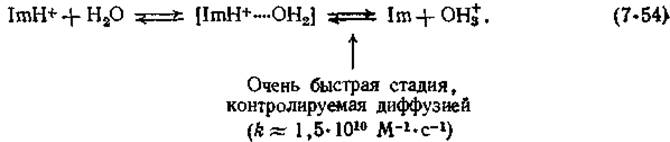
The Equilibrium Constant for reaction (7-54), calculated from the pKa value of 7.0 for imidazole, is 10-7 M. Since Keq is also The ratio of the overall forward and reverse rate constants, we find that for the forward reaction kf = 10-7∙1.5X1010 = 1.5∙103 s-1. This relatively low reaction rate is due to the fact that in the transiently formed complex [shown in parentheses in equation (7-54)], the proton spends most of its time on the imidazole group. For brief intervals, it resides on the coordinatively bound Water molecule, but it repeatedly returns to the imidazole group many times before the imidazole and ОН+3 dissociate. Because of this unfavorable equilibrium within the complex, the diffusion-controlled rate of proton transfer from the protonated imidazole to water is significantly lower than the rate of the reverse proton transfer.
Last update: 06/08/2026
Editorial and Educational Adaptation: This material has been compiled based on the primary/original source text. The project team performed an editorial review, corrected technical inaccuracies, structured sections, and adapted the content for an educational format.
What was processed:
- elimination of formatting defects (OCR errors, structural breaks, corrupted characters);
- editorial organization of content;
- standardization of terminology in accordance with academic sources;
- verification of factual statements against the original source text.
All mentions of the author, publication year, and origin of the primary text have been preserved in accordance with the source.