Biochemistry - The Chemical Reactions of Living Cells Volume 2 - D. Metzler 1980
Organization of Metabolism: Catabolic Pathways
Catabolism of Propionyl-CoA and Propionate
Catabolic Pathways Involving the Formation of Malonate Semialdehyde
The most probable metabolic pathway for propionyl-CoA is its further ß-Oxidation leading to The formation of the CoA derivative of malonate semialdehyde. The latter, in turn, can be oxidized to malonyl-CoA-ß-keto acid, which readily undergoes decarboxylation to acetyl-CoA (Fig. 9-6, pathway a). Although all the Enzymes required for these reactions have indeed been detected in Clostridium kluyveri [32], this pathway appears to be of minor importance. However, green plants and many microorganisms utilize a similar pathway in which ß-hydroxypropionyl-CoA is not converted into the CoA derivative of malonate semialdehyde, but is instead hydrolyzed to yield free ß-hydroxypropionate, which is then oxidized to malonic acid semialdehyde (Fig. 9-6, pathway b).
Class="center">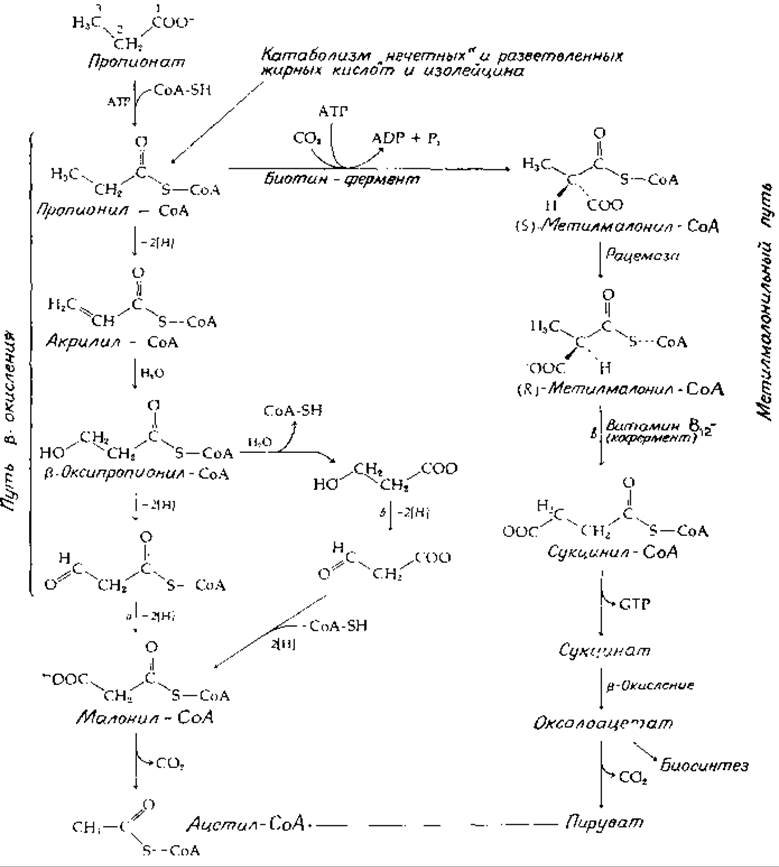
FIG. 9-6. Catabolism of propionate and propionyl-CoA. Note that the malonyl-CoA formed via pathway b contains the thioester bond at C-3 of the original propionate rather than at C-1 (as shown in the figure).
Pathway b would offer a tangible advantage over pathway a if the Cleavage of ß-hydroxypropionyl-CoA were not limited to simple Hydrolysis as shown in Fig. 9-6. If the energy of the thioester bond were conserved via the formation of ATP or GTP (such as in The Tricarboxylic Acid Cycle during The conversion of succinyl-CoA to succinate), an additional substrate-level phosphorylation step would be achieved1).
It is often assumed that propionate, being a three-carbon compound, can be directly converted into Pyruvate, which is also a three-carbon compound. The simplest route for such a conversion might proceed through α-oxidation to yield lactate; however, there is virtually no evidence supporting this process. Another potential pathway for conversion to lactate involves The addition of a Water molecule to acrylyl-CoA, an intermediate of pathway a in Fig. 9-6. In this case, the water molecule would have to add "incorrectly": the OH- group would attach not to the ß-carbon, but to the α-carbon2). The resulting lactyl-CoA could then be readily converted into pyruvate. Although data have been reported regarding the interconversion of propionate, lactate, and pyruvate in Clostridium propionicum, attempts to isolate the corresponding enzymes have been unsuccessful [33]. A chemically more favorable reaction occurs in the same Organism: the Addition of an ammonium ion to acrylyl-CoA to form ß-alanyl-CoA.
1) We invite the reader to consider why coupling pathway a with the synthesis of an additional ATP molecule would be disadvantageous.
2) What type of Active Site would the reader expect an enzyme catalyzing such a reaction to possess? See a similar reaction described by equation (8-36).
Last update: 06/08/2026
Editorial and Educational Adaptation: This material has been compiled based on the primary/original source text. The project team performed an editorial review, corrected technical inaccuracies, structured sections, and adapted the content for an educational format.
What was processed:
- elimination of formatting defects (OCR errors, structural breaks, corrupted characters);
- editorial organization of content;
- standardization of terminology in accordance with academic sources;
- verification of factual statements against the original source text.
All mentions of the author, publication year, and origin of the primary text have been preserved in accordance with the source.