Biochemistry - The Chemical Reactions of Living Cells, Volume 2 - D. Metzler 1980
Coenzymes - specialized natural reagents
ATP and nucleotide "handles"
The Role of ATP in driving biosynthetic reactions was examined in Chapter 7 (Section E), with the focus entirely on the polyphosphate group undergoing Cleavage.
What about the adenosine moiety? Here we find an exquisite Structure borrowed from Nucleic Acids. What is its function in ATP as a carrier of phosphate groups? At least part of the answer appears to be that the adenosine monophosphate (AMP) portion of the molecule serves as a "handle" by which catalytic Proteins can "grab hold":
Class="center">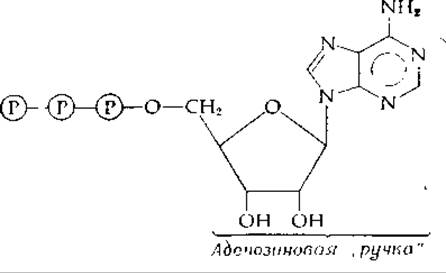
In the case of acetate thiokinase [Equation (7-30)], this "handle" plays a crucial role by holding the transiently formed acyl adenylate in a tightly protein-bound state. This would hardly be possible without the participation of the bulky adenosine group.
AMP is just one of the "handles" to which nature attaches phosphate groups to yield di- and triphosphate derivatives. Like AMP, other handles are also NUCLEOTIDES, the monomeric units of nucleic acids. Thus, one enzyme requiring a polyphosphate as an energy source selects ATP, whereas another chooses CTP or GTP. Furthermore, nucleotide handles carry more than just phosphate groups; they are also present in other Coenzymes, such as CoA, NAD+, NADP+, and FAD. In addition, they frequently serve as carriers for various small organic molecules. In such cases, these molecules become active metabolites, such as uridine diphosphate glucose (UDP-glucose or UDPG), which participates in sugar METABOLISM (Chapter 11, Section D, 1,6), and cytidine diphosphate Choline, an intermediate in phospholipid synthesis [Equation (11-26)].
Recalling that acetyl adenylate (acetyl-AMP) is formed as an intermediate in the synthesis of acetyl-CoA, and comparing The Biosynthesis of sugars, Phospholipids, and acetyl-CoA, we see that in each instance the biosynthetic enzyme exhibits Specificity for a particular nucleotide handle. This handle provides the recognition features by which the enzyme can select the correct "raw material" from the surrounding sea of molecules. Of course, the presence of a handle is not the sole requirement for a molecule to be selected by an enzyme, since the entire substrate molecule, rather than just its handle, must conform to the Enzyme Structure.
Figure 2-21 illustrates the structures of the four purine and pyrimidine bases that make up most common nucleotide handles. The outlines represent Contact surfaces defined by Van der Waals radii, and the arrows indicate some of the directions in which Hydrogen Bonds can form with neighboring groups. The distinctive Features of the four bases, both in terms of geometric shape and potential hydrogen-bonding patterns, are immediately apparent. Upon binding to proteins, the hydrogen-bonding groups of the purine and pyrimidine bases can interact with strictly positioned groups of the protein molecule. The ribose or deoxyribose ring contains additional groups capable of forming hydrogen bonds with the protein, while the negatively charged oxygen atoms of the 5'-phosphate can interact with positively charged side chains of the protein molecule.
Are nucleotide handles merely inert groups of fixed conformation, or can they actively participate in chemical processes? Biochemists rarely ask this question, perhaps because there is as yet no evidence directly implicating the handle in catalysis. Nevertheless, in biochemistry we must always be prepared for surprises, and it may well turn out that these handles participate in catalysis just as traditional "working" portions of coenzymes do.
Last update: 06/08/2026
Editorial and Educational Adaptation: This material has been compiled based on the primary/original source text. The project team performed an editorial review, corrected technical inaccuracies, structured sections, and adapted the content for an educational format.
What was processed:
- elimination of formatting defects (OCR errors, structural breaks, corrupted characters);
- editorial organization of content;
- standardization of terminology in accordance with academic sources;
- verification of factual statements against the original source text.
All mentions of the author, publication year, and origin of the primary text have been preserved in accordance with the source.