Biochemistry of Amino Acids - A. Meister 1961
Intermediary Metabolism of Amino Acids
β-Alanine
ß-Alanine is known as a product of aspartic acid decarboxylation (p. 208) and as a constituent of carnosine, anserine (p. 70), coenzyme A, and pantothenic acid (p. 79).
ß-Alanine is rapidly deaminated in vivo and in preparations of various Tissues [3, 4]1. Transamination of ß-alanine has also been described (p. 227), but the postulated reaction product, malonic semialdehyde, has not yet been identified. There is a report that the N-phospho derivative of ß-alanine undergoes rapid turnover [4]. Peel and Fritzson [5] present data indicating that in rats, the deamination of ß-alanine is followed by decarboxylation and acetate formation:
Class="center">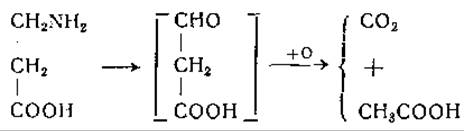
Stedman [6] described the enzymatic synthesis of ß-alanyl-coenzyme A from acrylyl-coenzyme A and ammonia in preparations of Clostridium propionicum:

ß-Alanyl-coenzyme A is the only currently known thioester of coenzyme A and an amino acid. Stedman suggests that this derivative may play a role in the synthesis of Carnosine and Anserine.
ß-Aminopropionitrile, an analogue of ß-alanine, has been isolated from a toxic component of Lathyrus odoratus seeds (p. 77). Another compound structurally similar to ß-alanine, ß-nitropropionic acid, is produced by an Aspergillus flavus strain [7].
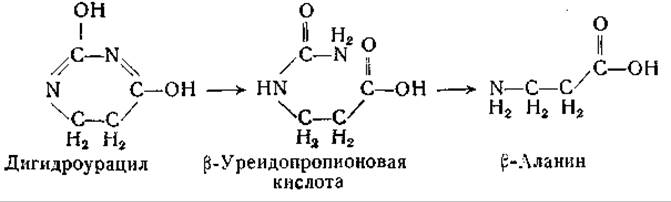
Fink and coworkers [8, 1073] found that rats excrete ß-aminoisobutyric acid in their urine following the administration of deoxyribonucleic acid, dihydrothymine, or thymine. It was later demonstrated that rat Liver slices catalyze The formation of ß-aminoisobutyric acid from dihydrothymine, as well as the formation of ß-alanine from dihydrouracil. The latter has been isolated from bovine Spleen [9].
1 According to S. E. Severin and Wu Weiming (Bull. Exp. Biol. Med., 11, 4851 (1958)), the dissimilation of ß-alanine in mammalian liver and Kidneys begins with transamination reactions in which pyruvic and, possibly, ketoglutaric acids serve as primary amino group acceptors. — Ed. note

Chromatographic analysis has shown that incubation of labeled thymine with rat liver slices yields dihydrothymine
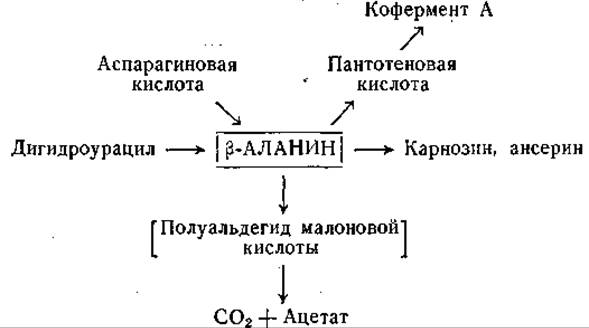
Fig. 7. Summary scheme of ß-alanine transformations.
and ß-ureidoisobutyric acid. An enzyme preparation obtained from rat liver catalyzes the formation of ß-alanine from dihydrouracil and from ß-ureidopropionic acid [1073]:
The synthesis of pantothenic acid from pantoic acid and ß-alanine has been studied in Escherichia coli. The reaction proceeds via the following pathway:
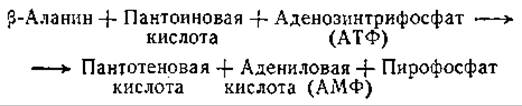
It is hypothesized that an intermediate reaction establishes a bond between the pantoic residue and adenylic acid ([445, 446, 1074]; see also p. 278):

The existence of an intermediate reaction involving the formation of a mixed anhydride of adenylic and pantoic acids is supported by observations showing that during the synthesis of pantothenic acid from O18-pantoic acid, the labeled oxygen is transferred to the phosphate group of adenylic acid.
Last update: 06/08/2026
Editorial and Educational Adaptation: This material has been compiled based on the primary/original source text. The project team performed an editorial review, corrected technical inaccuracies, structured sections, and adapted the content for an educational format.
What was processed:
- elimination of formatting defects (OCR errors, structural breaks, corrupted characters);
- editorial organization of content;
- standardization of terminology in accordance with academic sources;
- verification of factual statements against the original source text.
All mentions of the author, publication year, and origin of the primary text have been preserved in accordance with the source.