Biochemistry of Amino Acids - A. Master 1961
The Role of Amino Acids in Nutrition
Amino Acid Antagonists
Phenylalanine Antagonists
Many analogues of phenylalanine have been studied; as a rule, altering the phenylalanine molecule by introducing substituents into the benzene ring or replacing its carbon atoms with oxygen or sulfur leads to The formation of active antimetabolites. An extensive body of literature has accumulated on the inhibition of microbial and animal growth by compounds such as thienylalanines, halogenated phenylalanine derivatives, and related compounds (see Table 17). This inhibition is typically competitive in nature and can be reversed solely by phenylalanine, although in some cases Tyrosine and Tryptophan are also effective. Racemic mixtures of these analogues have generally been used; when optical isomers are tested separately, they frequently exhibit varying degrees of activity.
Class="center">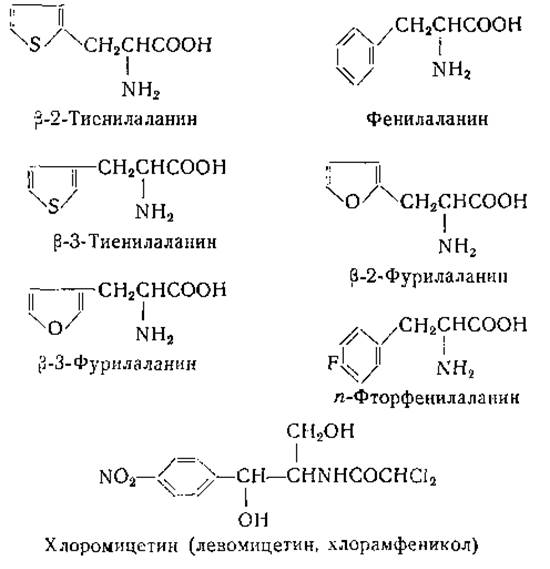
For instance, the growth of certain microorganisms [250] is inhibited exclusively by the L-isomer of ß-2-thienylalanine, whereas in rats both stereoisomers of this analogue act as active antagonists [246]. Many phenylalanine analogues are oxidized by amino acid oxidases [277, 278], and ß-2-thienylalanine can also undergo Transamination (see Table 22). The activity of ß-2-thienyl-D-Alanine in rats likely depends on its inversion via oxidation to the corresponding a-keto acid, followed by transamination to yield the L-form.
The growth inhibition of Bacteria by the antibiotic chloromycetin can, under certain conditions, be reversed by phenylalanine, although the antagonism in this case is predominantly non-competitive. Investigation of a series of related compounds has demonstrated that sequential modifications of the phenylalanine molecule, bringing its Structure closer to that of chloromycetin, lead to a gradual shift in The Nature of the antagonism toward non-competitive inhibition [164, 279]. Chloromycetin appears to exhibit some anti-phenylalanine activity, which may be related to its antibiotic properties. Nevertheless, according to certain data, the MECHANISM OF ACTION of this antibiotic cannot be entirely explained by its properties as an amino acid antimetabolite [287].
Last update: 06/08/2026
Editorial and Educational Adaptation: This material has been compiled based on the primary/original source text. The project team performed an editorial review, corrected technical inaccuracies, structured sections, and adapted the content for an educational format.
What was processed:
- elimination of formatting defects (OCR errors, structural breaks, corrupted characters);
- editorial organization of content;
- standardization of terminology in accordance with academic sources;
- verification of factual statements against the original source text.
All mentions of the author, publication year, and origin of the primary text have been preserved in accordance with the source.