Human Biochemistry, Volume 1 - Murray R. 1993
Bioenergetics and Metabolism of Carbohydrates and Lipids
Metabolism of Unsaturated Fatty Acids and Eicosanoids
Synthesis of Polyunsaturated Fatty Acids (Fig. 24.3)
Additional double bonds introduced into monounsaturated Fatty acids are always separated from one another by a methylene group. However, this rule does not apply to bacterial METABOLISM. In animals, all additional double bonds are formed between an existing double bond and the carboxyl group, whereas in plants they can also form between an existing double bond and the ω-carbon (terminal methyl) atom. Thus, since animals possess the ∆9-desaturase system, they can synthesize Unsaturated fatty acids of the oleic acid series (ω9) by combining Elongation and desaturation reactions (Fig. 24.3). However, animals are incapable of synthesizing either linoleic (ω6) or α-linolenic (ω3) acids due to the lack of the corresponding desaturases; therefore, these acids must be obtained from the diet, as they are essential for the Synthesis of Other polyunsaturated fatty acids of the ω6 and ω3 series. In the body, linoleic acid can be converted into arachidonic acid (Fig. 24.4). The first step of this conversion involves the dehydrogenation of linoleoyl-CoA to yield γ-linolenate, which then reacts with malonyl-CoA via a microsomal elongation system and is extended by 2 carbon atoms, resulting in The formation of eicosatrienoate (dihomo-γ-linolenate). The latter undergoes dehydrogenation to yield arachidonic acid. The dehydrogenating system is similar to the one described above for saturated fatty acids. Thus, if a sufficient amount of linolenic acid is provided in the diet, the body's requirement for arachidonic acid can be fully met.
During fasting and Insulin deficiency, the processes of desaturation and elongation are significantly impaired.
Class="center">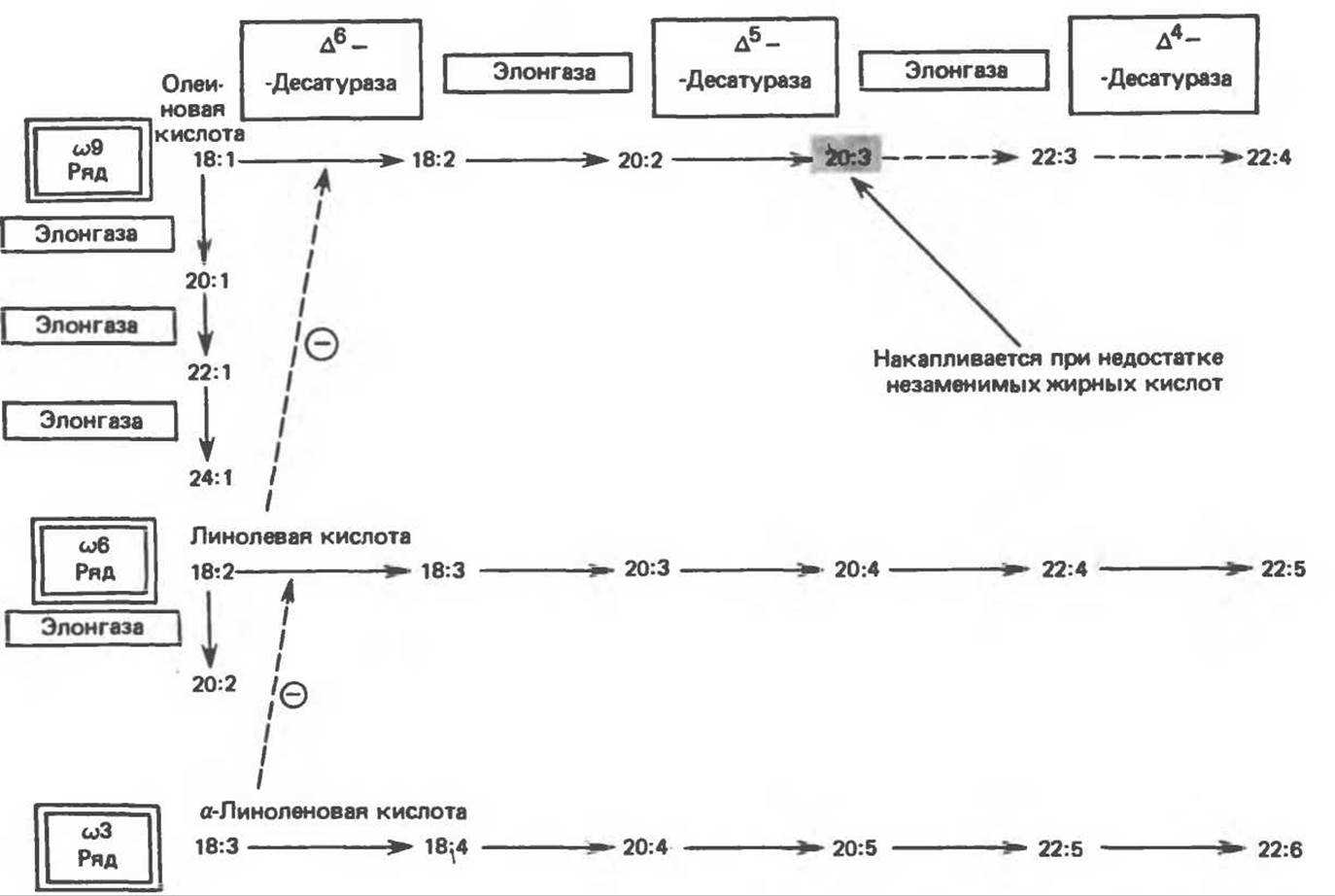
Fig. 24.3. Biosynthesis of polyunsaturated fatty acids of the ω9, ω6, and ω3 series. The respective steps are catalyzed by either the microsomal chain elongation system or the microsomal desaturase system. Polyunsaturated fatty acids of the ω9 series are synthesized in significant amounts only when linoleic and α-linolenic acids are absent from the diet. This is because all polyunsaturated fatty acid series compete for the same enzyme system, and its affinity decreases from the ω3 series to the ω9 series (⊝ denotes inhibition).

Fig. 24.4. Pathway of linoleate conversion to arachidonate; members of the cat family cannot perform this conversion due to the absence of ∆6-desaturase and therefore must obtain arachidonate from their diet.
Last update: 06/08/2026
Editorial and Educational Adaptation: This material has been compiled based on the primary/original source text. The project team performed an editorial review, corrected technical inaccuracies, structured sections, and adapted the content for an educational format.
What was processed:
- elimination of formatting defects (OCR errors, structural breaks, corrupted characters);
- editorial organization of content;
- standardization of terminology in accordance with academic sources;
- verification of factual statements against the original source text.
All mentions of the author, publication year, and origin of the primary text have been preserved in accordance with the source.