Human Biochemistry, Volume 1 - Murray R. 1993
Bioenergetics and Metabolism of Carbohydrates and Lipids
Metabolism of Unsaturated Fatty Acids and Eicosanoids
Metabolism of Unsaturated Fatty Acids
Fig. 24.1 illustrates several long-chain Unsaturated Fatty acids involved in mammalian metabolic processes (fatty acid Classification is discussed in Chapter 15).
Other C20, C22, and C24 polyenoic Fatty acids are also found in animal Tissues; they can be synthesized from linoleic and a-linolenic acids via carbon chain elongation. It should be emphasized that all double bonds in the unsaturated fatty acids commonly occurring in mammalian tissues possess the cis-conformation.
Palmitoleic and oleic acids are not essential dietary components because they can be synthesized in tissues from their corresponding saturated fatty acids by the Introduction of a single double bond. Studies utilizing radiolabeled palmitate have demonstrated that the label is rapidly incorporated into palmitoleic and oleic acids, whereas it is absent from linoleic, linolenic, and arachidonic acids. The fatty acids required for adequate Nutrition in many animal species, including humans, are linoleic, a-linolenic, and arachidonic acids. These are termed Essential Fatty Acids and must be supplied in the diet. It should be noted, however, that while linoleic acid cannot be synthesized endogenously and must be obtained from dietary sources, arachidonic acid can be synthesized from linoleic acid in most mammals (Fig. 24.4). In animals, double bonds are introduced at the ∆4-, ∆5-, ∆6-, and ∆9- positions of the fatty acid chain, counting from the carboxyl terminus (see Chapters 15 and 23), but not beyond the ∆9- position, whereas in plants, double bonds can be formed at the ∆6-, ∆9-, ∆12-, and ∆15- positions.
Class="center">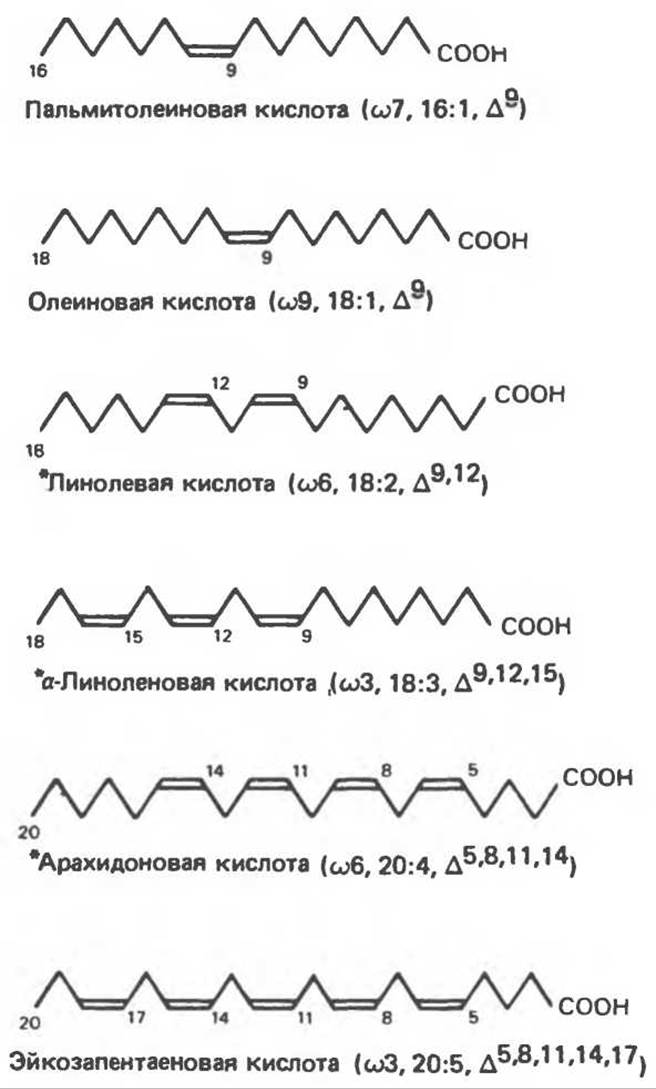
Fig. 24.1. Structures of several unsaturated fatty acids. Carbon atoms in the molecules are numbered by convention, i.e., starting from the carboxyl terminus; the numbers following the ω symbol (e.g., ω7 in palmitoleic acid) indicate THE POSITION OF the double bond relative to the opposite end (the terminal methyl group) of the fatty acid molecule. The values in parentheses indicate, for example, that in palmitoleic acid the double bond is located at the seventh carbon atom from the terminal methyl group (ω7), that it contains 16 carbon atoms and has one double bond (16:1), and also that this double bond is positioned at the ninth carbon atom from the carboxyl terminus (∆9). Similarly, a-linolenic acid contains double bonds, the first of which is located at the third carbon atom from the terminal methyl group; it consists of 16 carbon atoms and has a total of 3 double bonds, which are located at carbon atoms 9, 12, and 15, counting from the carboxyl terminus. Substances marked with an asterisk are classified as essential fatty acids.
Last update: 06/08/2026
Editorial and Educational Adaptation: This material has been compiled based on the primary/original source text. The project team performed an editorial review, corrected technical inaccuracies, structured sections, and adapted the content for an educational format.
What was processed:
- elimination of formatting defects (OCR errors, structural breaks, corrupted characters);
- editorial organization of content;
- standardization of terminology in accordance with academic sources;
- verification of factual statements against the original source text.
All mentions of the author, publication year, and origin of the primary text have been preserved in accordance with the source.