Principles of Biochemistry Volume 2 - A. Lehninger 1985
Bioenergetics and Metabolism
Photosynthesis
Chlorophylls are the primary light-absorbing pigments.
Let us now turn to the light-absorbing pigments of the thylakoid membranes. The foremost among them are the green chlorophylls, which are Mg2+ complexes structurally reminiscent of the protoporphyrin found in Hemoglobin (Fig. 8-2). The molecule of chlorophyll a, present in the METABOLISM/14.html">Chloroplasts of all green plant Cells, contains four substituted pyrrole rings, one of which (ring IV) is in a reduced form (Fig. 23-8). There is also a fifth, non-pyrrole ring. This characteristic five-ring Structure, which is a porphyrin derivative, is termed pheophorbide (from the Greek pheos, meaning brown). The long isoprenoid side chain in the chlorophyll a molecule is a phytol alcohol residue attached via an ester bond to the carboxyl group of a substituent on ring IV (Fig. 23-8). Four central nitrogen atoms in the chlorophyll a molecule are coordinately bonded to the Mg2+ ion.
Class="center">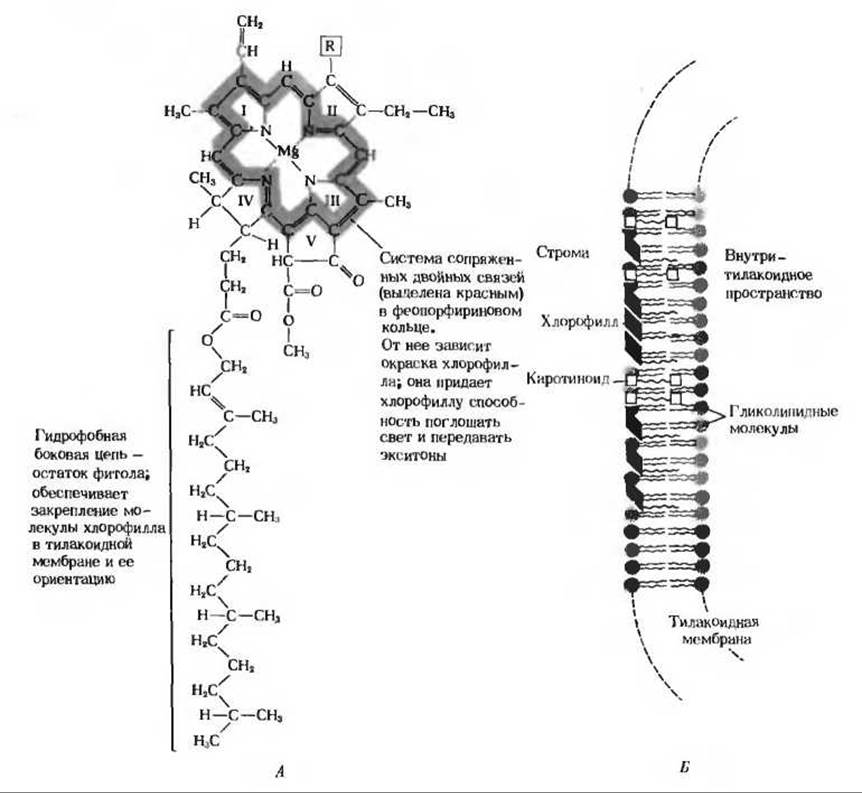
Fig. 23-8. A. Chlorophylls a and b. Ring V is absent in the protoporphyrin molecule. R represents a —CH3 group in chlorophyll a and a —CHO group in chlorophyll b. B. Arrangement of light-absorbing pigments (chlorophylls and carotenoids) within the thylakoid membrane. The pigment molecules are specifically oriented and organized into so-called Photosystems. Chlorophyll molecules are bound to specific Proteins within the thylakoid membrane; for simplicity, these proteins are omitted here.
Photosynthetic cells of higher plants invariably contain Two Types of chlorophyll. One of these is chlorophyll a, while the second, in many species, is chlorophyll b, which differs from chlorophyll a by having an aldehyde group in place of the methyl group at ring II (Fig. 23-8). Chlorophylls a and b can be isolated in pure form from leaf extracts using chromatographic techniques. Although both are green, their absorption spectra differ slightly. In most higher plants, The amount of chlorophyll a is approximately twice that of chlorophyll b.
Figure 23-8 illustrates how The structure of chlorophyll a is tailored to perform its biological function. Highlighted in red in the figure, the five-ring system—which itself forms a large macrocycle around the Mg atom—grants the molecule The ability to absorb light. The Mg atom promotes the aggregation of chlorophyll molecules, thereby facilitating light harvesting. The long hydrophobic side chain serves not only to anchor chlorophyll molecules within Cell/29.html">The Lipid Bilayer of the membranes, but also to maintain their precise orientation.
Last update: 06/08/2026
Editorial and Educational Adaptation: This material has been compiled based on the primary/original source text. The project team performed an editorial review, corrected technical inaccuracies, structured sections, and adapted the content for an educational format.
What was processed:
- elimination of formatting defects (OCR errors, structural breaks, corrupted characters);
- editorial organization of content;
- standardization of terminology in accordance with academic sources;
- verification of factual statements against the original source text.
All mentions of the author, publication year, and origin of the primary text have been preserved in accordance with the source.