Principles of Biochemistry, Volume 2 - A. Lehninger 1985
Bioenergetics and Metabolism
Photosynthesis
How the Photosynthesis Equation Was Derived
We now turn to the process that ultimately serves as the source of nearly all biological energy: the capture of solar energy by photosynthetic organisms and its conversion into biomass energy. Photosynthetic and heterotrophic organisms coexist in the biosphere in a balanced steady state (Fig. 23-1). Photosynthetic plants capture solar energy and store it in the form of ATP and NADPH, which provide the energy needed to synthesize CARBOHYDRATES and other organic cellular components from carbon dioxide and Water, releasing oxygen into the atmosphere in the process. Aerobic heterotrophs use this oxygen to break down energy-rich organic products of Photosynthesis into CO2 and H2O, thereby generating ATP for their own metabolic needs. The carbon dioxide produced during heterotrophic Respiration returns to the atmosphere to be reused by photosynthetic organisms. Solar energy thus drives a continuous global cycle in which atmospheric carbon dioxide and oxygen circulate ceaselessly through the biosphere (Fig. 23-1).
The products of photosynthesis store a vast amount of energy. Each year, the plant world generates at least 1017 kcal of Free energy derived from captured sunlight—more than ten times the total energy consumed annually from fossil fuels by the entire human population. Even these fossil fuels themselves (coal, petroleum, and natural gas) are nothing more than the preserved products of photosynthesis that took place millions of years ago. Because of this profound global dependence on photosynthesis—both past and present—for our energy and food supply, unraveling its mechanisms remains one of the most fundamental challenges in biochemistry.
Class="center">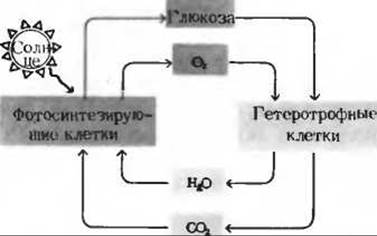
Fig. 23-1. Solar energy as the primary source of all biological energy. Photosynthetic Cells utilize sunlight energy to synthesize glucose and other organic products, which in turn serve as sources of energy and carbon for heterotrophic cells.
Joseph Priestley, one of the co-discoverers of oxygen, conducted the first milestone experiments on photosynthesis between 1770 and 1780. He discovered that the air in a sealed vessel in which a candle had burned out soon became "spoiled," no longer supporting combustion or animal life—a mouse placed inside would perish. However, if a sprig of mint was placed in the vessel, the air gradually "recovered," regaining its ability to support combustion and sustain the animal's life. From these experiments, Priestley concluded that green plants release oxygen—a process seemingly opposite to animal respiration, which consumes oxygen. Ironically, despite making these remarkably accurate observations, Priestley failed to realize that light is essential for the mint sprig to "repair" the air. The crucial role of light in this process was demonstrated a few years later by the Dutch physician Jan Ingenhousz. He was not a professional scientist, pursuing research rather as an amateur by conducting experiments in his home laboratory. Ingenhousz also discovered that oxygen is produced in the light exclusively by the green parts of plants.
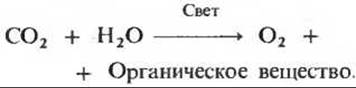
Later, in the early 19th century, the first quantitative measurements were made of carbon dioxide uptake, oxygen evolution, and plant biomass accumulation during photosynthesis. In 1842, Julius Robert Mayer, who formulated The First Law of Thermodynamics (the conservation of energy), published a paper asserting that sunlight serves as the energy source for The formation of photosynthetic products. Thus, by the mid-19th century, it became clear that the overall equation for plant photosynthesis can be written as
Last update: 06/08/2026
Editorial and Educational Adaptation: This material has been compiled based on the primary/original source text. The project team performed an editorial review, corrected technical inaccuracies, structured sections, and adapted the content for an educational format.
What was processed:
- elimination of formatting defects (OCR errors, structural breaks, corrupted characters);
- editorial organization of content;
- standardization of terminology in accordance with academic sources;
- verification of factual statements against the original source text.
All mentions of the author, publication year, and origin of the primary text have been preserved in accordance with the source.