Principles of Biochemistry Volume 2 - A. Lehninger 1985
Bioenergetics and Metabolism
Biosynthesis of Carbohydrates in Animal Tissues
A bypass pathway is required to convert pyruvate into phosphoenolpyruvate
The first bypass reaction in Gluconeogenesis is The conversion of Pyruvate to phosphoenolpyruvate (Fig. 20-2). This cannot simply be the reverse of the pyruvate kinase reaction (Section 15.7, d).
Class="center">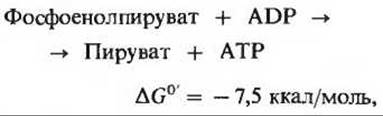
which is characterized by a large negative standard free-energy change and is therefore irreversible in the intact Cell. Instead, the phosphorylation of pyruvate is accomplished via a bypass pathway—a sequence of reactions that, in some animals, requires the concerted action of cytosolic and mitochondrial Liver cell Enzymes (Fig. 20-2). The first step in this bypass sequence is catalyzed by mitochondrial pyruvate carboxylase. This biotin-containing enzyme catalyzes The formation of oxaloacetate from pyruvate (Fig. 20-3), an anaplerotic reaction (Section 16.11) capable of replenishing the pool of Citric Acid Cycle intermediates.
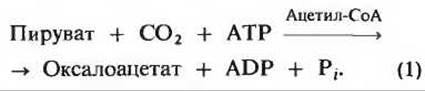
Pyruvate carboxylase is a regulatory enzyme; in the absence of acetyl-CoA, which serves as a positive effector, it is almost completely devoid of activity.
Oxaloacetate produced in the Mitochondria from pyruvate is reversibly reduced at the expense of NADH to form malate by mitochondrial malate dehydrogenase (Section 16.5,3).

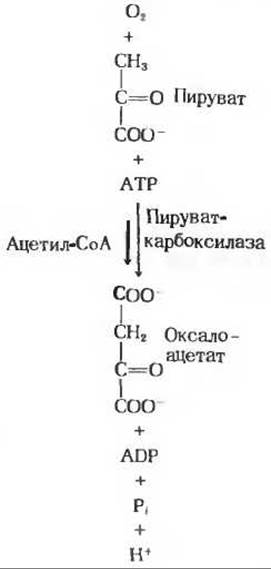
Fig. 20-3. Carboxylation of pyruvate leading to oxaloacetate formation. The CO2 incorporated into oxaloacetate is released again in one of the subsequent reactions (Fig. 20-4).
Malate leaves the mitochondria via a specific dicarboxylate transport system located in The inner mitochondrial membrane (Section 17.19) and enters the Cytosol. Here it is reoxidized by the cytosolic NAD-dependent malate dehydrogenase to yield oxaloacetate, now extramitochondrial:

The oxaloacetate formed in this way is acted upon by phosphoenolpyruvate carboxykinase (Section 16.11). The product of this Mg2+-dependent reaction, in which guanosine triphosphate (GTP) serves as the phosphoryl donor, is phosphoenolpyruvate (Fig. 20-4).

Under intracellular conditions, this reaction is reversible. In rat liver Cells, phosphoenolpyruvate carboxykinase is found exclusively in the cytosol, but in the liver of some other species, the enzyme is detected in both the cytosol and the mitochondria.
We can now write the overall equation for these bypass reactions by which pyruvate is converted to phosphoenolpyruvate—that is, reactions (1) through (4):
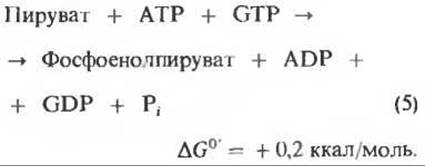
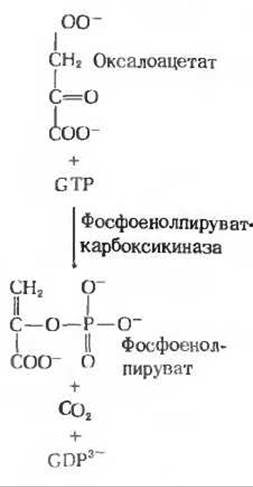
Fig. 20-4. Conversion of oxaloacetate to phosphoenolpyruvate. The CO2 fixed in the pyruvate carboxylase reaction (Fig. 20-3) is now released again as CO2.
We can see that the phosphorylation of one molecule of pyruvate to phosphoenolpyruvate (a process requiring an energy input of 14.8 kcal/mol under standard conditions) consumes the energy of two high-energy phosphate groups (one from ATP and one from GTP), each characterized by a Hydrolysis ∆G0' of -7.3 kcal/mol. Meanwhile, when phosphoenolpyruvate is converted to pyruvate during Glycolysis, only one ATP molecule is synthesized from ADP. Although the standard free-energy change ∆G0' for the overall reaction of phosphoenolpyruvate formation is +0.2 kcal/mol, the actual free-energy change ∆G' under cellular conditions is a large negative value, approximately -6.0 kcal/mol; it is thus evident that this reaction is practically irreversible.
Last update: 06/08/2026
Editorial and Educational Adaptation: This material has been compiled based on the primary/original source text. The project team performed an editorial review, corrected technical inaccuracies, structured sections, and adapted the content for an educational format.
What was processed:
- elimination of formatting defects (OCR errors, structural breaks, corrupted characters);
- editorial organization of content;
- standardization of terminology in accordance with academic sources;
- verification of factual statements against the original source text.
All mentions of the author, publication year, and origin of the primary text have been preserved in accordance with the source.