Principles of Biochemistry Volume 1 - A. Lehninger 1985
Biomolecules
Enzymes
Enzyme systems feature a "conductor," a role performed by the regulatory enzyme
The Enzymes that carry out various metabolic processes within The Cell—such as The conversion of glucose into lactic acid in skeletal Muscles or the synthesis of Amino Acids from simpler precursors—are organized into sequential chains or systems in which they act in a coordinated manner. In such enzyme systems, the product of the reaction catalyzed by the first enzyme becomes the substrate for the next enzyme, and so on (Fig. 9-17). Multienzyme systems may comprise 15 or more enzymes acting in a definite sequence.
Each enzyme system contains at least one pacemaker enzyme that sets the pace for the entire reaction sequence by catalyzing the rate-limiting step—that is, the slowest reaction that determines the overall rate of the process. Such pacemaker enzymes not only perform a catalytic function but are also capable of increasing or decreasing their catalytic activity in response to specific signals. Through the action of these enzymes, The rate of each metabolic pathway is constantly modulated, adapting almost instantaneously to the changing cellular demands for energy and for the building-block molecules required for cell growth and renewal. In most multienzyme systems, the pacemaker enzyme catalyzes the initial reaction of the pathway. The remaining enzymes, which are typically present in quantities sufficient to ensure very high catalytic activity, simply follow the pacemaker's lead; the reactions they catalyze are accelerated only upon the arrival of adequate amounts of substrates generated as products of preceding reactions.
Class="center">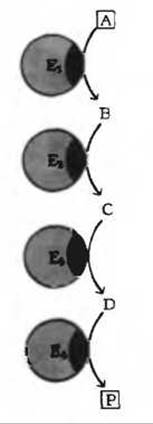
Fig. 9-17. Schematic representation of a multienzyme system catalyzing the conversion of A to P through four sequential enzymatic reactions.
Such pacemaker enzymes, whose activity is modulated by various types of molecular signals, are referred to as regulatory enzymes. There are two Major Classes of regulatory enzymes: allosteric enzymes, which are regulated by noncovalently bound modulators, and enzymes regulated through covalent modification.
Last update: 06/08/2026
Editorial and Educational Adaptation: This material has been compiled based on the primary/original source text. The project team performed an editorial review, corrected technical inaccuracies, structured sections, and adapted the content for an educational format.
What was processed:
- elimination of formatting defects (OCR errors, structural breaks, corrupted characters);
- editorial organization of content;
- standardization of terminology in accordance with academic sources;
- verification of factual statements against the original source text.
All mentions of the author, publication year, and origin of the primary text have been preserved in accordance with the source.