Glycoproteins - Hughes, R. 1985
Structure
Sequence Determination
Only in rare cases is a single specific carbohydrate chain attached to the polypeptide backbone of a glycoprotein. Typically, multiple amino acid residues are glycosylated, and each of these glycosylated residues can be linked to several highly similar glycans. Proteolysis can be used to cleave these glycans attached to the binding Amino Acids or small Peptides. The resulting glycopeptides are then separated and analyzed for their monosaccharide composition. Often, the complete carbohydrate sequence can be established [7] by combining various chemical, enzymatic, and physical Methods (Table 2.2).
Class="center">Table 2.2. Steps in determining the sugar sequence of glycans
|
1. |
Proteolysis: prolase, Trypsin, Chymotrypsin, collagenase, etc. |
|
2. |
Glycopeptide Separation: Gel filtration, Ion-exchange Chromatography, Electrophoresis, and paper chromatography |
|
3. |
Composition: Gas-Liquid Chromatography (Monosaccharides), ion-exchange chromatography (amino acids) |
|
4. |
Determination of sugar sequence: a) chemical: methylation, periodic acid oxidation b) enzymatic: exo- and Endoglycosidases c) physical: mass spectrometry, nuclear magnetic Resonance |
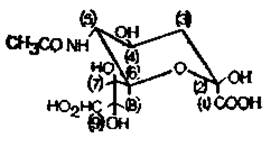
Fig. 2.3. Structure of N-acetylneuraminic acid and other sialic acids.
|
Name |
Substitution site |
Substituting group |
Typical source |
|
N-acetylneuraminic acid |
C-5 |
CH3CONH— |
Common |
|
N-glycolylneuraminic acid |
C-5 |
HOCH3CONH— |
Pig Tissues (>90%) |
|
O-acetyl derivatives |
C-9 C-7 |
СН3СО— СР3СО— |
Bovine submandibular gland (rare) |
|
C-4 |
СН3СО— |
Horse tissues |
The identification of sialic acids incorporated into Glycoproteins presents a particular analytical challenge, as the core ring structure of neuraminic acid exists in numerous variants that differ in the positions of their substituent groups. The most frequently occurring derivative is N-acetylneuraminic acid (Fig. 2.3); in addition, about 20 other sialic acid derivatives are known. For instance, N-glycolylneuraminic acid is commonly found in glycoproteins or Glycolipids, and several O-acyl derivatives of this and N-acetylneuraminic acid are also known. The hydroxyl group at C-2 takes part in The formation of the glycosidic bond.
Last update: 06/08/2026
Editorial and Educational Adaptation: This material has been compiled based on the primary/original source text. The project team performed an editorial review, corrected technical inaccuracies, structured sections, and adapted the content for an educational format.
What was processed:
- elimination of formatting defects (OCR errors, structural breaks, corrupted characters);
- editorial organization of content;
- standardization of terminology in accordance with academic sources;
- verification of factual statements against the original source text.
All mentions of the author, publication year, and origin of the primary text have been preserved in accordance with the source.