Fundamentals of Biochemical Engineering, Part 1 - Bailey J., Ollis D. 1989
Introduction to Microbiology
Cell Structure
Cell Fractionation
The primary challenge in studying The properties of specific Organelles from a given Cell type lies in obtaining a sufficient quantity of these organelles for subsequent biochemical analysis. Typically, this requires isolating A large number of organelles from a large cell population. As a rule, the standard isolation Procedure begins with homogenizing The Cell suspension in a specialized solution using a tissue grinder with a rotating pestle or ultrasonication. This approach aims to disrupt the Cells without damaging their constituent organelles or altering their Structure. The next stage involves fractionating the resulting suspension, which ideally represents a mixture of intact organelles isolated from the cells.
As chemical engineers, we know that any Separation process is based on differences in the physical and/or Chemical properties of the components being separated. The conventional method for fractionating cell organelles is based on differences in their physical characteristics: particle size, shape, and density. A simplified view of the centrifugation process is illustrated in the example below.
Class="center">
FIG. 1P1.1. During high-speed centrifugation, particles suspended in centrifuge tubes move away from the axis of rotation. Since the velocity of these particles depends on their size, shape, and density, centrifugation allows for the separation of particles differing in these parameters.
Example 1.1. Studying particle motion under centrifugation conditions.
Suppose a spherical particle of radius R and density ρp is placed in a centrifuge tube containing a liquid medium of density ρj and viscosity μc. If this tube is then placed in a centrifuge and rotated at an angular velocity ω (Fig. 1P1.1), the particle's motion parameters can be calculated using the following equation (what assumptions are made in this equation?):
Drag force = Buoyant force
 (1P1.1)
where ur is the particle velocity in the r direction:
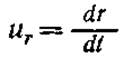 (1P1.2)
and G is the centrifugal acceleration:
 (1P1.3)
To determine the drag force acting on the particle in Eq. (1P1.1), Stokes' law is used, because under centrifugation conditions, particle velocities (and consequently, their Reynolds numbers) are typically very small. The gravity term is absent in Eq. (1P1.1) because the r direction is perpendicular to the direction of gravity (see Fig. 1P1.1). At the same time, when the centrifuge rotor spins at high angular velocity, an acceleration G is generated, which usually many times greater than gravity and can reach values of 600 to 600,000 g.
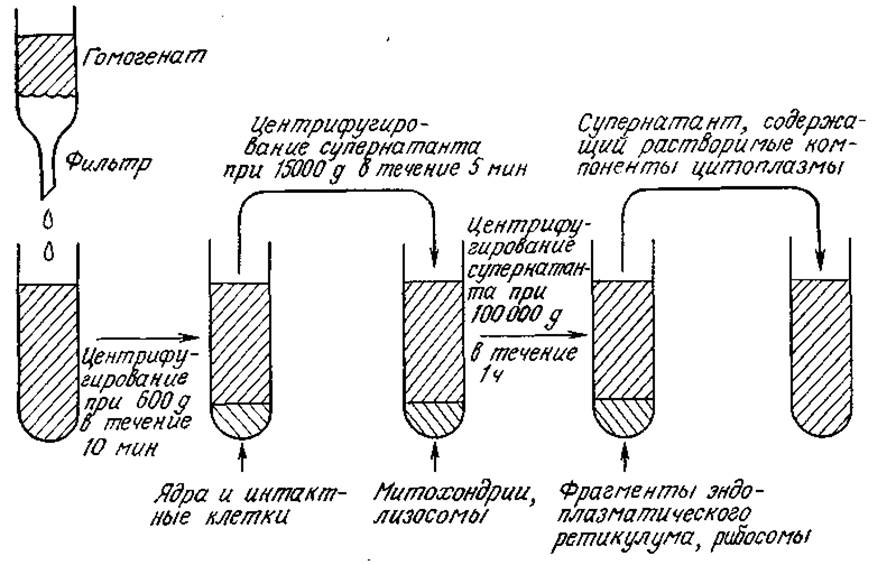
FIG. 1P1.2. KEY STAGES IN the separation of cellular structural elements by centrifugation. In the later Stages of the process, increasingly smaller cellular components are isolated.
By integrating this expression, one can determine the time required for the particle to move from position r1 to position r2:

Spherical particles of different sizes and/or densities will traverse the same distance in a centrifuge tube in different times; this fact forms The basis of differential centrifugation. Since relatively large particles, such as nuclei and intact cells, sediment quite rapidly, they can be collected and separated as a pellet after centrifuging the suspension for a limited time at relatively low speeds. The supernatant suspension is then subjected to repeated short-term centrifugation at higher rotor speeds, after which a second pellet containing Mitochondria is separated. By continuing this operation, a series of fractions of cellular components is obtained. The entire process is schematically illustrated in Fig. 1P1.2.
More sophisticated centrifugation techniques employ liquid media with a density gradient along the height of the centrifuge tube. These Methods are also used for the preliminary separation and fractionation of smaller cellular components, such as certain types of macromolecules. Other useful methods for separating such complex mixtures, based on differences in The chemical properties of the components, will be discussed in more detail in Chapter 11.
There are several limitations to the application and interpretation of cell fractionation results obtained by centrifugation, which are well covered in the book by Mahler and Cordes (Mahler H. R., Cordes E. H., Biological Chemistry, 2nd ed., Harper and Row, Publishers, Inc., New York, 1971). One of the difficulties is characteristic of any work in the field of studying and applying microorganisms. In order to obtain a sufficient quantity of cells, organelles, biologically important molecules, and other cellular components for subsequent work, we are forced to use a population, i.e., a large number of individual cells. It is usually assumed that this population is homogeneous, or, in other words, that all the microorganisms comprising it are identical. In such cases, the population is only needed to increase the number of these microorganisms to facilitate further experimental studies.
Usually, however, the microorganisms making up a population differ to some extent; such a population is called heterogeneous. For example, a population of growing cells contains old and young, large and small cells, which often differ in their biochemical composition and activity. If we consider the Structural elements of the cell, it should be noted that organelles of the same type, such as mitochondria within the very same cell, also differ slightly from one another. Therefore, the mitochondrial cell fraction also represents a heterogeneous population. Consequently, further study of such mixtures essentially determines certain average CHARACTERISTICS OF THE cell population, and the parameters found will thus depend on the COMPOSITION OF THE population.
Last update: 06/08/2026
Editorial and Educational Adaptation: This material has been compiled based on the primary/original source text. The project team performed an editorial review, corrected technical inaccuracies, structured sections, and adapted the content for an educational format.
What was processed:
- elimination of formatting defects (OCR errors, structural breaks, corrupted characters);
- editorial organization of content;
- standardization of terminology in accordance with academic sources;
- verification of factual statements against the original source text.
All mentions of the author, publication year, and origin of the primary text have been preserved in accordance with the source.