Practical Protein Chemistry - A. Darbre 1989
Chemical Fragmentation of Polypeptides
Cleavage at Tyrosine Residues
Cleavage at Cysteine Residues
The method of selective peptide bond Cleavage at the amino group of Cysteine residues is based on The conversion of SH groups into thiocyanate groups [183]. The cleavage of peptide bonds in cystine-containing Proteins by the action of cyanides was first reported in 1964–66 [23, 24]. The formation of thiocyanoalanine residues (74), which cyclize into acyliminothiazolidine (75), is accompanied by rapid Hydrolysis of the peptide bond with a high enough yield, producing an N-terminal peptide and a C-terminal 2-iminothiazolidine-4-carboxylic fragment (76). Since the Cleavage of disulfide Bonds by cyanides leads to partial and random formation of thiocyano groups, one might expect a complex mixture of Peptides to be obtained. In practice, however, Treatment of bovine Ribonuclease with a 1000-fold excess of cyanide at pH 8 and 37 °C for 48 h yields 9 peptides. According to their Amino Acid Composition, the resulting fragments correspond to the known Structure of ribonuclease, as well as to the fragments obtained by cleavage at the N-acyl bonds of all eight half-cystine residues [24].
Class="center">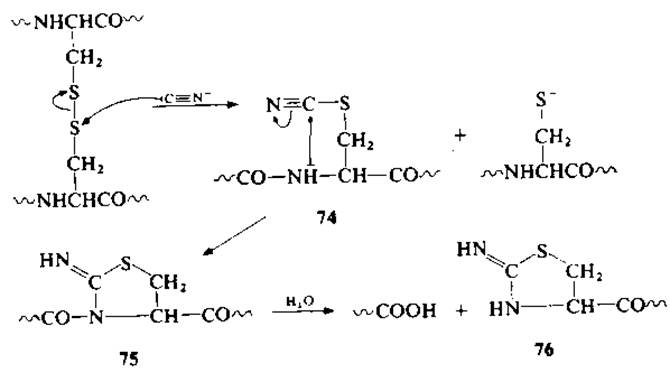

A method has been proposed for the direct and quantitative conversion of protein SH groups into their corresponding thiocyano derivatives using 2-nitro-5-thiocyanobenzoic acid (78) [38, 39] [equations (2.17) and (2.18)]. The reagent is synthesized by the reaction of 5,5'-dithiobis-(2-nitrobenzoic) acid with sodium cyanide [equation (2.17)]. 2-Nitro-5-thiocyanobenzoic acid is a fairly mild and selective cyanating reagent for SH groups; its high reactivity is due to the ease with which the readily leaving p-nitrothiophenol is displaced by a sulfur-containing nucleophile [equation (2.18)]. The labeled reagent is obtained by cleavage of Ellman's reagent using Na14CN. This method makes it possible to introduce a radioactive label into the thiocyanoalanine residue and monitor The rate of formation of labeled 2-iminothiazolidine peptides.
It has also been demonstrated that 1-cyano-4-dimethylaminopyridinium salts (80) serve as active cyanating agents for SH groups in proteins [199]. The reaction is carried out in a neutral or acidic medium, for example, in 0.1 M acetate buffer (pH 2–7) containing 7 M urea, at 25 °C for 11 min with a threefold molar excess of the reagent.
The two-step cyanylation Procedure involves, as The First stage, the treatment of a cysteine-containing protein with Ellman's reagent under mild alkaline conditions (Section 2.2.2.4). The mixed disulfide is then cleaved by the action of cyanide to yield the protein thiocyanoalanine derivative and the 2-nitro-5-thiobenzoate anion [94]. It has also been shown that a similar two-step cyanylation reaction occurs upon the interaction of cyanides with mixed disulfides formed by the reaction between a cysteine-containing protein and 2-nitrophenylsulfenyl chloride in aqueous acetic acid [46, 48, 49].

Selective cleavage at the thiocyanoalanine residues is carried out in an alkaline medium (pH 9) at 37 °C for 24 h. Under these conditions, the thiocyanoalanine residues undergo ß-elimination to yield thiocyanate and dehydroalanine (Section 2.5.2). Since the cleavage and ß-elimination reactions occur simultaneously in a weakly alkaline medium, one might expect them to compete, resulting in a low peptide bond cleavage yield. However, results obtained from the analysis of A number of proteins indicate that the cleavage proceeds almost quantitatively [183]. The low yield is probably due to incomplete cyanylation. Taking Papain [105], the catalytic subunit of E. coli aspartate transcarbamylase [194], and Azotobacter vinelandii isocitrate dehydrogenase [28] as Examples, it was established that monothiocyano derivatives of the native protein do not cyclize, and peptide bond cleavage occurs only after Denaturation [194]. Consequently, the cleavage step of the S-cyanylated protein should be carried out in the presence of Denaturing Agents, such as guanidine-HCl.
Last update: 06/08/2026
Editorial and Educational Adaptation: This material has been compiled based on the primary/original source text. The project team performed an editorial review, corrected technical inaccuracies, structured sections, and adapted the content for an educational format.
What was processed:
- elimination of formatting defects (OCR errors, structural breaks, corrupted characters);
- editorial organization of content;
- standardization of terminology in accordance with academic sources;
- verification of factual statements against the original source text.
All mentions of the author, publication year, and origin of the primary text have been preserved in accordance with the source.