Practical Protein Chemistry - A. Darbre 1989
Methods for Solid-Phase Amino Acid Sequence Analysis
Coupling Methods
Coupling of Lysyl-Containing Peptides Using DITC
Peptides containing Lysine residues located either within the chain or at the C-terminus of the polypeptide, as well as peptides containing aminoethylcysteine, can be efficiently attached via their free amino groups to Polystyrene-Based Resins or aminopropyl Glass (APS or ß-APS) using DITC (Fig. 12.3). A variation of the "DITC method" involves using a bifunctional reagent, N-(p-isothiocyanatobenzoyl)-DL-homoserine lactone, to attach lysyl-containing peptides to Glass-Based Supports containing amino groups. High coupling yields have been reported [21].
12.4.1.1. Coupling Procedures.
Advantages. Coupling yields are generally very high (80–90%). When comparing various polystyrene supports in the Edman Degradation, peptidylaminopolystyrene yields the fewest by-products. Previously, aminopolystyrene was considered the best support for coupling small peptides (containing 25–30 Amino Acids), whereas longer Peptides and Proteins were predominantly bound to glass supports (aminopropyl glass or ß-aminopropyl glass). Currently, Methods have been developed for coupling smaller peptides to glass supports (Sections 12.4.2–12.4.4).
Limitations.
1. Coupling conditions may cause a decrease in the solubility of certain peptides, leading to low coupling yields. To prevent losses, control tests should be performed during and after the completion of the coupling process (Section 12.4.5). Some peptides that are insoluble in the coupling buffer (its composition is given below) can be dissolved by adding pyridine or DMF. If this does not help, sample solubility can be improved by adjusting the buffer pH (from 7.5 to 10). Sometimes peptides become soluble after preliminary TFA Treatment and drying. The solubility issue can also be resolved by performing the Condensation under anhydrous conditions (DMF – triethylamine) [60]. Lysyl-containing peptides can likewise be attached to aminopolystyrene via carbodiimide (CDI) condensation at pH 3–5 (Section 12.4.4).
Class="center">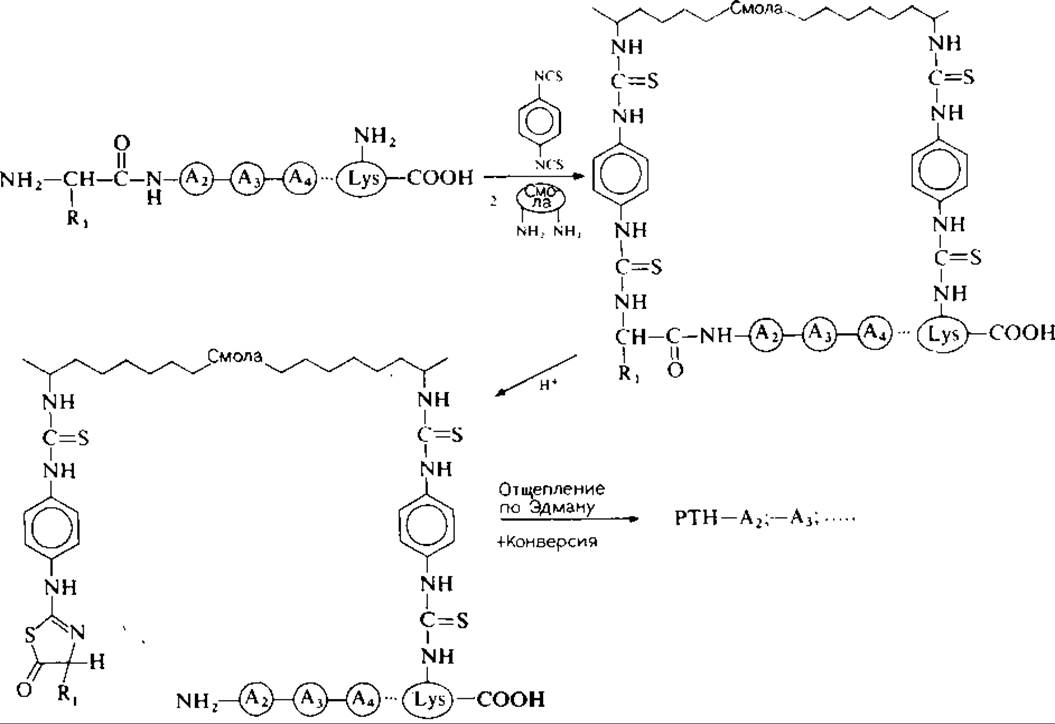
FIG. 12.3. Coupling of peptides to amino-containing supports; activation of peptide α- and ε-amino groups with p-phenylene diisothiocyanate.
2. N-terminal Amino Acids and lysine residues remain covalently bound to the supports after Cleavage from the peptide chain, and thus cannot be identified. However, in the case of incomplete coupling of N-terminal amino acids to the resin (glass), small amounts of PTH-derivatives of N-terminal Amino acids are detected among the cleavage products. Usually, after coupling the peptide to the support, methyl isothiocyanate (MITC) is used to block the remaining free amino groups of the resin (glass). In this case, the methylthiohydantoin (MTH) of the first amino acid is formed [28]. We replaced MITC with PITC; therefore, the N-terminal amino acid can be determined as a conventional PTH-derivative. In macro-scale analysis, this treatment does not affect cleavage yields, provided that distilled PITC was used.
3. The DITC method is inapplicable to Peptides with a C-terminal Arg; therefore, the Arg residue is converted to Orn by Hydrazinolysis [28, 45]. However, hydrazinolysis often causes cleavage of internal peptide bonds, for example, at Asn residues, which complicates the interpretation of amino acid cleavage results. Therefore, the DITC method is not recommended for peptides containing a C-terminal Arg.
Coupling Procedure. Condensation with aminopolystyrene or amino-functionalized glass supports is carried out at pH 9.5 According to the procedure described in [28, 59] or a modified procedure [30, 55, 61].
Support capacity: 1–3 nmol peptide/mg polymer or 1 nmol/mg glass.
10–100 nmol of desalted peptide is transferred to a glass tube (size 5x130 mm) and dried under vacuum (oil pump), preferably in a concentrator (Savant) or a desiccator; the peptide can also be lyophilized. Dissolve the peptide under nitrogen in 50 µl of coupling buffer (Section 12.2.5). Check the pH (>9.0) and solubility of the peptide. Take an aliquot (2–5 µl) for TLC monitoring (Section 12.4.5.1). Add 1.0 mg of DITC (5 µmol) in 100 µl of DMF, stir under nitrogen for 30 min at 50 °C. The yellowed solution should be free of precipitate.
30–50 mg of aminopolystyrene (or 100 mg of aminopropyl glass) is washed with DMF and allowed to swell in 200 µl of DMF for 15 min at room Temperature. The support is then added in two portions to the peptide previously activated with DITC. Stir the mixture under nitrogen for 60 min at room temperature. To block excess amino groups of the support, add 100 µl of FITC solution and 100 µl of buffer (Section 12.2.6), stir under nitrogen for 60 min at 30 °C, and centrifuge. The supernatant is checked for the presence of the starting peptide (Section 12.4.5.2). Wash the support with methanol (3 times with 8 ml), centrifuge, and dry under vacuum. When using aminopolystyrene, it is mixed with 900 mg of glass beads (Section 12.2.3); this mixed support is then packed into a Column.
Last update: 06/08/2026
Editorial and Educational Adaptation: This material has been compiled based on the primary/original source text. The project team performed an editorial review, corrected technical inaccuracies, structured sections, and adapted the content for an educational format.
What was processed:
- elimination of formatting defects (OCR errors, structural breaks, corrupted characters);
- editorial organization of content;
- standardization of terminology in accordance with academic sources;
- verification of factual statements against the original source text.
All mentions of the author, publication year, and origin of the primary text have been preserved in accordance with the source.