Vertebrate Zoology - V. M. Konstantinov 2011
Chordates
Terrestrial, or Tetrapod, Vertebrates — Vertebrates with Embryonic Membranes
Class Birds — Subclass Fan-tailed Birds, or True Birds — Superorder Penguins
The superorder Penguins is a small (about 15 species) and highly specialized group of marine birds, well-differentiated from other Divisions of the Class. Penguins likely emerged no later than the mid-Paleogene–Neogene. In the fossil record, about 32 species are known from Eocene deposits, with the most ancient ones found in the deposits of New Zealand, Australia, and Argentina.
The superorder includes a single order, Sphenisciformes, with the sole family Spheniscidae.
These birds are flightless, as their forelimbs are modified into flippers used for swimming and propulsion in Water. On land, they walk slowly, maintaining an upright posture. When moving across ice, adults lie on their bellies and slide, pushing off with all four limbs. Due to the critical role of the forelimbs in swimming, the sternal keel is well developed, and the pectoral musculature accounts for about 1/4 of the bird's body mass.
A primitive skeletal feature is the incomplete fusion of the distal bones forming the tarsometatarsus. Along with this, the legs are set far back, which dictates the upright posture when walking on land. This body position is also supported by a short, stiff tail, which the bird uses for balance in a standing position.
The plumage is peculiar. There are no apteria. The feather shafts are broadened and flattened. The barbs are poorly developed, and the feathers somewhat resemble scales. They molt once a year, with new feathers growing underneath the old ones and effectively pushing them out. They molt on land and do not feed during this period.
Penguins are monogamous; pairs in most species probably remain together for life. When nesting, birds of almost all species form large colonies numbering in the thousands, and sometimes hundreds of thousands, of pairs. They nest on flat, usually rocky shores, and more rarely (e.g., the emperor penguin) on ice. They build primitive nests On the surface of shoals, lining them with small pebbles, in rock crevices, in burrows, or they do not build nests at all. The clutch contains 1–2, rarely three eggs. Incubation is performed in turns by the male and female, more rarely solely by the male. The non-incubating parent goes to sea for 1–3 weeks to forage. After such a prolonged absence, the partners switch roles: the one that previously foraged begins incubation, while the other goes to sea in search of food.
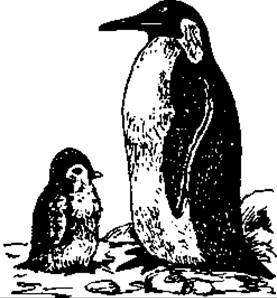
Fig. 143. King penguin (Aptenodytes patagonicuś) with a chick
Many species have a Skin fold on the abdomen that forms a kind of pouch, which the incubating bird uses to cover the eggs (usually one) during incubation. Often the egg lies not in the nest, but on the webbing of the bird's feet.
Penguins are distributed in the Southern Hemisphere, mainly along the coast of Antarctica and adjacent islands. Further north, they reach the southern coasts of Australia, Africa, and South America. One species nests near the equator on the Galapagos Islands. Outside the breeding season, they stay in the open sea, usually well north of the breeding areas.
The emperor penguin (Aptenodytes forsteri) is the largest species: its height is 110–120 cm, and its body mass reaches up to 45 kg. It nests on the ice near the coast of the Antarctic continent and, unlike other species, during the winter. It does not build nests and holds the egg on The surface of its feet, covered by the skin fold of the pouch.
Close to the described species is the king penguin (A. patagonicuś, Fig. 143). It is smaller in size (body length 91–96 cm) and nests further north, i.e., in warmer latitudes, such as on the islands of South Georgia and Kerguelen. It lays a single egg in summer (in December) on stony ground. The laid egg is then placed on the feet and covered by the fold of the abdominal pouch. Both parents incubate in turns. Incubation lasts about two months.
The Adélie penguin (Pygoscelis adeliae) is the most abundant and widespread species. It is found not only along the coast of Antarctica but also on the South Shetland, South Orkney, and South Sandwich (Hawaiian) Islands, and others. It nests on firm, snow-free ground, making a shallow depression that it lines with pebbles. The clutch usually contains two eggs. Incubation lasts a little over a month.
The distinctive macaroni penguin (Eudyptes chrysolophus) features a characteristic tuft of golden feathers located above the eyes like crests. Its body length is 65–75 cm. It is distributed in the southern PARTS OF THE Atlantic and Indian Oceans and in sub-Antarctic latitudes. It lays two eggs in a primitive nest on land.
Along the southern and southwestern shores of Africa, the African penguin (Spheniscus demersus) is found. Finally, there is one penguin species that inhabits the tropics — the Galapagos penguin (S. mendiculus), one of the smallest species, with a body length barely reaching 50 cm. It nests in rock crevices, laying two eggs. Penguins have no commercial value.
Last update: 13/08/2026
Editorial and Educational Adaptation: This material has been compiled based on the primary/original source text. The project team performed an editorial review, corrected technical inaccuracies, structured sections, and adapted the content for an educational format.
What was processed:
- elimination of formatting defects (OCR errors, structural breaks, corrupted characters);
- editorial organization of content;
- standardization of terminology in accordance with academic sources;
- verification of factual statements against the original source text.
All mentions of the author, publication year, and origin of the primary text have been preserved in accordance with the source.