Vertebrate Zoology - V. M. Konstantinov 2011
Chordates
Gnathostomes
Class Cartilaginous Fishes - Subclass Elasmobranchii - Superorder Rays
Rays and skates are cartilaginous fish with a dorsoventrally flattened body and highly developed pectoral fins (Fig. 35). Due to this body shape, the five pairs of gill slits are located on the ventral side. Spiracles are better developed than in sharks, and the respiratory Water flow enters through these openings. Skates and rays have adapted to a sluggish, bottom-dwelling lifestyle. The caudal fin—a crucial organ for forward propulsion—is rather weakly developed in them. They feed mainly on slow-moving benthic animals such as Mollusks and crustaceans. Their Teeth are usually blunt, adapted for crushing mollusk shells and the chitinous exoskeletons of Arthropods.
Class="center">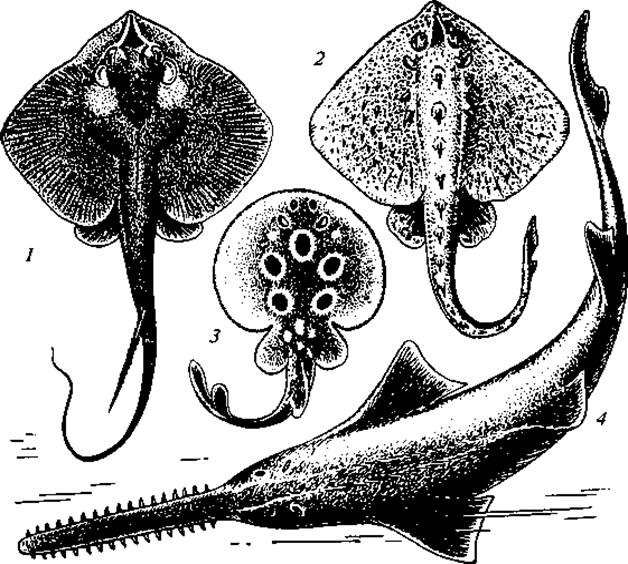
Fig. 35. Types of rays and skates:
1 — stingray; 2 — thorny skate; 3 — marbled electric ray; 4 — sawshark
Within the order Pristiformes, the family Pristidae (sawfishes) provides an example of convergent evolution with the sawsharks described earlier. Their bodies are flattened, pectoral fins are fused with the HEAD, and gill slits open on the underside of the body. The snout is elongated into a flattened blade armed along the edges with 16 to 32 teeth on each side (depending on the species). These large fish, reaching lengths of up to 4 — 5 m, inhabit the tropical and subtropical waters of all oceans. They feed on benthos and schooling bottom-dwelling fish, which they first stun with blows from their saw-like snout. They are ovoviviparous.
The order Rajiformes (skates) comprises numerous species (up to 100 species across three families) featuring a wide, flattened body typical of rays and skates, along with a long, thin tail bearing a barely noticeable fin. They are typical bottom dwellers found in temperate and northern seas, and less commonly in tropical ones.
Typical species include the thornback ray (Raja clavata), which inhabits shallow Atlantic waters and is fished in our region of the Black Sea for oil production; the starry skate (Raja radiata), which populates the waters of the North Atlantic and is common in the Barents Sea, residing at depths of up to 900 m.
Representatives of the order Dasyatiformes (stingrays) are distinguished by rounded fins that fuse ahead of the snout. A serrated venomous spine is located on the upper surface at the Base of the long tail. When defending itself, the ray delivers a powerful strike with this spine. Stingrays are distributed in temperate and southern seas. In the Azov and Black Seas, for example, the common stingray (Dasyatis pastinaca) is found. The family Mobulidae (manta rays and devil rays) includes the largest living rays. The largest of these (up to 6 m across), the giant oceanic manta ray (Manta birostris), occurs in the tropical waters of all oceans and is frequently seen swimming near the surface or leaping out of the water.
The order Torpediniformes (electric rays) is characterized by a rounded body shape without a rostrum and a relatively short tail with a well-developed fin. The Skin is smooth. Electric Organs, situated between the pectoral fins and the head, are capable of generating strong electric discharges (up to 70 V) capable of stunning animals much larger than the rays themselves. They inhabit the tropical, subtropical, and temperate waters of the oceans, such as the marbled electric ray (Torpedo marmorata).
Subclass Holocephali (chimaeras)
Holocephali are a small and well-differentiated group of cartilaginous fish distinct from elasmobranchs, combining primitive features with traits of narrow specialization arising from their ADAPTATION TO A deep-water lifestyle.
Most representatives possess an elongated, spindle-shaped body that tapers toward the tail. A rostrum is not developed in all species. The skin is naked, almost entirely devoid of scales. The lateral line is prominent, appearing as an open groove.
External gill openings are covered by a skin fold, with only a single external slit visible leading to the chamber into which the gill openings empty. Spiracles are absent.
The Axial Skeleton is primitive, consisting mainly of a notochord. The cranium is autostylic: the palatoquadrate Cartilage fuses with the braincase. Teeth are few in number and plate-like. The digestive tract is poorly differentiated.
Fertilization is internal. Chimaeras typically lay two eggs enclosed in a thick, complex capsule.
Distribution and ecology. The small number of extant species (about 30) is grouped into a single order and three families. They are distributed in the seas of the Atlantic, Indian, and Pacific Oceans in both the Northern and Southern Hemispheres.
Most chimaera species inhabit great depths (1,000 m or more) and feed on benthic invertebrates. The population size of all species is small. They have no commercial value. Off the Murman coast, the rabbit fish, or king herring (Chimaera monstrosa), is found; growing to about 1.5 m in length, it ranges from the coasts of Iceland and the Barents Sea down to the Mediterranean Sea.
Last update: 13/08/2026
Editorial and Educational Adaptation: This material has been compiled based on the primary/original source text. The project team performed an editorial review, corrected technical inaccuracies, structured sections, and adapted the content for an educational format.
What was processed:
- elimination of formatting defects (OCR errors, structural breaks, corrupted characters);
- editorial organization of content;
- standardization of terminology in accordance with academic sources;
- verification of factual statements against the original source text.
All mentions of the author, publication year, and origin of the primary text have been preserved in accordance with the source.