Molecular Biology: Protein Structure and Functions - Stepanov V.M. 2005
G proteins
Transducin
Transducin is a much more complex G protein involved in the transmission of the light signal and, crucially, in its massive Amplification. The Mechanism of its action can be outlined as follows (Fig. 12.3). Upon capturing a photon, a rhodopsin molecule enters an activated state and forms a complex with transducin, a G protein bound to a GDP molecule. The formation of the activated rhodopsin • transducin complex accelerates the exchange of the bound GDP for GTP. The resulting activated rhodopsin • transducin • GTP complex then dissociates, releasing activated rhodopsin, which can interact with another transducin molecule and similarly convert it into the active state through the exchange of GDP for GTP. This constitutes The First stage of signal amplification: during its lifespan, a single activated rhodopsin molecule manages to interact with several hundred transducin molecules, converting them into their active form, the transducin • GTP complex.
Class="center">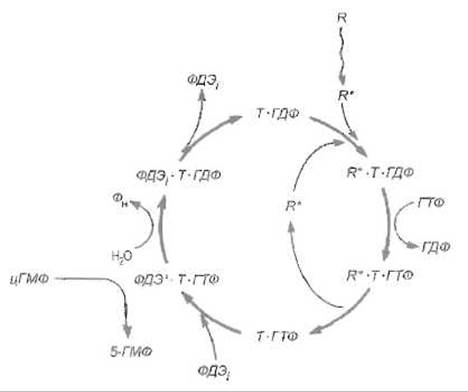
Fig. 12.3. Light signal amplification cycle involving the G protein transducin.
Upon absorbing a light quantum, rhodopsin R transitions into the activated state R* and binds to the T • GDP complex. Within the ternary complex R* • T • GDP, guanosine diphosphate is rapidly exchanged for GTP. Having fulfilled its function while remaining activated, rhodopsin can then re-form a complex with another transducin molecule, thereby amplifying the signal approximately fivefold. Having altered its conformation through complexation with GTP, transducin acquires The ability to interact with the inactive form of phosphodiesterase (PDEi). As a result, the latter is activated (PDE*), and the ternary complex transducin • GTP • activated phosphodiesterase (T • GTP • PDE*) acts as an efficient catalyst for the Hydrolysis of cyclic GMP until intramolecular hydrolysis of GTP takes place within it. During this time, it manages to hydrolyze an average of about 1000 cGMP molecules. Following GTP hydrolysis, transducin loses its ability to bind and activate phosphodiesterase. The latter reverts to its inactive state, and the T • GDP complex returns to the cycle.
Released following the dissociation of rhodopsin, GTP-activated transducin forms a complex with the inactive form of cyclic guanosine monophosphate phosphodiesterase (cGMP), thereby activating this enzyme, which then begins to efficiently hydrolyze cGMP. The action of the phosphodiesterase - transducin - GTP enzyme complex continues until the bound GTP undergoes hydrolysis, which is catalyzed by transducin itself.
Following this, phosphodiesterase dissociates and loses its activity, the accumulation of GMP ceases, and the transducin-GDP complex becomes ready for a new cycle of light signal amplification through binding to light-activated rhodopsin. The transducin action scheme outlined above is simplified. In reality, transducin is a protein composed of three distinct subunits. One of them, Tα (39 kDa), binds GTP and GDP and catalyzes GTP hydrolysis. It contains a Structure homologous to the c-H-ras protein. Another transducin subunit, Tβ (35 kDa), is very similar to the Gi and Gs subunits of the adenylate cyclase system (see below) and represents a polypeptide chain built from four tandemly repeating regions of similar Primary Structure, each about 86 amino acid residues long. This subunit is tightly bound to the third, the γ-subunit (8 kDa). The Formation of the α—β—γ complex between transducin and activated rhodopsin accelerates the GDP-for-GTP exchange and leads to the dissociation of the β- and γ-subunits, after which the liberated Tα-GTP complex activates cGMP phosphodiesterase.
The operation of this system, consisting of three regulated Proteins, results in the absorption of a single photon by a rhodopsin molecule triggering The breakdown of approximately 500,000 cyclic guanosine monophosphate molecules; that is, the signal amplification factor for this system is 5∙105. It is also significant that the inclusion of the G protein transducin in the system ensures not only signal amplification but also The regulation of its duration.
Last update: 13/08/2026
Editorial and Educational Adaptation: This material has been compiled based on the primary/original source text. The project team performed an editorial review, corrected technical inaccuracies, structured sections, and adapted the content for an educational format.
What was processed:
- elimination of formatting defects (OCR errors, structural breaks, corrupted characters);
- editorial organization of content;
- standardization of terminology in accordance with academic sources;
- verification of factual statements against the original source text.
All mentions of the author, publication year, and origin of the primary text have been preserved in accordance with the source.