GENERAL MICROBIOLOGY - T.P. Pyrog - 2004
14. TYPES OF FERMENTATION
14.3. LACTIC ACID FERMENTATION AND THE FAMILY LACTOBACILLACEAE
14.3.2. Homofermentative lactic acid fermentation
Homofermentative lactic acid Bacteria produce exclusively lactic acid (accounting for at least 90% of all Fermentation products). Glucose is catabolized via The Glycolytic Pathway. Hydrogen released during the dehydrogenation of glyceraldehyde-3-phosphate as NADH is transferred to Pyruvate (Fig. 14.3). In the presence of Lactate dehydrogenase, pyruvate is reduced to lactate. Only a minor fraction of pyruvate undergoes decarboxylation to form acetic acid, ethanol, CO2, and acetoin. Homofermentative Lactic acid fermentation is carried out by streptococci, and among lactobacilli, by Lactobacillus lactis, L. bulgaricus, L. delbruckii, and L. acidophilus.
Class="center">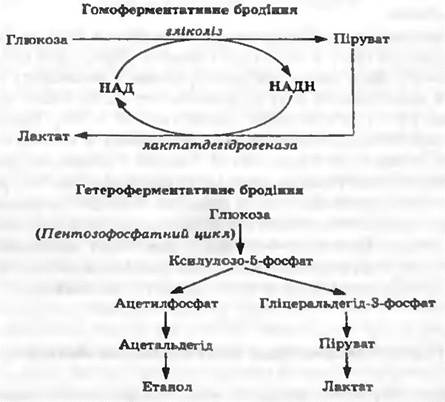
Fig. 14.3. Lactic acid fermentation
Last update: 12/08/2026
Editorial and Educational Adaptation: This material has been compiled based on the primary/original source text. The project team performed an editorial review, corrected technical inaccuracies, structured sections, and adapted the content for an educational format.
What was processed:
- elimination of formatting defects (OCR errors, structural breaks, corrupted characters);
- editorial organization of content;
- standardization of terminology in accordance with academic sources;
- verification of factual statements against the original source text.
All mentions of the author, publication year, and origin of the primary text have been preserved in accordance with the source.