GENERAL MICROBIOLOGY - T.P. Pirog - 2004
3. MICROBIAL MORPHOLOGY
3.3. YEASTS
The term "Yeast" has no taxonomic significance. This group of microorganisms includes microscopic unicellular Fungi that reproduce primarily by budding or fission. This definition is not entirely precise, as certain yeast species are capable of forming mycelium during a specific developmental phase, while some microscopic filamentous fungi grow in a yeast-like form under certain cultivation conditions. However, their predominant existence as unicellular forms makes it appropriate to consider Yeasts as a distinct group of eukaryotic microorganisms.
Yeast Cells vary greatly in shape (Fig. 3.5): spherical, oval (Trichosporon), egg-shaped (Candida), cylindrical (Endomyces), triangular (Trigonopsis), lemon-shaped (Nadsonia), pear-shaped (Schizoblastosporion), arrow-shaped (Brettanomyces), and sickle-shaped (Selenotila).
For some yeasts, Cell shape is so characteristic that it can be used for taxonomic identification of their genus (for instance, Trigonopsis cells are triangular). In Representatives of the genus Candida, conversely, cell Morphology is not constant; it varies depending on the medium composition and cultivation conditions, and therefore cannot be used as a taxonomic criterion.
Yeast cell dimensions also vary within a wide range, in µm: the diameter of the smallest cells is 1.5–2.0, length is 3–5; the diameter of large cells is 8–10, their length is 11–18; and elongated cells can reach a length of 20–25.
Yeasts reproduce by asexual (budding, fission, asexual spores) and sexual means (see table). The most common method of asexual reproduction in yeasts is budding (see Fig. 3.4). A bud forms on The Cell surface, grows to the size of the mother cell, and detaches from it, leaving a scar or cicatrix. A single mother cell may form not just one, but several buds. This type of budding is referred to as multipolar or multiple budding.
Class="center">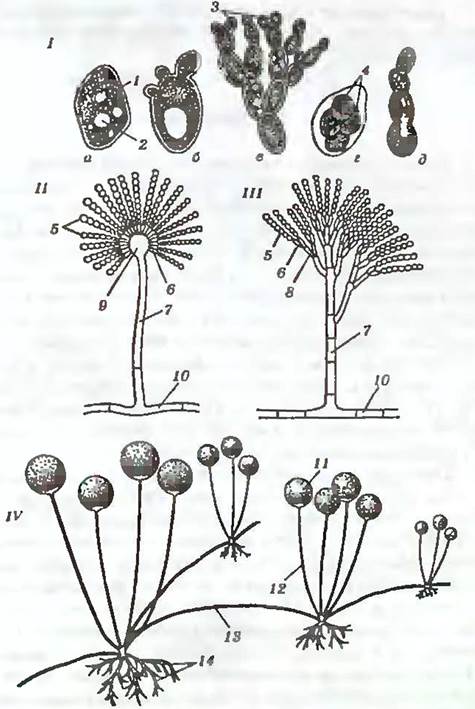
Fig. 3.4. Morphology of microscopic fungi:
I — yeasts; II — Aspergillus; III — Penicillium; IV — Rhizopus: a — resting cell; b, c — cells during budding; d — ascospores; e — formation of a new individual; 1 — Nucleus; 2 — vacuole; 3 — buds; 4 — ascospores; 5 — conidia; 6 — sterigmata; 7 — conidiophore; 8 — metulae; 9 — club-shaped Swelling of the conidiophore; 10 — vegetative hypha; 11 — sporangium; 12 — sporangiophore; 13 — stolon; 14 — rhizoids
The Organs of Sexual reproduction in yeasts are spores, which can be endogenous or exogenous. Ascospores are endogenous (see Fig. 3.4), whereas sporidia are exogenous.
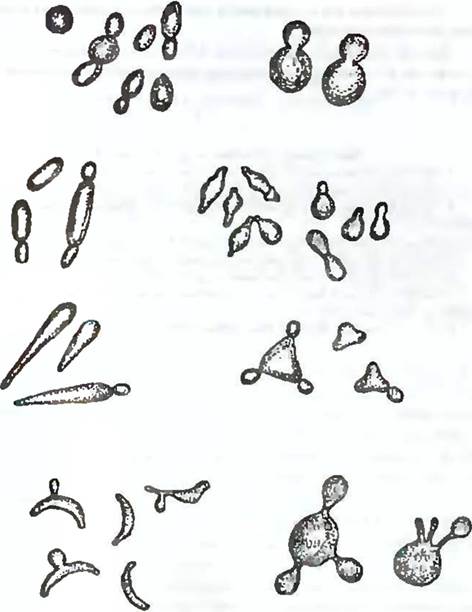
Fig. 3.5. Yeast cell shapes
Depending on the presence and type of sexual process, yeasts are classified into three fungal classes:
Ascomycetes — produce asci containing endogenous sexual spores;
Basidiomycetes — produce basidia-like sporophores with exogenous sexual spores;
Deuteromycetes — lack a sexual process, producing only asexual spores.
More comprehensive data on Cell Structure, fungal and yeast reproduction, their modern systematics, and practical significance are provided in chapters 8 and 9.
Last update: 12/08/2026
Editorial and Educational Adaptation: This material has been compiled based on the primary/original source text. The project team performed an editorial review, corrected technical inaccuracies, structured sections, and adapted the content for an educational format.
What was processed:
- elimination of formatting defects (OCR errors, structural breaks, corrupted characters);
- editorial organization of content;
- standardization of terminology in accordance with academic sources;
- verification of factual statements against the original source text.
All mentions of the author, publication year, and origin of the primary text have been preserved in accordance with the source.