Fundamentals of Molecular Biology - V. I. Rezyapkin 2009
Mobile Genetic Elements
Mobile Genetic Elements in Prokaryotes
Mobile Genetic Elements (MGEs) are specific DNA sequences capable of moving within The Genome of living organisms. They have been found in virtually all organisms studied to date. Currently, several types of MGEs are known, each differing in their genomic Organization and cellular Functions.
Several types of MGEs have been identified in prokaryotes, including IS elements, Transposons, Plasmids, and certain Bacteriophages. Let us examine them in greater detail.
IS elements (insertion sequences)
IS elements, also known as insertion sequences, typically consist of 700 - 1500 Base Pairs (Fig. 10.1). Their termini feature inverted repeats, usually 10-40 base pairs in length, which are essential for mobility. An IS element contains one or more genes responsible for its transposition throughout the genome. The product of these genes is transposase, an enzyme that facilitates the movement of the IS element. Transposition of IS elements can occur via two distinct mechanisms. In the first mechanism, the IS element undergoes Replication, leaving one copy at the original site while the second copy inserts into a new DNA locus (Fig. 10.2). This integration is also associated with the duplication of a target site of a characteristic length (typically 5-10 base pairs) specific to each element (Fig. 10.2). Generally, IS elements can integrate into various Regions of the bacterial genome, although certain DNA sequences may be preferred over others. The second mechanism involves the excision of the IS element followed by its direct insertion into another genomic site.
Class="center">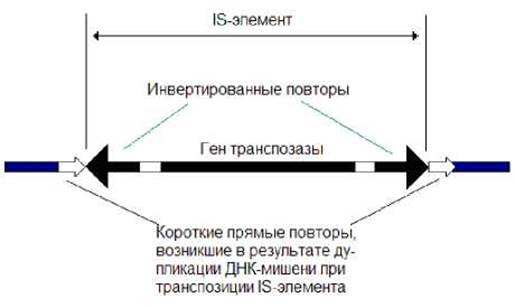
Fig. 10.1. IS element

Fig. 10.2. Scheme of IS element transposition.
During transposition, IS elements may integrate into the regulatory or coding regions of a Gene, thereby inactivating it or disrupting its normal regulation. Furthermore, IS elements can influence the expression of neighboring genes due to the presence of promoters within their sequence that affect the initiation of bacterial METABOLISM/31.html">Transcription. In addition, IS elements can increase the frequency of inversions and deletions in adjacent genomic regions.
IS elements are capable of mediating translocations. When located in close proximity, two IS elements can flank and mobilize intervening host DNA sequences.
Last update: 12/08/2026
Editorial and Educational Adaptation: This material has been compiled based on the primary/original source text. The project team performed an editorial review, corrected technical inaccuracies, structured sections, and adapted the content for an educational format.
What was processed:
- elimination of formatting defects (OCR errors, structural breaks, corrupted characters);
- editorial organization of content;
- standardization of terminology in accordance with academic sources;
- verification of factual statements against the original source text.
All mentions of the author, publication year, and origin of the primary text have been preserved in accordance with the source.