Molecular Biotechnology. Principles and Applications - Glick B., Pasternak J. 2002
Molecular Biotechnology of Microbiological Systems
Gene Therapy
Correction of Genetic Defects Using Oligonucleotides
Many genetic defects can be corrected by replacing the disease-causing nucleotide pair in a mutant Gene with the "correct" pair. In one approach, a 68-mer chimeric DNA-RNA oligonucleotide was used for this purpose; it forms a double-loop hairpin Structure and contains a 2'-O-methylated ribose residue (Fig. 21.16). The choice of such an unusual oligonucleotide is based on the following experimental findings: 1) RNA-DNA heteroduplexes form Base Pairs with homologous nucleic acid sequences more readily than double-stranded DNAs do; 2) the non-pairing hairpin loops protect the oligonucleotide from exonucleases; and 3) 2'-O-methylation prevents degradation of the molecule by RNase H. The arrangement of NUCLEOTIDES within the chimeric molecule is also crucial: ten ribonucleotides flank five central deoxyribonucleotides, a segment that shares the same sequence as the target and contains the normal nucleotide pair.
The feasibility of correcting Mutations using chimeric oligonucleotides has been investigated using both plasmid-borne cDNA and chromosomal DNA. In both cases, the mutant site was replaced by the normal sequence with high frequency. However, further research is required for chimeric oligonucleotides to become effective therapeutic agents. When a mutation within an intron is recognized by the RNA Processing machinery as an authentic splice site, a portion of the intron is retained in the processed mRNA (Fig. 21.17A). This results in a reading frame shift and The production of a truncated protein. Consequently, the level of the normal protein drops, which can lead to disease. It is reasonable to hypothesize that if an antisense oligonucleotide complementary to the mutant intron hybridizes with it, aberrant splicing will be blocked, thereby increasing the likelihood of splicing at the normal site. This hypothesis was tested using the β-globin gene containing a mutation In the second intron (Fig. 21.17B), which causes one of the forms of β-thalassemia, an inherited Blood disorder characterized by the destruction of red Blood Cells (anemia). Cells homozygous for the mutant gene (IVS2-654) were treated with a phosphorothioate-linked antisense 2'-O-methyl oligonucleotide complementary to the mutant splice site. As a result, the yield of normal β-globin chains increased by 50%. Further studies will determine whether this approach is sufficiently effective for treating thalassemia and other conditions caused by similar mutations.
Class="center">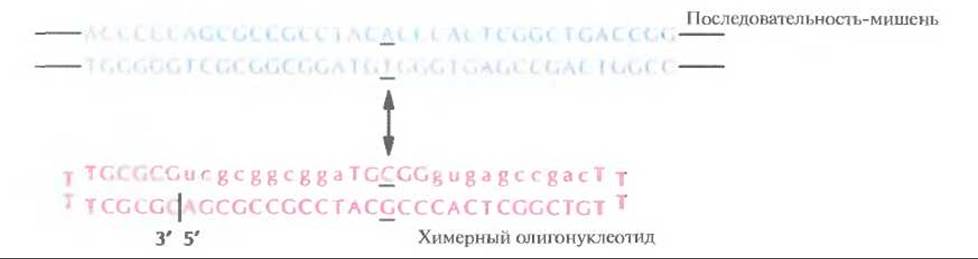
Fig. 21.16. Correction of a single-nucleotide genetic defect using a chimeric oligonucleotide. The arrow points to the mutant site in the target sequence and the normal base pair in the chimeric oligonucleotide. Corresponding nucleotides are underlined. Uppercase letters denote deoxyribonucleotides, and lowercase letters denote ribonucleotides. Bold letters indicate nucleotides forming the hairpin loops. The vertical bar marks the 3'- and 5'-ends of the chimeric oligonucleotide. (Modified from Yoon et al., Proc. Natl. Acad. Sci. USA 93: 2071–2076, 1996.)

Fig. 21.17. Correction of an aberrant splicing defect using an antisense oligonucleotide. A. Outcome of a mutation leading to aberrant splicing. Designations: numbers indicate exons, A is the first intron, B is the second intron containing the mutation (red circle) that divides it into two parts (B1 and B2). Dashed lines enclose RNA segments excised during processing. Two splicing pathways are possible: pathway (a) yields functional mRNA, whereas pathway (b) yields an RNA containing a portion of the second intron (B2). B. An antisense oligonucleotide (AS) binding to the mutant splice site prevents its recognition during processing, resulting in the production of functional mRNA exclusively.
Last update: 11/08/2026
Editorial and Educational Adaptation: This material has been compiled based on the primary/original source text. The project team performed an editorial review, corrected technical inaccuracies, structured sections, and adapted the content for an educational format.
What was processed:
- elimination of formatting defects (OCR errors, structural breaks, corrupted characters);
- editorial organization of content;
- standardization of terminology in accordance with academic sources;
- verification of factual statements against the original source text.
All mentions of the author, publication year, and origin of the primary text have been preserved in accordance with the source.