Medical Genetics - V. M. Zaporozhan 2005
Monogenic Disorders
Classification of Monogenic Disorders
The Classification proposed by N. P. Bochkov (2001) is based on three approaches: genetic, clinical, and pathogenetic.
The genetic classification takes into account the mode of inheritance.
Class="center">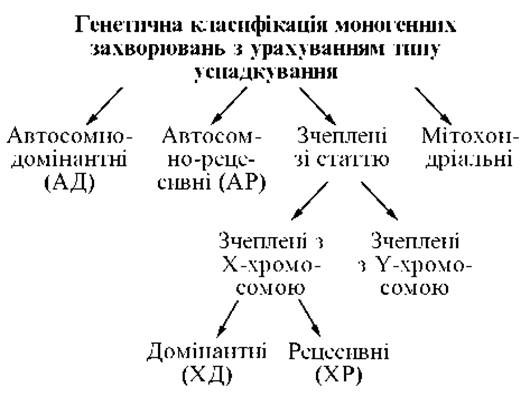
The pathogenetic classification comprises three groups of Monogenic Disorders depending on the primary pathogenetic mechanism involved.

The clinical classification is based on the affected organ or organ system. Accordingly, monogenic disorders are categorized into diseases of The Nervous system, neuromuscular system, Skin, eyes, Musculoskeletal System, Endocrine System, Blood, Cardiovascular system, psychiatric disorders, Urogenital System, gastrointestinal tract, Lungs, and others.
The clinical classification is somewhat conventional, as many diseases can affect multiple Organs and systems. For instance, cystic fibrosis may present with forms involving the Pancreas and gastrointestinal tract, or the lungs. Marfan Syndrome affects the Skeleton, cardiovascular system, and eyes. Nevertheless, this classification is practical and convenient for clinicians across various specialties.
Today, more sophisticated pathogenetic and clinical classifications have also been developed.
Since knowing the mode of inheritance is crucial for assessing the risk of having an affected child during Genetic Counseling, we will adopt the genetic classification for the subsequent presentation of material.
Last update: 11/08/2026
Editorial and Educational Adaptation: This material has been compiled based on the primary/original source text. The project team performed an editorial review, corrected technical inaccuracies, structured sections, and adapted the content for an educational format.
What was processed:
- elimination of formatting defects (OCR errors, structural breaks, corrupted characters);
- editorial organization of content;
- standardization of terminology in accordance with academic sources;
- verification of factual statements against the original source text.
All mentions of the author, publication year, and origin of the primary text have been preserved in accordance with the source.