Medical Genetics - V. M. Zaporozhan 2005
Etiology of Hereditary Diseases
Types of Mutations Caused by Changes in Chromosome Number and Structure
Mosaicism and Chimerism (Mixoploidy)
Mosaicism refers to the presence of two or more Cell clones with distinct genotypes within an Organism's Cells, having developed from a single zygote (i.e., sharing the same genetic origin).
Chromosomal mosaicism typically results from chromosome nondisjunction during mitosis in the embryo at Cytology/cytology/16.html">Early stages of embryonic development. Thus, mosaicism is a consequence of somatic Mutations.
Let us consider the formation scheme of mosaic Down syndrome as an example. A normal zygote carries two chromosome 21s (2n,21). Under normal mitosis, it gives rise to a normal cell clone. In the event of nondisjunction, cells with trisomy (21,21,21) and monosomy (21) are formed. Autosomal monosomies are lethal to cells, causing the monosomic cell to perish. As a result, two cell clones remain: normal (21,21) and trisomic (21,21,21). Mosaicism is observed in 1–2% of all Down syndrome cases.
Class="center">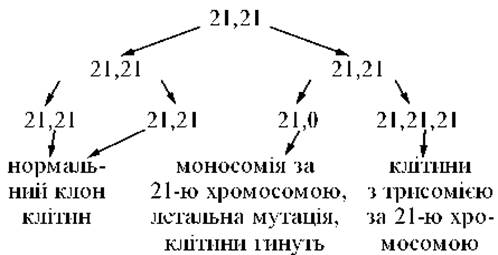
The later in embryonic development that mitotic disruption occurs, the fewer abnormal cells are produced and the milder the disease symptoms.
Gene mosaicism may also occur. It results from a somatic gene mutation. Phenotypic manifestations may include dominant autosomal mutations or X-linked recessive mutations in boys. Recessive autosomal Gene Mutations can only manifest in homozygotes.
A special type of mosaicism is Gonadal Mosaicism, which stems from a mutation during gonad formation. This leads to The Emergence of an entire clone of mutant Germ Cells in a phenotypically healthy individual. Gonadal mosaicism explains cases where phenotypically healthy parents give birth to multiple children with dominant Monogenic Disorders. An example is the pedigree of a French family (see Fig. 4.13). A healthy man, through two marriages with healthy women, fathered three children with Achondroplasia. Achondroplasia is an autosomal dominant disorder. The most plausible explanation for this phenomenon is the presence of gonadal mosaicism in the father, who harbors a high percentage of germ cells carrying the achondroplasia gene.
Gonadal mosaicism has also been proven in cases where healthy parents with normal genotypes have multiple children with Osteogenesis Imperfecta (an autosomal dominant disorder), hemophilia, and Duchenne muscular dystrophy (X-linked recessive disorders). Gonadal mosaicism should always be kept in mind when counseling families that have affected children with autosomal dominant and X-linked recessive disorders resulting from de novo mutations.
Chimerism is the presence within an organism of two or more cell clones with different genotypes originating from separate zygotes, meaning they have different genetic origins. The word chimera derives from the mythical Greek monster (the Chimera), which had the HEAD of a lion, the body of a goat, and the tail of a dragon. Two Types of chimeras are found in humans: true hermaphrodites with a 46,XX/46,XY karyotype and Blood group chimeras.
True hermaphrodites with a 46,XX/46,XY karyotype result from the Fertilization of two ova by two spermatozoa. Normally, this would form dizygotic twins; however, the two embryos fuse to form a chimeric organism. If the twins are of different sexes, a chimera with such a karyotype exhibits true Hermaphroditism (The Development of Gonads and Organs of both sexes).
Blood group chimeras result from the exchange of stem cells across the Placenta between two dizygotic twins. For instance, one twin has blood group A while the other has blood group B. Following the exchange, both acquire stem cells with Antigens A and B. However, one twin will predominantly have cells bearing antigen A, and the other with antigen B. Furthermore, in blood group chimeras, one population of stem cells may function at one time of life and the other at another, which can lead to a shifting blood group.
Last update: 11/08/2026
Editorial and Educational Adaptation: This material has been compiled based on the primary/original source text. The project team performed an editorial review, corrected technical inaccuracies, structured sections, and adapted the content for an educational format.
What was processed:
- elimination of formatting defects (OCR errors, structural breaks, corrupted characters);
- editorial organization of content;
- standardization of terminology in accordance with academic sources;
- verification of factual statements against the original source text.
All mentions of the author, publication year, and origin of the primary text have been preserved in accordance with the source.