Genetics - A. V. Syvolob 2008
Human Genetics
Quantitative and Multifactorial Human Traits
Twin and Adoption Studies
The significant dependence of multifactorial traits on external factors complicates their genetic analysis and the identification of the genes responsible for them. Even within a single family, it is sometimes difficult to determine whether a similarity in certain traits among relatives confirms the heritability of the trait or simply reflects identical living conditions. To distinguish between environmental and genotypic influences on phenotypic expression in Human Genetics, researchers use the Twin method and the adoption method.
The twin method is based on comparing the concordance of trait expression in twins. In humans, twins are born at a frequency of approximately 1 pair per 84 births (triplets occur at about 1 in 7,000). One-third of these are monozygotic or identical twins. They develop from blastomeres of a single fertilized egg that split during early Cleavage stages (most commonly at the two-Cell stage), giving rise to separate organisms. Consequently, monozygotic twins share identical genotypes. In contrast, dizygotic twins develop from two separate eggs that matured and were fertilized simultaneously. Genetically, they are no more similar than ordinary siblings born at different times.
When examining same-sex twin pairs, accurately establishing their zygosity type is essential. This is determined either by assessing phenotypic similarities in traits minimally influenced by environmental factors (such as various Blood Group Antigens, eye color, or The ability to taste PTC) or by using DNA fingerprinting. Traits that show matched expression in a twin pair are called concordant (or discordant if the trait is absent in one of the twins).
METABOLISM/18.html">The Influence of heredity on a trait's expression is calculated by comparing trait concordance—the percentage of twin pairs with identical manifestation of the trait in question—between monozygotic and dizygotic twins (Table 7.3). Naturally, since monozygotic twins share identical genotypes, any phenotypic differences between them must stem entirely from environmental influences during prenatal development and after birth. Meanwhile, trait concordance can be explained by both genetic identity and similar living conditions. In this context, cases where monozygotic twin pairs were separated in childhood and raised in distinct environments are particularly illuminating. Concordance in such pairs highlights the decisive role of the genotype in the expression of specific traits. Conversely, analyzing dizygotic twin pairs provides insight into how identical environmental conditions (including prenatal ones) affect trait development in individuals with different genotypes.
Class="center">Table 7.3. Concordance of certain human traits in monozygotic (MZ) and dizygotic (DZ) twins
|
Trait |
Concordance, % |
|
|
MZ |
DZ |
|
|
Blood group (ABO) |
100 |
46 |
|
Eye color |
99 |
28 |
|
Hair color |
89 |
22 |
|
Intellectual disability |
97 |
37 |
|
Elevated body weight at age 18-20 |
51,8 |
20,2 |
|
Elevated body weight at age over 45 |
53 |
27,4 |
|
72 |
15 |
|
|
Tuberculosis |
56 |
22 |
|
Cleft lip ("harelip") |
42 |
5 |
|
Measles |
98 |
94 |
|
46 |
14 |
|
|
Manic-depressive psychosis |
60 |
14 |
Quantitatively, THE CONTRIBUTION OF the genotype to The Development of a given trait is expressed as the heritability coefficient H, which in this case can be calculated using the formula
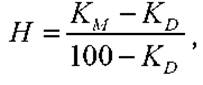
where Km is the concordance rate (in percent) for monozygotic twins, and Kd is that for dizygotic twins. If H = 1, the trait is entirely determined by the genotype, whereas H = 0 indicates complete environmental control. For example, the heritability coefficient for hair color is 0.86, pointing to a predominant genetic contribution to the trait, though a minor environmental influence (0.14) also exists. For excess body weight, the heritability coefficients are 0.4 (for ages 18-20) and 0.35 (for individuals over 45), indicating a greater IMPACT OF ENVIRONMENTAL factors, while the hereditary component still plays a substantial role.
Another approach to assessing the roles of genotype and environment in the development of multifactorial traits is the analysis of phenotypic expressions in adopted children—known as the adoption method. Adoptees and their adoptive families share completely unrelated genotypes yet live in similar environments. The adoption method is most powerful when used in conjunction with the twin method, yielding more objective insights into genetic influences on the development of Quantitative Traits.
Last update: 11/08/2026
Editorial and Educational Adaptation: This material has been compiled based on the primary/original source text. The project team performed an editorial review, corrected technical inaccuracies, structured sections, and adapted the content for an educational format.
What was processed:
- elimination of formatting defects (OCR errors, structural breaks, corrupted characters);
- editorial organization of content;
- standardization of terminology in accordance with academic sources;
- verification of factual statements against the original source text.
All mentions of the author, publication year, and origin of the primary text have been preserved in accordance with the source.