Genetics - A. V. Sivolob 2008
Gene Expression
Regulation of Gene Expression in Eukaryotes
Alternative Splicing
Pre-mRNA synthesized during METABOLISM/31.html">Transcription can undergo splicing and polyadenylation via various alternative pathways (Fig. 2.17): several exons at the beginning or within a Gene may be excised from the transcript, the latter can be truncated and polyadenylated through The Use of a polyA signal within one of the introns, and so on. As a result, diverse mRNA molecules are generated with different combinations of exons, which accordingly encode different Proteins. The average number of alternative mRNA isoforms is estimated to be 5.4 per human gene.
The multicomponent nature (and the necessity of cooperation among the components) of the spliceosome and the Cleavage/polyadenylation system allows for fine-tuning The production of specific mRNA types. This is achieved by altering the transcriptional activity of genes encoding various Components of the Processing machinery, changing component concentrations, or through their chemical modification.
A pivotal role in determining the splicing pathway belongs to splicing regulatory proteins. For instance, a regulator very often specifically binds to a certain nucleotide sequence within an exon and stimulates the recognition of adjacent intron boundaries (splice sites) on both sides. Naturally, in the absence of the regulator, such an exon will be excised along with its flanking introns. Conversely, the regulator can block the recognition of splice sites. Splicing regulators may also have binding sites within introns, affecting the efficiency of spliceosome assembly. Furthermore, the choice of the final mRNA product often depends on the alternative Selection of polyA signals mediated by splicing regulators, which may reside not only downstream of the final exon but also within introns.
Class="center">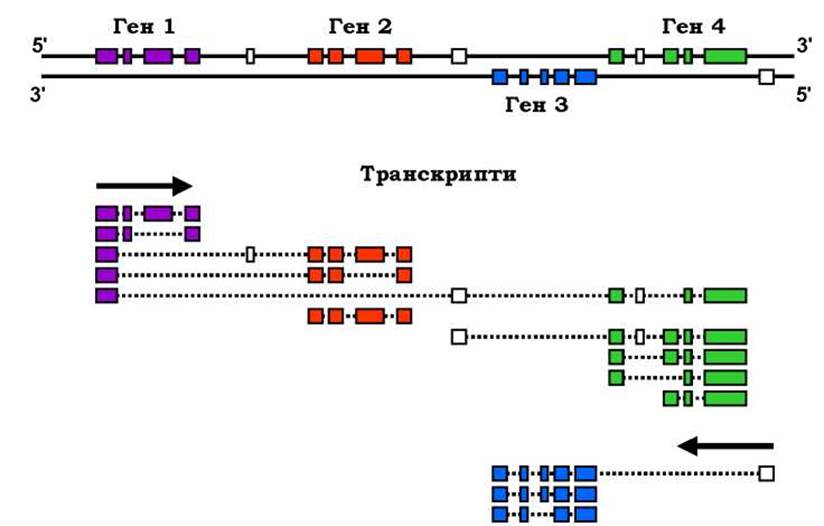
Fig. 2.17. Eukaryotic genomic region: four genes and their corresponding exons (rectangles) within the coding strands are shown. White rectangles are difficult to assign to a specific gene. Bottom: final transcripts synthesized in this region; arrows indicate the direction of transcription.
Along with splicing regulators, The rate of transcription is a crucial factor in regulating splicing: the lower the speed, the more time there is to "decipher" the signals—at high speed, the polymerase may "skip" over an exon or polyA signal. Meanwhile, transcription speed (the frequency of polymerase recruitment to the promoter) is determined at the initiation stage and controlled by transcription factors. Thus, to a large extent, the splicing pathway is already predetermined at the initiation stage. Moreover, splicing regulators can also be recruited to the promoter (and consequently to the RNA polymerase complex).
Eukaryotic genes also quite frequently exhibit trans-splicing: the joining of exons from different genes within a single mRNA. The basis for trans-splicing is the fact that many genes have not just one, but several alternative transcription start sites, including those located quite far from the gene and simultaneously serving as start sites for other genes (Fig. 2.17). As a result, transcription sometimes spans multiple genes (a situation somewhat reminiscent of the prokaryotic operons discussed above), and splicing occurs at the level of such "combined" primary transcripts.
Additionally, cases of trans-splicing have been described between pre-mRNAs that are products of different transcription units, sometimes located on different Chromosomes. In this case, the 5' and 3' ends of two pre-mRNAs contain what appears to be a "split" intron—the joining of the two ends within the spliceosome leads to the removal of this intron and the ligation of the terminal exons.
Last update: 11/08/2026
Editorial and Educational Adaptation: This material has been compiled based on the primary/original source text. The project team performed an editorial review, corrected technical inaccuracies, structured sections, and adapted the content for an educational format.
What was processed:
- elimination of formatting defects (OCR errors, structural breaks, corrupted characters);
- editorial organization of content;
- standardization of terminology in accordance with academic sources;
- verification of factual statements against the original source text.
All mentions of the author, publication year, and origin of the primary text have been preserved in accordance with the source.