Anatomy and Physiology of Children and Adolescents - M. R. Sapin 2007
Musculoskeletal System
Skull
Skull of the Newborn
In a newborn infant, layers of Connective Tissue lie between the Skull bones, particularly at the junctions where multiple bones meet. These areas are known as fontanelles (Fig. 25). A newborn has a total of six fontanelles: unpaired anterior and posterior fontanelles, and two paired ones—the sphenoidal and mastoid fontanelles. The largest is the anterior, or frontal, fontanelle, located at the junction of the frontal and both parietal bones. The posterior, or occipital, fontanelle is situated where the parietal bones meet the Occipital bone. The sphenoidal fontanelle is visible laterally at the junction of the Frontal bone, Parietal bone, and the greater wing of the Sphenoid bone. The mastoid fontanelle is located where the occipital bone, parietal bone, and the mastoid process of the Temporal bone converge. Thanks to these fontanelles, the newborn's skull is highly flexible, allowing its shape to change as the fetal HEAD passes through the mother's birth canal during delivery.
The fontanelles begin to ossify and close During the first months of an infant's life. The posterior (occipital) fontanelle closes by the second month, and the sphenoidal and mastoid fontanelles close by the 2nd to 3rd month. The anterior (frontal) fontanelle does not close until the second year of life. The formation of sutures between the skull bones is completed by 3 to 5 years of age.
Class="center">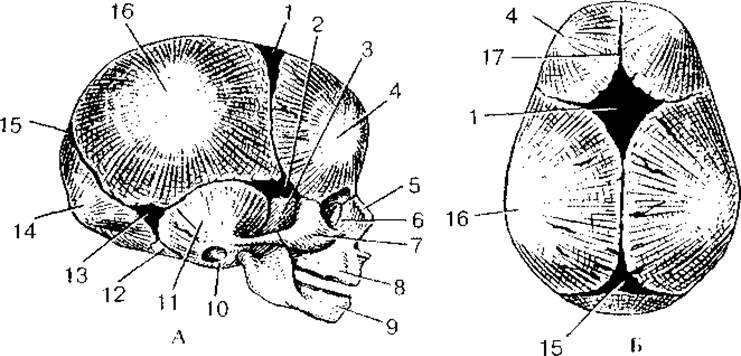
Fig. 25. Newborn skull. Lateral view (A) and superior view (B):
1 — anterior fontanelle; 2 — sphenoidal fontanelle; 3 — greater wing of sphenoid bone; 4 — frontal eminence; 5 — Nasal bone; 6 — Lacrimal bone; 7 — Zygomatic bone; 8 — Maxilla; 9 — Mandible; 10 — tympanic ring of temporal bone; 11 — squamous part of temporal bone; 12 — lateral part of occipital bone; 13 — mastoid fontanelle; 14 — occipital squama; 15 — posterior fontanelle; 16 — parietal eminence; 17 — frontal suture
Last update: 10/08/2026
Editorial and Educational Adaptation: This material has been compiled based on the primary/original source text. The project team performed an editorial review, corrected technical inaccuracies, structured sections, and adapted the content for an educational format.
What was processed:
- elimination of formatting defects (OCR errors, structural breaks, corrupted characters);
- editorial organization of content;
- standardization of terminology in accordance with academic sources;
- verification of factual statements against the original source text.
All mentions of the author, publication year, and origin of the primary text have been preserved in accordance with the source.