Military Hygiene and Hygiene in Emergency Situations - K.O. Pashka 2005
Fundamentals of organizing and conducting sanitary supervision and medical control over the nutrition of military personnel and the civilian population in the field.
Specifics of organizing and conducting sanitary and epidemiological expertise of food products contaminated with radioactive and toxic agents, as well as infected with bacteriological (biological) agents.
Sanitary and epidemiological expertise is mandatory for foodstuffs and Water contaminated with radioactive or toxic substances, or infected with bacteriological (biological) agents resulting from The Use of weapons of mass destruction (nuclear, chemical, or biological) or technological disasters. A prime example is the Chornobyl disaster, which caused radioactive contamination across vast areas, including edible greens (onions, parsley, sorrel, etc.) and water sources (lakes, rivers, wells, etc.).
Food contamination or infection control is carried out by order of the formation commander (HEAD of the regional state administration) to determine the type and level of contamination by radioactive substances (RS), toxic agents (TA), or infection by biological agents (BA).
Control Procedures should begin with gathering intelligence from the headquarters and directorates of relevant coordination commissions regarding the radiation, chemical, and biological situation to detect potential contamination or infection of food supplies within target (affected) areas.
Control may be preliminary, laboratory-based, or expert (sanitary and epidemiological expertise).
Preliminary control is conducted for initial (approximate) Assessment of the degree of food contamination or infection using specialized instruments: a radiometer-roentgenometer (DP-5V, DP-5M) or a radiometric laboratory, and chemical reconnaissance devices (VPHR, PHR-MV, MPHR) (Fig. 4.13 a, b, c, d). It is performed directly at the contamination (infection) sites or at special Processing sites by organic (attached) dosimetrist-chemists.
Class="center">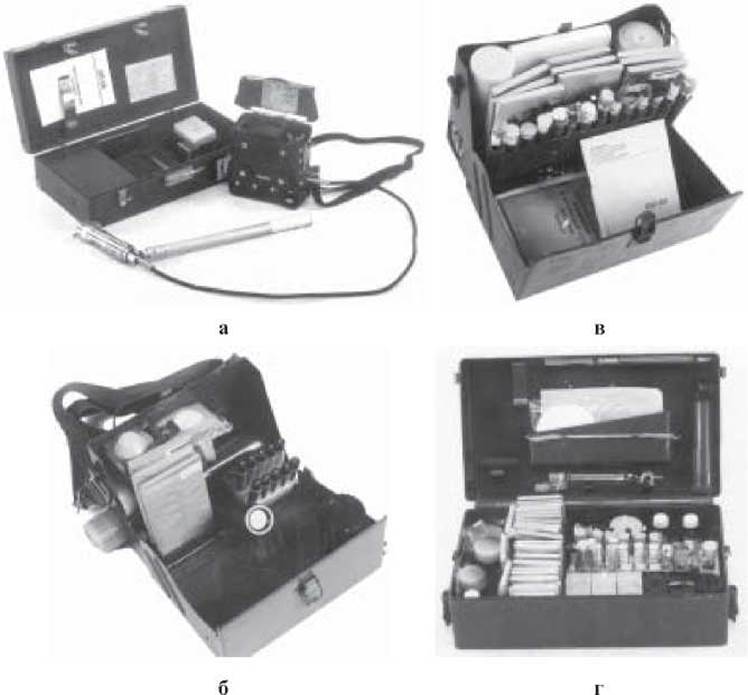
Fig. 4.13. Instruments for determining the degree of food contamination (infection):
a) DP-5V dose rate meter; b) VPHR; c) PHR-MV; d) MPHR
Its objectives are:
- sorting food stocks According to the degree and type of contamination (infection);
- dispatching contaminated (infected) food for special processing—decontamination, degassing, or disinfection;
- determining the degree of purification (sanitization) of food following decontamination and degassing.
Based on preliminary control data, an expert decides whether the food can be utilized or must be prohibited; in the latter case, samples are sent for laboratory control to determine the specific type and specific activity of contamination by toxic agents or radioactive substances using specialized mobile laboratories: the field medical chemical laboratory (FMCL) and the packaged radiometric laboratory (RLU-2). This is performed by sanitary and epidemiological surveillance (SES) specialists at food preparation and consumption sites, bakeries, food warehouses, etc.
The laboratory control process includes:
- receiving and registering food samples delivered for analysis;
- primary Sample preparation, specimen generation, and analysis to determine specific contamination by radioactive substances or toxic agents, as well as the type and degree of toxic agent presence;
- issuing a laboratory report.
Sanitary and epidemiological expertise is carried out by specialists from sanitary and epidemiological surveillance (SES) or sanitary and epidemiological laboratories (SEL), alongside chemical and veterinary services, in cases of food infection by biological agents, contamination with unknown types of toxic agents, or when it is necessary to identify the Qualitative and quantitative composition of radioactive isotopes. Sanitary and epidemiological expertise encompasses the full scope of preliminary and laboratory control procedures, as well as additional research to identify all potential poisons and pathogens that cannot be detected using field radiometric and chemical laboratory resources.
The findings of the sanitary and epidemiological expertise are documented in an official report signed by the expert and approved by the official who ordered the examination.
To ensure a reliable assessment of radioactive food contamination, strict adherence to sampling protocols is required. Samples are collected from the most heavily contaminated areas, identified using a radiometer-roentgenometer (DP-5V, DP-5M). For liquid samples placed in jars or loose products in polyethylene bags, the containers are hermetically sealed (jars with polyethylene or ground-Glass lids, bags by folding the top several times and tying with a cord). Each sample is labeled with its serial number, sample type, Location of collection, date, time of contamination (if known) and sampling, as well as the military rank (position), initials, and surname of the sampler.
Sampling of bakery products, fresh fruits, and vegetables is carried out individually from the top row or surface layer. Samples are placed in polyethylene bags with attached labels.
Food samples stored in multi-layered stacked bags are collected in a checkerboard pattern from the most suspect areas, inspecting at least 10 of the most suspicious bags in a given batch. Food samples can be extracted from bags using a metal probe directly through the surface layer beneath the burlap, or by cutting a U-shaped flap (20 × 10 × 20 cm) in the bag, folding it back, and scooping a sample up to 3 cm deep, weighing approximately 100 g (Fig. 4.14). From open boxes, sacks, or barrels, samples of loose products are collected from a surface layer 10–30 mm thick, and pasta or vermicelli samples from up to 10 cm deep.
Sampling of meat, fish, solid fats, etc., is performed by slicing off a 10 mm thick surface layer with a knife. Meat samples must weigh at least 100 g (Liver samples 100–150 g).
Samples of liquid or semi-liquid products are collected using a large pipette after thoroughly mixing the container contents. The sample volume must be at least 0.2 L.
Following sample collection and packaging, a sampling report is drawn up in duplicate; one copy, along with the samples, is dispatched to the laboratory.
In wartime, the concentration of nuclear explosion products (NEPs) in food and water is considered safe for an adult's health if consumed continuously for 30 days or more (excluding meat and milk from animals that ingested NEPs with fodder, and fish caught in water bodies containing NEPs, as these are not standardized due to significant variations in NEP concentrations in bones, intestines, and other Organs and Tissues): 1 day – 15∙106 Bq/kg, up to 10 days – 4∙106 Bq/kg, up to 30 days – 2∙106 Bq/kg, more than 30 days – 1∙106 Bq/kg; for milk: 1 day – 4∙106 Bq/kg, up to 10 days – 0.5∙106 Bq/kg, up to 30 days – 0.1∙106 Bq/kg.
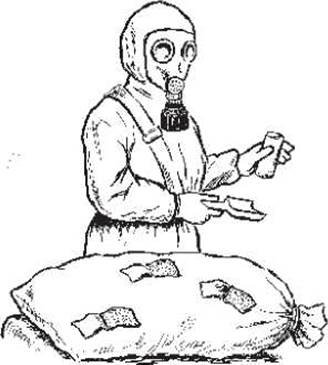
Fig. 4.14. Sampling of bulk products.
For children, the permissible concentrations in food and water are 5 times lower, and in milk – 10 times lower. These values apply to NEPs aged from 12 hours to 30 days.
Food sampling to determine contamination with toxic agents is carried out after signs of chemical agent (CA) contamination are detected at a food facility (warehouse, kitchen-dining room, field feeding point). A product sample is taken from the most heavily contaminated areas at a depth of 2-4 cm by cutting from the surface using scissors (a knife) and tweezers, or by scraping with a scoop. After crushing, the sample is poured into a CHP-MV glass container up to 2/3 of its capacity, and the lid is tightly screwed on. The marked end of a detector tube is connected to the outlet tube of the jar lid. The opposite end is connected to a pump, and a specified number of strokes are performed (according to the instructions). Afterward, the appearance of a corresponding color change in the detector tube, when compared with the standard on the tube cassette, makes it possible to identify the applied CA.
Food samples are taken for specific indication only if There is a clear suspicion of their contamination by biological (bacteriological) agents. They must be delivered to a laboratory equipped with appropriate specialists and equipment for indication no later than 1-1.5 hours after sampling. Indication is performed using rapid and accelerated Methods.
In all other cases, food samples are taken for the purpose of conducting a sanitary and epidemiological expertise to issue a Conclusion on their potential further use.
1. The purpose of sanitary supervision over the Nutrition of personnel of formations and the affected population. Its content.
2. Who organizes catering in an emergency zone?
3. Where and using what technical equipment is food prepared in emergency zones?
4. Name the hygienic requirements for a field feeding point.
5. Name the measures to prevent food poisoning among servicemen and the Procedure for investigating such cases.
6. What are the Specific features of organizing nutrition under conditions of terrain and facility contamination with radioactive and chemical agents, as well as biological agent contamination?
7. Name the pathways and means of food contamination by radioactive substances (RS), chemical agents (CA), and biological agents (BA).
8. What Methods of decontamination, degasification, and disinfection can be applied to clean (disinfect) food and packaging from RS, CA, and BA?
9. Define sanitary and epidemiological expertise.
10. What specialists, in which institutions, and for what purpose conduct sanitary and epidemiological expertise?
11. Specify the procedure for conducting sanitary and epidemiological expertise.
12. How are the results of the sanitary and epidemiological examination of products documented?
13. By what forces, means, and methods, and at what stages is the sanitary and epidemiological expertise of food contaminated with RS, CA, and BA carried out?
14. Specify the procedure for sampling food contaminated with RS, CA, and BA.
15. What concentrations of nuclear explosion products in food and water are considered safe for the health of an adult and a child?
Last update: 10/08/2026
Editorial and Educational Adaptation: This material has been compiled based on the primary/original source text. The project team performed an editorial review, corrected technical inaccuracies, structured sections, and adapted the content for an educational format.
What was processed:
- elimination of formatting defects (OCR errors, structural breaks, corrupted characters);
- editorial organization of content;
- standardization of terminology in accordance with academic sources;
- verification of factual statements against the original source text.
All mentions of the author, publication year, and origin of the primary text have been preserved in accordance with the source.