Orthopedics - Oleksa A.P. 2006
Congenital malformations of the upper extremity
The absence and underdevelopment of limbs can be classified into three main types: ectromelia, hemimelia, and phocomelia.
Ectromelia refers to the complete absence of one or more limbs. Specifically, the absence of a single upper limb is termed monobrachius, two upper limbs — abrachius (Fig. 110, a, b), a single leg — monopus, and both legs — apus. The absence of all four limbs is known as amelus.
Ectromelia can be inherited; notably, the higher the level of the limb defect, the lower the probability of its inheritance.
Hemimelia is the Congenital absence of one of the paired bones or the distal part of a limb, while the proximal part remains intact. This congenital defect resembles an amputation stump and can occur at various levels in both the upper and lower limbs.
Phocomelia is a limb malformation characterized by the underdevelopment of the proximal segment, with the distal part (hand or FOOT) attaching directly to the trunk. This congenital anomaly resembles "penguin flippers," which explains the name derived from the Greek word *phoke*, meaning seal/penguin (Fig. 110, c).
In cases where a digit or a rudimentary part of a hand or foot protrudes directly from the trunk, the anomaly is referred to as peromelia.
Treatment. The majority of patients with these congenital defects require comprehensive medical and social rehabilitation from early childhood.
Class="center">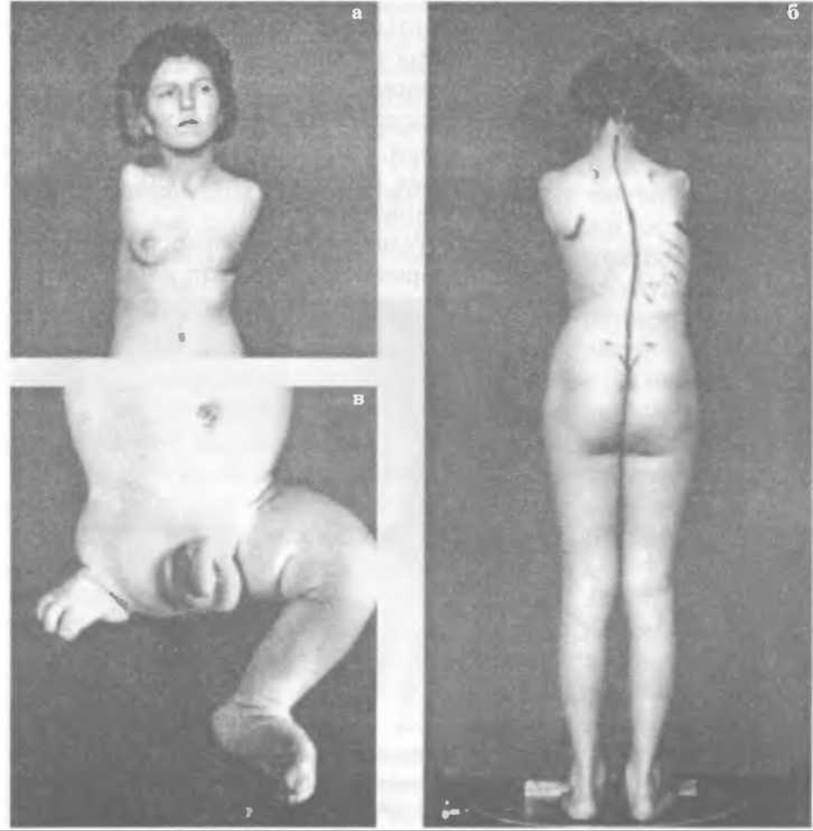
Fig. 110. Congenital anomalies: a, b — abrachia, c — phocomelia.
Most of these patients require prosthetics, and some need surgical preparation prior to prosthetic fitting. Recently, there has emerged a promising prospect for adult hand and distal forearm transplantation in cases of hemimelia. Undoubtedly, limb segment transplantation will be successfully performed in the future, much like internal organ transplantation is applied today.
Currently, treatment for upper limb hemimelia typically involves cosmetic prosthetics and, very rarely, bioelectric prosthetics. It should be emphasized that children with congenital and acquired limb deficiencies adapt remarkably well to everyday social and domestic environments, demonstrating extraordinary resourcefulness in daily life. The lack of upper limbs is often compensated for by using the feet, and so forth. Notably, the talented Ukrainian artist Mykola Bidniak (a Canadian citizen) created magnificent and valuable paintings by holding the brushes in his Teeth.
All children with congenital limb anomalies are referred to the medical and social expert commission (MSEC) to establish a disability Classification.
Last update: 10/08/2026
Editorial and Educational Adaptation: This material has been compiled based on the primary/original source text. The project team performed an editorial review, corrected technical inaccuracies, structured sections, and adapted the content for an educational format.
What was processed:
- elimination of formatting defects (OCR errors, structural breaks, corrupted characters);
- editorial organization of content;
- standardization of terminology in accordance with academic sources;
- verification of factual statements against the original source text.
All mentions of the author, publication year, and origin of the primary text have been preserved in accordance with the source.