Orthopedics - Oleksa A.P. 2006
Joint Diseases
Infectious Arthritis of Known Etiology
Brucellar Arthritis
Brucellosis affects people who have been in contact with infected animals, consumed their meat, handled animal hides, and the like.
Brucellosis is a chronic infectious disease caused by Brucella melitensis, which frequently involves joint damage (50–90%).
Brucella Bacteria enter The Human Body via the digestive tract, broken Skin, mucous membranes, etc. Through the bloodstream, they spread to the Lymph Nodes, Spleen, and Liver, where they form persistent foci and from which they periodically re-enter the bloodstream, affecting the cardiovascular, nervous, and musculoskeletal systems.
Arthritis typically develops at the height of a fever, given the undulating course of the disease, or during the recovery period.
According to G. Pandikov, the average duration of the illness is 10 months.
Brucellar joint lesions can manifest in various clinical ways. Most commonly, they are toxicoallergic in nature, as the brucellar antigen sensitizes the body and triggers an allergic reaction.
During brucellaemia, a metastatic mechanism of joint involvement with pyogenic arthritis and bone-Cartilage destruction is possible.
Typically, the disease begins with arthralgia that subsides after a few days; therefore, B. P. Kushelevsky (1961) attributes its onset to an allergic state of the body. This is supported by histological studies of the synovial membrane (obtained during an episode of arthralgia), which revealed serous inflammation.
Acute and subacute brucellar toxicoallergic polyarthritis is characterized by severe pain and restricted joint mobility. The joints may be swollen, sometimes due to synovitis, and hyperemic with local hyperthermia. The clinical course of such polyarthritis is favorable, and all mentioned manifestations disappear within a few days. Joint radiographs reveal no pathological changes.
Chronic brucellar arthritis is metastatic, more commonly affecting one or several large joints (knee, ankle, and less frequently hip and elbow), although involvement of other joints is not excluded. Such chronic arthritis typically appears after the fever subsides and, as it is accompanied by the destruction of articular cartilage with marginal osteophytic growths, leads to deforming arthrosis. Occasionally, joint suppuration may occur, causing severe destruction, with Treatment extending over several months and resulting in ankylosis.
It should be noted that brucellosis can affect the intervertebral discs, sacroiliac joints, etc. Intervertebral discs are most frequently affected in the lumbar spine of young men.
Radiographs reveal damage to one to three discs, resulting in narrowed intervertebral spaces, destruction of the subchondral layer in the adjacent vertebrae leading to wedge-shaped deformity, as well as the appearance of marginal osteophytes.
At the level of the affected discs, the anterior longitudinal ligament ossifying the vertebrae presents as a classic spondylosis, followed by spondyloarthrosis due to the involvement of the vertebral joints. Cases of brucellar cold abscesses can also occur.
Occasionally, spinal lesions are combined with brucellar sacroiliitis and ligamentous ossification, resembling Bechterew's disease (Ankylosing spondylitis). However, sacroiliitis is characterized by severe pain radiating to the lower extremities, a decrease in lumbar lordosis, tension in the lumbar Muscles, and local tenderness upon Percussion of the spinous processes.
Brucellosis may feature peri- and pararthritis, clinically manifested as bursitis (Fig. 322), ligamentitis, and tenosynovitis. Over time, this also leads to the ossification of periarticular Tissues and a restricted range of motion in the joint.
Class="center">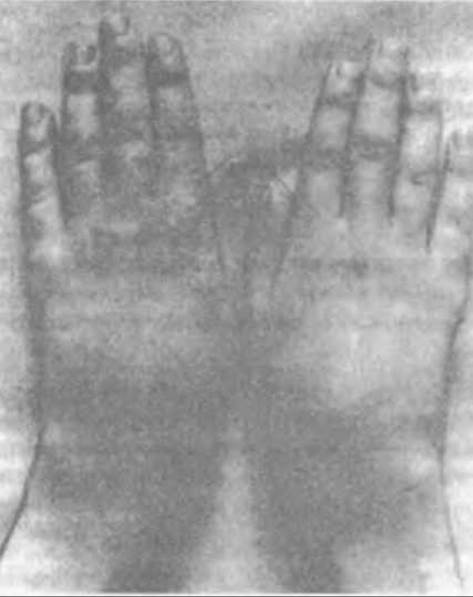
Fig. 322. Brucellar bursitis of the dorsal surface of the wrist joints.
In 24% of patients (according to P. I. Ragoza, 1972), X-rays reveal periostitis, perichondritis, osteoperiostitis, and even Osteomyelitis.
The Diagnosis of brucellosis is based on the patient's history—contact with infected animals, consumption of raw milk, meat, and other livestock products in an endemic area—as well as clinical signs characteristic of the disease, such as undulating fever, hepatosplenomegaly, and joint involvement.
Important diagnostic tools include the Wright serological test, accelerated Huddleson agglutination, and particularly the opsonophagocytic reaction, which is highly specific for brucellosis, as well as the Complement fixation test.
Another specific diagnostic test is the intradermal brucellin skin test (Burnet test), which yields positive results starting from the eighth day of the illness.
The treatment of acute and subacute brucellosis involves the administration of Antibiotics, which are used until body Temperature normalizes, followed by a 3–4 week course at lower doses, along with biomycin for 7–8 days with 10–14 day intervals (three courses).
Chronic brucellosis is treated with antibiotics combined with a vaccine (killed Brucella).
For joint involvement, immobilizing devices, heat therapy, analgesics, and—in cases of exudation—corticosteroids are prescribed. During the rehabilitation period, physical therapy (exercise therapy), physical and balneotherapy, and health resort treatment (Odessa, Yevpatoria, Lubin Velykyi) are administered.
Last update: 10/08/2026
Editorial and Educational Adaptation: This material has been compiled based on the primary/original source text. The project team performed an editorial review, corrected technical inaccuracies, structured sections, and adapted the content for an educational format.
What was processed:
- elimination of formatting defects (OCR errors, structural breaks, corrupted characters);
- editorial organization of content;
- standardization of terminology in accordance with academic sources;
- verification of factual statements against the original source text.
All mentions of the author, publication year, and origin of the primary text have been preserved in accordance with the source.