Orthopedics - Oleksa A.P. 2006
Congenital and acquired lower limb deformities
Congenital deformities of the lower leg
Congenital rotation of the lower leg
Many infants and preschool children walk with an in-toeing gait due to the medial Rotation of the lower legs and thighs. It should be noted that during the child's growth, i.e., longitudinal bone growth, femoral torsion occurs along with a decrease in the neck-shaft angle, anteversion, and lateral Torsion of the tibial bones (Fig. 183, 184).
Thus, during growth, the degree of bone and FOOT rotation normalizes. This process can be facilitated by massage, manual stretching (redressing), corrective night splints, and orthopedic shoes.
If conservative Treatment is ineffective and the deformity does not decrease with growth, leading to secondary Changes in the ankle joint (where an abnormal malleolar mortise disrupts the normal growth of the talus), surgical intervention is indicated.
Before surgery, the shape of the Tibia is traced on paper from radiographs, and the optimal level of osteotomy at the apex of the deformity is determined for wedge resection; if this is insufficient, the sites for double or triple osteotomy are planned. During the Procedure, soft Tissues are incised only at the designated osteotomy sites. The periosteum is incised longitudinally, partially elevated, and the bone is divided subperiosteally. Next, the Fibula is osteotomized 3–4 cm below the tibial osteotomy level, the axis of the lower leg is aligned, and the normal position of the foot is restored through rotation, with overcorrection into 10–15° of lateral rotation. A plaster cast is applied for two to three and a half months, depending on the child's age. Following bone union, rehabilitation therapy is carried out. Surgery on the other leg is performed 6 months later.
Class="center">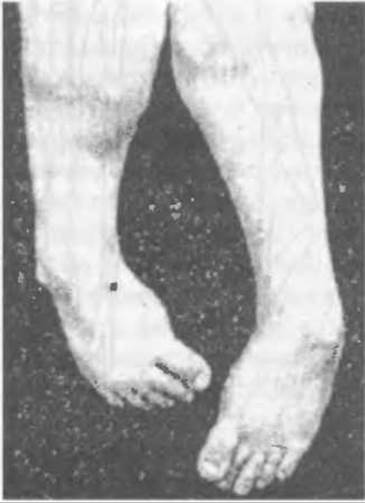
Fig. 183. Congenital tibial torsion.
If intraoperative correction of the lower leg axis cannot be achieved, an Ilizarov apparatus should be applied to gradually correct the alignment.
Last update: 10/08/2026
Editorial and Educational Adaptation: This material has been compiled based on the primary/original source text. The project team performed an editorial review, corrected technical inaccuracies, structured sections, and adapted the content for an educational format.
What was processed:
- elimination of formatting defects (OCR errors, structural breaks, corrupted characters);
- editorial organization of content;
- standardization of terminology in accordance with academic sources;
- verification of factual statements against the original source text.
All mentions of the author, publication year, and origin of the primary text have been preserved in accordance with the source.