Medical Radiology - Lazar A.P. 2008
Methods of Radiation Diagnostics
Fundamentals of Radiation Safety
Medical exposure of humans occurs As a result of medical examinations or treatments using ionizing (X-ray, gamma, etc.) radiation. Radiation safety is based on the following principles:
> exposure must be justified and prescribed exclusively by a physician to achieve beneficial diagnostic and therapeutic effects that cannot be obtained through alternative diagnostic and therapeutic Methods (THE PRINCIPLE OF justification);
Class="center">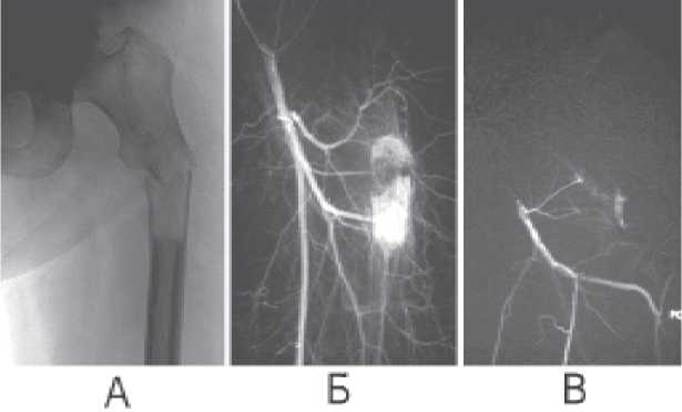
Fig. 27. Endovascular intervention (embolization) on a series of radiographs. A - the radiograph reveals a tumor destroying the spongy and cortical bone of the Femur and a pathological fracture of the proximal third of the femoral diaphysis; B - the angiogram demonstrates bleeding from the deep femoral artery; C - embolization of the damaged vessel stops the bleeding.
> collective doses received by the public during X-ray and radiological Procedures must be kept as low as reasonably achievable, taking into account economic and social factors (the principle of optimization, or ALARA - as low as reasonably achievable);
> the magnitude of the radiation dose is established exclusively by a physician on an individual basis for each patient, grounded in clinical indications. It is mandatory to factor in the necessity of preventing deterministic effects in healthy Tissues and the Organism as a whole (the principle of non-exceedance).
Dose limits for restricting medical exposure are not established; instead, the necessity of performing a specific X-ray or radiological Procedure is justified by a physician based on clinical indications. The repeated prescription of identical X-ray and radiological diagnostic procedures is permitted only when necessary, specifically to obtain new or additional information.
Potential harmful effects of ionizing radiation can be divided into two categories: deterministic and stochastic. Deterministic effects inevitably occur once a specific threshold absorbed dose is reached; Examples include Skin reactions (erythema, epilation, desquamation), cataracts, fibrosis, and hematopoiesis disorders. Stochastic effects may appear following exposure, with the probability of their occurrence depending on the magnitude of the absorbed dose; examples include carcinogenic and hereditary effects.
The lowest threshold dose characteristic of a deterministic effect such as transient erythema is 2-3 Gy under acute exposure. 1 gray is the unit of absorbed dose equal to 1 joule of absorbed energy per 1 kilogram of mass. When radiation exposure is protracted over time, the threshold dose increases. During a routine chest X-ray, the absorbed dose is approximately 0.15 mGy, which corresponds to an equivalent dose of 0.15 mЗв, meaning that to reach the threshold erythema dose, about 15,000 such X-rays would need to be performed within a short period. During CT and radionuclide Diagnostics, the equivalent dose generally ranges from 1 to 10 mЗв, depending on the technique and the volume of the study.
The core principles of radiation protection are protection by time, distance, quantity, and shielding. This means that to reduce the radiation burden on the patient and medical personnel, it is necessary to minimize exposure time, increase the distance between the radiation source and the person, reduce the source output or The amount of the radiopharmaceutical as much as possible, and employ protective shielding. Distance is a particularly effective form of protection because radiation intensity decreases inversely with the square of the distance from the radiation source.
Last update: 08/08/2026
Editorial and Educational Adaptation: This material has been compiled based on the primary/original source text. The project team performed an editorial review, corrected technical inaccuracies, structured sections, and adapted the content for an educational format.
What was processed:
- elimination of formatting defects (OCR errors, structural breaks, corrupted characters);
- editorial organization of content;
- standardization of terminology in accordance with academic sources;
- verification of factual statements against the original source text.
All mentions of the author, publication year, and origin of the primary text have been preserved in accordance with the source.