Human Anatomy - Kotsan I. Ya. 2009
Peripheral Nervous System
Cranial Nerves
Olfactory Nerves (I)
The olfactory nerves (nn. olfactorii) (Fig. 253) are sensory in function and develop from the rhinencephalon, which emerged As a result of The Development of the olfactory receptor. They contain viscerosensory fibers extending from Organs that perceive chemical stimuli. Since the olfactory nerves are outgrowths of the Forebrain, they lack a ganglion and instead appear as a collection of 15–20 fine nerve filaments, which are the central processes of olfactory Cells located in the olfactory region of the nasal mucosa. Without forming a common trunk, these nerve filaments pass through the openings of the cribriform plate in the upper wall of the Nasal cavity into the cranial cavity, where they terminate in the olfactory bulb.
Class="center">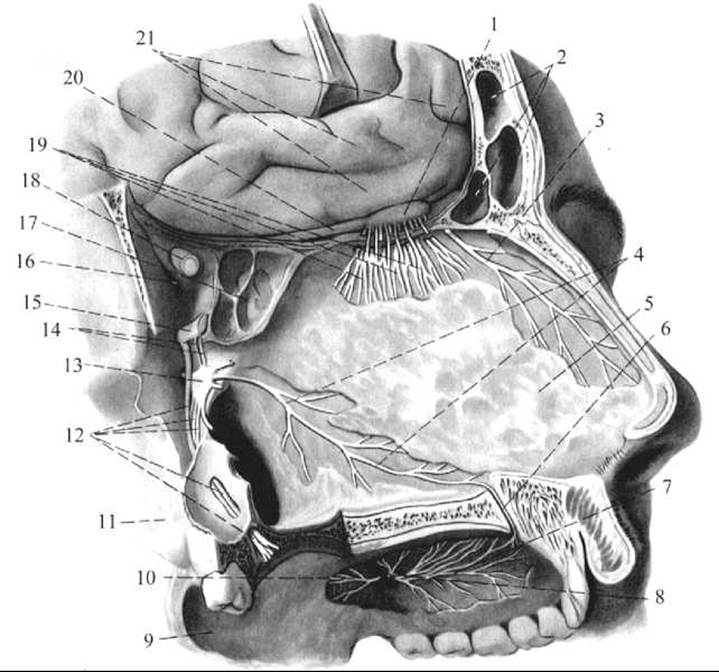
Fig. 253. Olfactory nerves, Branches of the Trigeminal nerve, and pterygopalatine ganglion (after R. D. Sinelnikov)
1 — olfactory bulb; 2 — frontal sinus; 3 — external nasal branch of the anterior ethmoidal nerve; 4 — nasopalatine nerve; 5 — nasal septum; 6 — hard palate and incisive canal; 7 — greater palatine nerve; 8, 10 — lesser palatine nerves; 9 — soft palate; 11 — lateral plate of the pterygoid process; 12 — lesser and greater palatine nerves; 13 — pterygopalatine ganglion; 14 — pterygopalatine nerves (from the maxillary nerve); 15 — maxillary nerve; 16 — superior orbital fissure; 17 — sphenoid sinus; 18 — Optic nerve; 19 — olfactory nerves; 20 — olfactory tract; 21 — orbital gyri
The olfactory bulb is a collection of mitral cells whose dendrites synapse with the fibers of the aforementioned filaments, while their axons form the olfactory tract. The olfactory tract continues into the olfactory trigone. Within the olfactory trigone, the olfactory tract divides into three bundles — lateral, intermediate, and medial — whose fibers travel via various pathways to reach the cortical center of the olfactory analyzer: the uncus and the gyrus of the hippocampus.
Last update: 08/08/2026
Editorial and Educational Adaptation: This material has been compiled based on the primary/original source text. The project team performed an editorial review, corrected technical inaccuracies, structured sections, and adapted the content for an educational format.
What was processed:
- elimination of formatting defects (OCR errors, structural breaks, corrupted characters);
- editorial organization of content;
- standardization of terminology in accordance with academic sources;
- verification of factual statements against the original source text.
All mentions of the author, publication year, and origin of the primary text have been preserved in accordance with the source.