Obstetrics and Gynecology - A.M. Gromova 2000
Miscarriage and Post-Term Pregnancy
Miscarriage
Obstetric Management in Preterm Labor
Hospitalization of women with threatened Miscarriage or inevitable abortion at 22 to 28 weeks of gestation is carried out In the second obstetric department of the maternity hospital. Pregnant women with a gestational age of over 28 weeks are hospitalized in the first obstetric department if there are no signs of infection, or in the second obstetric department if infection is present.
In cases of threatened or incipient preterm labor, therapy aimed at maintaining the Pregnancy may be administered. Once preterm labor has actively begun, such Treatment is no longer effective, and obstetric management should focus on careful delivery and providing optimal conditions for the premature infant.
Management of patients with threatened preterm labor
Treatment is performed in the pregnancy pathology department or delivery suite and includes:
1. Bed rest regimen (Level II-III).
2. A supportive and calming regimen involving motherwort or valerian infusions, tazepam 0.01 g 3 times daily, seduxen 0.2 g 2 times daily, and relanium 0.005 g 3 times daily.
3. Spasmolytics: papaverine hydrochloride 2%-2 ml intramuscularly or as suppositories, no-shpa 0.04 mg 3 times daily, baralgin 5 ml, or gangleron 2 ml intramuscularly.
4. Agents that reduce uterine activity.
5. Non-pharmacological Methods for reducing uterine tone (uterine electrorelaxation, acupuncture, external low-intensity laser Blood irradiation in the carotid sinus area, and sinusoidal modulated current magnesium Electrophoresis).
6. Prostaglandin inhibitors.
7. Prevention of fetal respiratory distress syndrome (RDS).
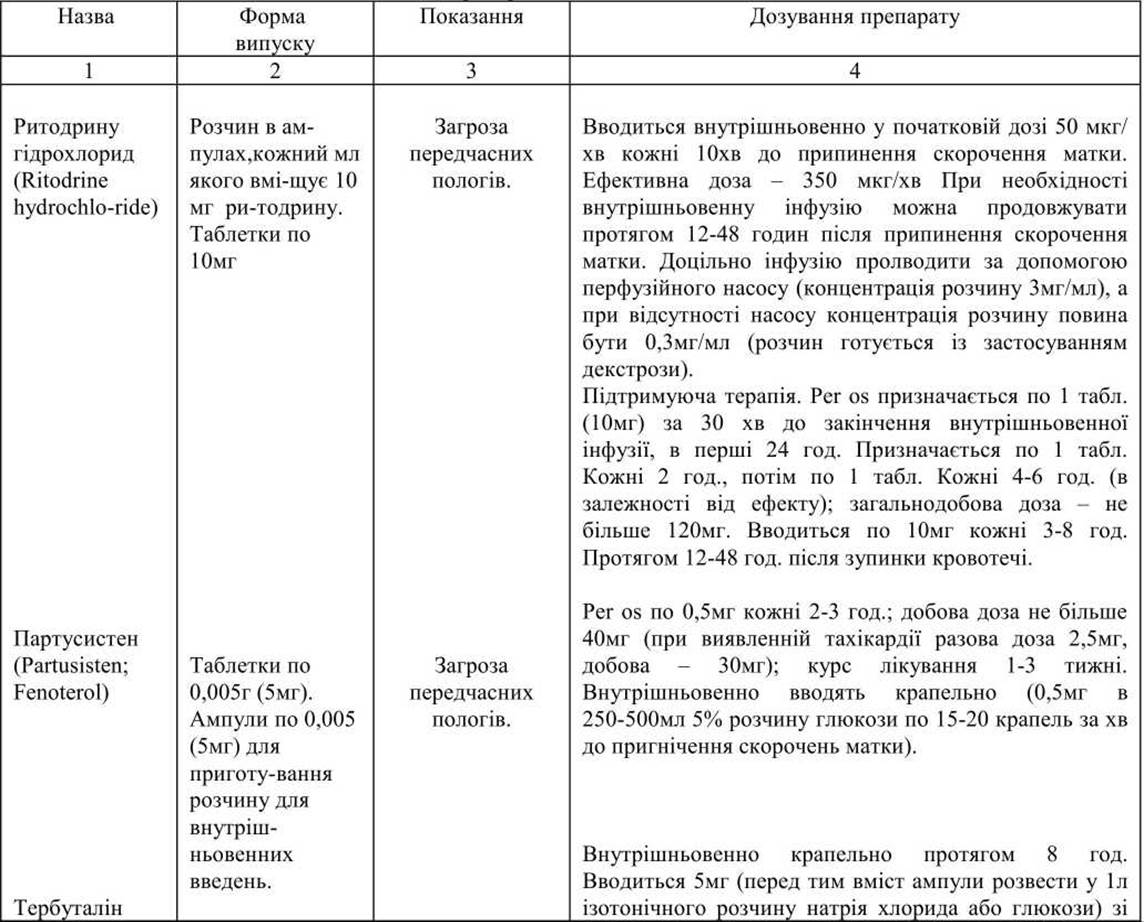
Medical tocolysis is performed to reduce uterine activity. The Use of ß-adrenomimetics as tocolytics is based on their ability to relax the uterine Muscle and decrease the strength and frequency of contractions. Furthermore, drugs in this group improve uteroplacental blood flow by lowering uterine artery tone and increasing Circulation. As a rule, tocolysis is effective if drug administration begins at the very onset of preterm labor, when cervical dilation does not exceed 4 cm and cervical effacement is less than 80%.
To counteract the side effects of ß-mimetic drugs, they are combined with phenoptin (0.04 g 3–4 times daily). This calcium antagonist not only mitigates the side effects of ß-mimetics but also directly reduces uterine contractility.
In cases of significantly increased uterine tone, the prostaglandin synthesis inhibitor indomethacin is used with great success. On day 1, 200 mg is administered (50 mg 4 times daily in tablets or 100 mg 2 times daily in suppositories); on days 2–3, 50 mg every 8 hours; on days 4–5, 50 mg every 12 hours; and on days 7–8, 50 mg at night. The total dose of the drug should not exceed 1000 mg. The course of treatment lasts 5–9 days. Therapy for threatened preterm labor can also be carried out via intravenous drip infusion of a 2% magnesium sulfate solution at a dose of 200 ml over one hour for 5–7 days (or 400 ml over 4–6 hours every other day), as it increases oxytocinase activity and acts as a calcium ion inhibitor. Tocolysis with magnesium sulfate has no negative impact on the fetus, lowers maternal blood pressure, enhances diuresis, and provides a good sedative effect. The efficacy of magnesium sulfate tocolysis is lower than that of ß-mimetics and indomethacin, but it increases significantly when combined with these drugs. Tocolysis is also possible by administering endogenous oxytocin inhibitors, such as a 10% ethyl alcohol solution (50 ml of 90% ethanol in 500 ml of saline or 5% glucose solution at 20–30 drops per minute for 2 hours). The effective dose of the drug is 15 mg per kilogram. The tocolytic effect of ethyl alcohol persists for 6–8 hours after administration and can be repeated for 2–3 days if necessary.
Lower doses of medications can be achieved by combining them with physical therapy, such as magnesium electrophoresis or sinusoidal modulated currents. Uterine tone is also effectively reduced by external low-intensity laser irradiation of the blood in the carotid sinus region.
Class="center">Tocolytic agents

Last update: 08/08/2026
Editorial and Educational Adaptation: This material has been compiled based on the primary/original source text. The project team performed an editorial review, corrected technical inaccuracies, structured sections, and adapted the content for an educational format.
What was processed:
- elimination of formatting defects (OCR errors, structural breaks, corrupted characters);
- editorial organization of content;
- standardization of terminology in accordance with academic sources;
- verification of factual statements against the original source text.
All mentions of the author, publication year, and origin of the primary text have been preserved in accordance with the source.